Heimskringla
Heimskringla
“Thou shalt keep watch, therefore, in case anything happen in the night."
Harald then went away to sleep somewhere else, and laid a billet of wood in his place. At midnight a boat rowed alongside to the ship's bulwark; a man went on board, lifted up the cloth of the tent of the bulwarks, went up, and struck in Harald's bed with a great ax, so that it stood fast in the lump of wood. The man instantly ran back to his boat again, and rowed away in the dark night, for the moon was set; but the axe remained sticking in the piece of wood as an evidence.
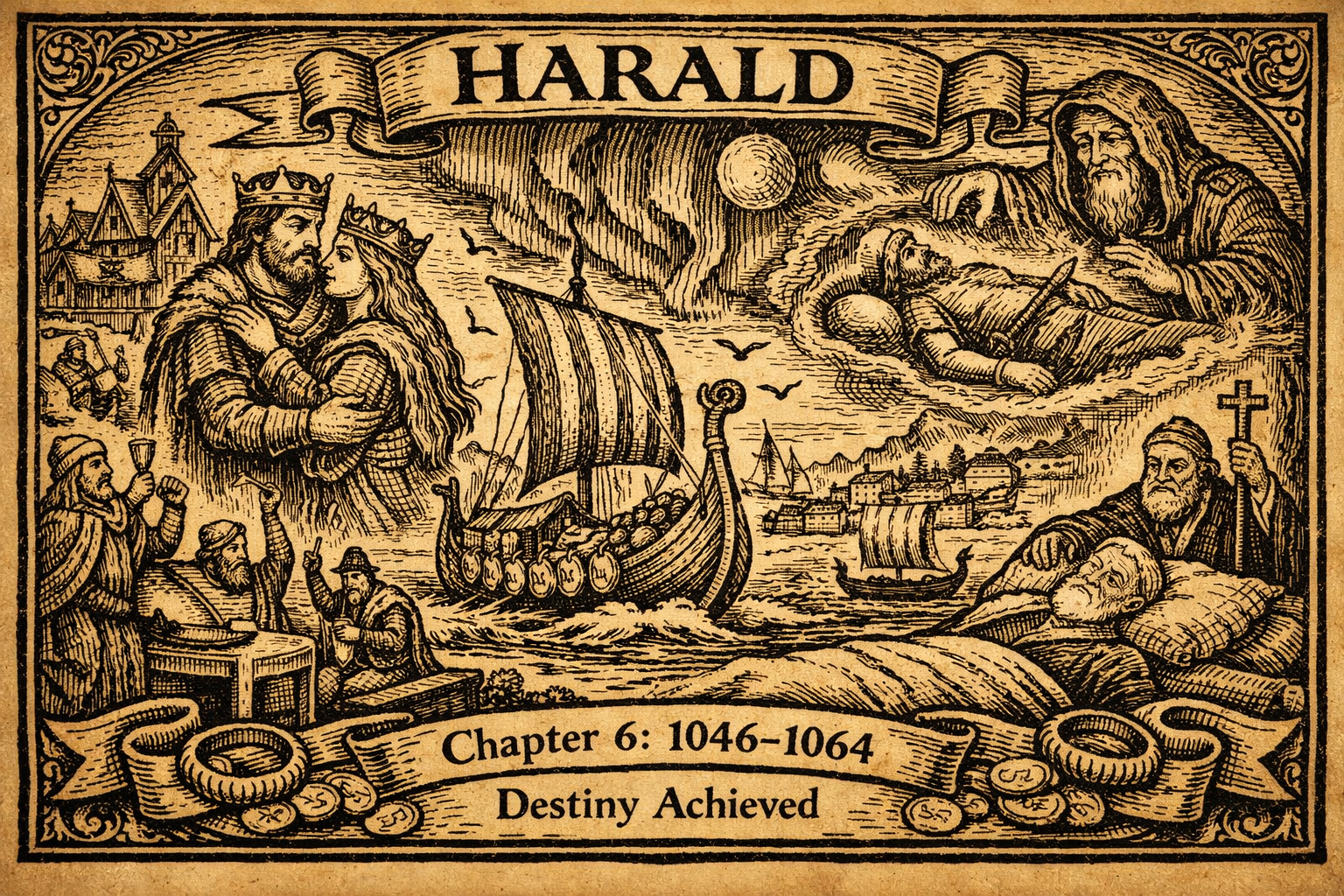
King Harald gave Steiger-Thorir there at the banquet a mazer bowl. It had a sliver band around it and a silver handle on top, both gilded, and was completely filled with pure silver coins. With it there were two golden rings which together weighed a mark. He also gave him his cloak, it was fine cloth dyed brown, trimmed with white fur, and promised him great honor and his friendship.
Harald
I was married to Ellisif, and that cut some ice with the Swedes. I was still Olaf’s half brother, and that cut some ice with the Norwegians. For everything else I had boats full of gold Byzantine solidi and silver Arab dirhams. Vikings are petty and vicious, but in the Viking world there is nothing that can’t be settled with gold. I traded a hundred gold arm rings for half a share of the kingdom of Norway, and when my nephew Magnus died a year and a half later it all came to me. I can’t help it if I’m lucky.
Heimskringla
King Harald had a market town built east in Oslofjord, and often stayed there, for it was a good place for getting supplies, the land around being very productive. Staying there was very convenient for guarding the land from the Danes, and also for incursions into Denmark. He was accustomed to doing this frequently, even when he did not have a large army out.
Harald
I spent a lot of time in Oslofjord. It was my home district, so I felt safe there.
I built ships there. We cut the big timber from the mountains and floated it down into the fjord. The blacksmith forged nails that did not rust. Our best seller was a knarr designed for two men and ten sheep.
Heimskringla
King Harald stayed the winter in Niðaróss. He had a ship built during the winter out on Eyrar. It was a búza type ship. This ship was built after the style of Ormr inn langi and finished with the finest craftsmanship. There was a dragon head at the prow, and in the rear a curved tail, and the necks of both were all decorated with gold. It numbered thirty-five rowing benches, and was of a proportionate size, and was a most handsome vessel. The king had all the equipment for the ship carefully made, both sail and rigging, anchor and cables.
Harald
I loved to sail. I sailed every summer. I had a shipbuilder in Oslofjord, implementing the designs I had used and seen in the Black Sea, in the Mediterranean, in Egypt. Clinker built Longships, Triremes with keels and a lateen sail, canoes with outriggers, I was always trying out a new design.
To Kattegat, and the markets of Copenhagen and Malmo, through the Belt, to Uppsala for the psychedelic Woodstock, over to Novgorod to see Yaroslav and Ellisif’s sisters.
Quick raiding trips in the North Sea, easy access to Hedeby and the Jutland coast and up the Elbe or down the Friesans.
Summer circles following the route of Rollo up the Seine to Paris, Normandy, the Isle of Wight, the slave market at Dublin, and then float the Gulf Stream home to Trondheim. You could take a lot more risks heading out, because to get home all you had to do was run before the wind.
I sailed to Halogaland. I sailed to the Faroes. I sailed to Iceland.
In the North Sea, with a sun compass and the stars by night you could steer a course, but the winds were always blowing you back home, not out to the location of your next adventure. Four days forced rowing to Hjaltland – the stopping point.
The North Atlantic – that was a whole different story. The favorable wind for Iceland is always the front edge of a storm. You hope the storm is large enough that you get to Iceland before the wind turns or small enough that you can ride it out and then navigate there under clear skies. Both my cruises were the in-between case. Two days due west on good winds, then four days of ten foot seas, rowers around the clock to give you way into the waves, and no sight of sky by day or by night.
Adam of Bremen
Those who have a knowledge of geography also assert that some men have passed by an overland route from Sweden into Greece. But the barbarous peoples who live between make this way difficult; consequently, the risk is taken by ship.
The route is of a kind that, boarding a ship, they may, in a day’s journey, cross the sea from Aalborg or Wendila of the Danes to Viken, a city of the Norwegians. Sailing thence toward the left along the coast of Norway, the city called Trondhjem is reached on the fifth day. But it is possible also to go another way that leads over a land road from Scania of the Danes to Trondhjem. This route, however, is slower in the mountainous country, and travelers avoid it because it is dangerous.
Situated between Norway and Britain and Ireland, the Orkneys, therefore, laugh playfully at the threats of a menacing ocean. It is said that one can sail to them in a day from the Norwegian city of Trondhjem. They say, too, that from the Orkneys it is just as far whether you steer toward England or set sail for Scotland.
This happens on the island of Thule, six days’ sail distant from Britain toward the north. … This Thule is now called Iceland, from the ice which binds the ocean. … It has on it many peoples, who make a living only by raising cattle and who clothe themselves with their pelts. No crops are grown there; the supply of wood is very meager.
In the ocean there are very many other islands of which not the least is Greenland, situated far out in the ocean. … To this island they say it is from five to seven days’ sail from the coast of Norway.
The third island is Helgeland, nearer to Norway but in extent not unequal to the rest. That island sees the sun upon the land for fourteen days continuously at the solstice in summer and, similarly, it lacks the sun for the same number of days in the winter.
Yet another island of the many found in that ocean. It is called Vinland because vines producing excellent wine grow wild there. That unsown crops also abound on that island we have ascertained not from fabulous reports but from trustworthy relation.
The very well-informed prince of the Norwegians, Harald, lately attempted this sea. After he had explored the expanse of the Northern Ocean in his ships, there lay before their eyes at length the darksome bounds of a failing world, and by retracing his steps he barely escaped in safety the vast pit of the abyss.
Harald
The sailing directions are pretty accurate. Some of the other stuff, the more outrageous it got the more they believed, so I just kept going.
I was King of Norway for 20 years. In retrospect, it went by in a flash. It was real life, which doesn’t always align with the historical record.
Tbh, the job of King of Norway was not that demanding. Anything can be settled with gold. I could travel freely and freeload. Keep the war-arrows to a minimum. Plenty of volunteers if you can plunder. I made the Halogaland people build me a longhouse so I could watch the Northern Lights one winter.
My hospitality was legendary. Good food, good drink, good stories by the fire. I was always ready to welcome the one-eyed wanderer, and my minstrels were always ready with a song or a kenning. I particularly liked the sagas of the Icelanders, and I kept one in Trondheim as my court poet.
Poetic Edda
Harald
I loved Ellisif. She was a good wife to me: bore my children, kept my house, held my counsel. Sure, there were other women; I was a Viking, I was a king, I was away from home a lot; things happen on the road and out in the field. But I always returned to Ellisif, and she always greeted me warmly. She was an educated woman, smart, cultured, could read and write, and she understood people and politics much better than I did. I tasked my poets to write a kenning for her.
Heimskringla
Harald
Yaroslav kept in touch with all his daughters. He treated them like pawns and married them off for his own political benefit, but that didn’t mean he didn’t care. The whole point was to build relationships. We had regular emissaries from Kiev; every couple of years he would get rid of some hanger on around the court by sitting him on a horse and sending him off as a “royal envoy”; they shared news of home, with enough detail to scratch my itch for adventure while reminding why I never wanted to go back there again, as well as a few gifts for the kids. One summer I told all the raiders that the Seine was off limits, and Ellisif and I did a family vacation together with her sister Anne at the island in Paris. So when a passing Swedish trader dropped off a Syriac monk from the East, and he told us that Yaroslav had died in Kiev, it wasn’t what we expected to hear. Ellisif let out a wail and left the great hall in tears.
Tale of Bygone Years
Yaroslav, Great Prince of Rus`, passed away.
Harald
I tried to comfort her, but she was in her private grief. I returned to the tale.
Tale of Bygone Years
While he was yet alive, he admonished his sons with these words:
“My sons, I am about to quit this world. Love one another, since ye are brothers by one father and mother. If ye abide in amity with one another, God will dwell among you, and will subject your enemies to you, and ye will live at peace. But if ye dwell in envy and dissension, quarreling with one another, then ye will perish yourselves and bring to ruin the land of your ancestors, which they won at the price of great effort. Wherefore remain rather at peace, brother heeding brother. The throne of Kiev I bequeath to my eldest son, your brother Izyaslav. Heed him as ye have heeded me, that he may take my place among you. To Svyatoslav I give Chernigov, to Vsevolod Pereyaslavl', to Igor' the city of Vladimir, and to Vyacheslav Smolensk.”
Thus he divided the cities among them, commanding them not to violate one another's boundaries, not to despoil one another. He laid upon Izyaslav the injunction to aid the party wronged, in case one brother should attack another. Thus he admonished his sons to dwell in amity. Being unwell, he came to Vyshgorod, and there fell seriously ill. Izyaslav at the moment was in Novgorod, Svyatoslav at Vladimir, and Vsevolod with his father, for he was beloved of his father before all his brethren, and Yaroslav kept him constantly by his side. The end of Yaroslav's life drew near, and he gave up the ghost on the first Saturday after the feast of St. Theodore. Vsevolod bore his father's body away, and laying it upon a sled, he brought it to Kiev, while priests sang the customary hymns, and the people mourned for him. When they had transported the body, they laid it in a marble sarcophagus in the Church of St. Sophia, and Vsevolod and all his subjects mourned him. All the years of his age were seventy six.
Harald
You love them all, equally. You really do. But proximity to power makes people crazy. I knew the brothers would be battling by spring.
Tale of Bygone Years
Yaroslav loved religious establishments and was devoted to priests, especially to monks. He applied himself to books, and read them continually day and night. He assembled many scribes, and translated from Greek into Slavic. He wrote and collected many books through which true believers are instructed and enjoy religious education. For as one man plows the land, and another sows, and still others reap and eat food in abundance, so did this prince. His father Vladimir plowed and harrowed the soil when he enlightened Rus` through baptism, while this prince sowed the hearts of the faithful with the written word, and we in turn reap the harvest by receiving the teaching of books. For great is the profit from book-learning. Through the medium of books, we are shown and taught the way of repentance, for we gain wisdom and continence from the written word. Books are like rivers that water the whole earth; they are the springs of wisdom. For books have an immeasurable depth; by them we are consoled in sorrow.
Harald
Before my father-in-law died I thought that the greatest success for a king is to be able to pass down the kingdom to his own son and to die in his own bed. You live and you learn.
Harald
The people kept up their calls for Olaf to be canonized. Which is an expensive proposition, the ways of the Church being what that they are. The pope kept sending me bishops and the bishops kept shaking me down for more “gifts”. Turns out that even if your remains are miraculous and your hair and fingernails continue to grow after your death you still need a cathedral before you can become St. Olaf. So I paid. It would have been quicker and easier if they let me hire the masons and source the building materials, but it kept the Christians off my back.
I maintained a pagan sacred grove in the hills above Trondheim. It helped offset the stench of Olaf’s decaying body in that half-built cathedral crypt. Voluspa always returned to me, under the ash tree, but her prophecies darkened.