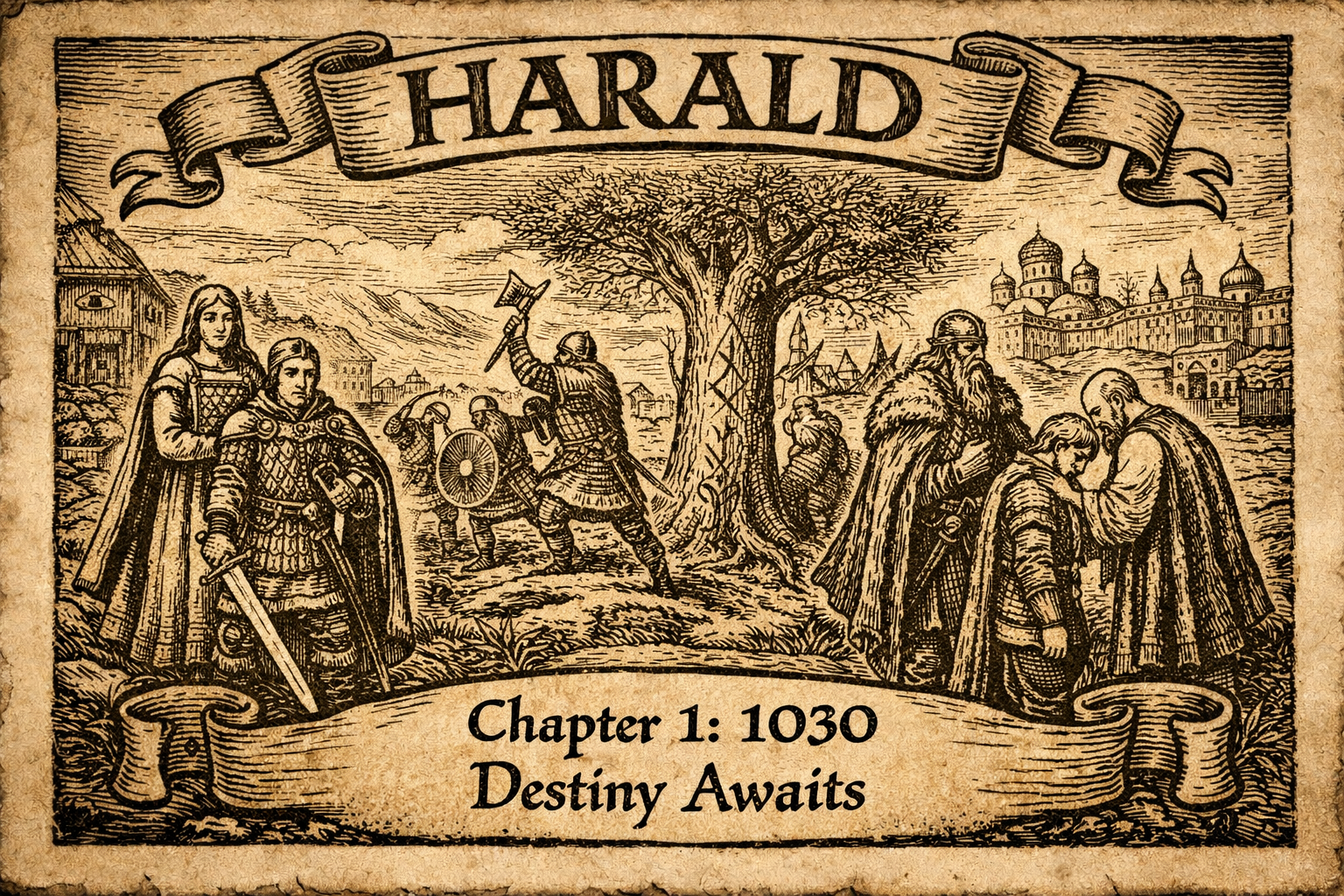
The Boy Who Would Be King
In the year when the fjords held their last ice and the sea-lanes opened like dark seams, the farmsteads of Ringerike lay under a thin, hard light. The land above the Oslofjord was not rich like the southlands men spoke of at hearths, but it was faithful: birch and pine on the slopes, rye and barley where the soil would take it, and long stretches of water that carried rumor faster than any horse.
On a slope set back from the shore, in a hall built of pine and turf, Asta Gudbrandsdatter kept her household as her mother had kept hers: keys at her belt, wool on the loom, ale set to sour and sweeten by its season. She had been wife to a petty king in youth, and then—when the world turned—wife to Sigurd Syr, a man whose strength was measured in plowlands more than raids. In that hall were boys of two lines: Olaf Haraldsson, grown toward manhood, hard in the jaw already; and Harald Sigurdsson, still young, all bone and restless hands, as if the body could not yet contain the will that lived inside it.
Harald’s hair was fair like flax when it was washed, but most days it was darkened by smoke and sweat and the dust of the yard. He carried himself as boys do when they are too young to have won any name and too old to accept the small errands of childhood. When men came to the hall—neighbors, freedmen, lendmenn from farther valleys—Harald placed himself where he could hear. When the women spoke of stores and spinning, he listened only long enough to learn what could be stolen from a shelf and what could not.
There were tales in the district about him, the way there are always tales that gather around a boy with sharp eyes. Some said he was born with the mark of a king, though no one agreed what such a mark looked like. Others said it was the set of his shoulders, or the way he never lowered his gaze first. Asta did not repeat such talk; she had seen enough kings to know that a crown is a wound you put on your own head.
Yet in that year, talk did not stay as talk. Word came northward along the shore and up through the valleys: Olaf Haraldsson had returned to claim Norway again, and he called for men to meet him under his banner. Those who had bent to the Danes and to new lords heard the summons with fear; those who had sworn to Olaf before heard it with the old sting of pride. Sigurd Syr listened, weighing what the land could spare. The hall grew crowded with questions, and the smoke from the central hearth seemed to hang lower.
Olaf, in those days, had the look of a man who had slept on hard ground and trusted few. He spoke plainly in the yard, with the calm of someone who believed that law and God stood behind him, whether the people did or not. Harald stood among the boys and younger men and watched his half-brother’s hands as he spoke—hands that had held both sword and cross. Harald did not yet know what it was to be pinned under the weight of oaths; he only knew the pull of the road and the raw heat of a great cause.
That evening, after the ale had gone around twice, a traveler from the northern routes told of signs. He spoke of ravens that gathered on a ridge above a frozen marsh, and of a dream in which a bright man stood on a hill with a red wound under his ribs. Such talk was not rare; men will give meaning to birds and sleep when they are afraid. But in the firelight Harald’s eyes held steady, and he asked about the hill—its shape, the trees around it, the path a man would take to reach it. The traveler shrugged: it was only a dream. Harald nodded as if he had been given a map.
Later, when the hall quieted and the animals shifted in their pens, Asta sat with Harald at the edge of the hearth. She said little. She did not forbid him to follow Olaf, because forbidding would have been a lie; the road had already taken him. Instead she gave him what mothers in the north give sons who step into war: a knife with a horn handle, a wool cloak thick enough to turn rain, and a warning that was also a prayer. “Do not be the first to boast,” she said. “Do not be the last to flee.” He answered as boys answer, with a short nod, as if he were already older than she was.
Life on the Farm
Before the war-arrow arrived in earnest, life still held to its old rhythm. The household woke before dawn when the frost was sharp, and later when the sun returned to the eastern ridge with some warmth. Women took turns at the quern stones, grinding grain with the steady work of shoulders and hips; the sound was a low, patient roar. Men checked the fences and the byres, mended harness leather, and led cattle to what grass the season allowed. Children gathered kindling and watched for foxes near the hens. No one spoke of kings at every breath, but no one forgot them either.
Harald was put to the tasks that make a farm boy useful: splitting wood along the straight grain, hauling water from the stream, driving sheep away from the garden beds. He learned to shape a shaft for a spear, to keep the iron head from loosening by careful binding, and to check the balance by rolling it between his palms. He hunted where the hills rose and the forest deepened, taking hare with snares, and once a young deer with a spear thrust that left him shaking afterward—not from fear, but from the sudden truth that living flesh could be stopped by his will.
In the evenings there was craftwork: a man at the whetstone turning an edge bright; a woman repairing a torn sleeve with small, quick stitches; a boy carving runes into a scrap of birch, not because he meant to cast them, but because the cuts pleased his eye. Harald watched the older men handle their weapons with a mixture of care and indifference, as if the blade were both sacred and ordinary, like a tool that could open a door or close it forever.
There were also the unseen structures of the village: the webs of kin, debt, and honor that held people together as surely as ropes. A man owed his neighbor help in haying because he had once been helped himself. A bride-price was discussed as carefully as a boundary stone. A feud was remembered for three generations even if no one could name the first insult. Harald absorbed these things without comment. He did not yet speak often in assemblies, but he watched who stood where and who chose silence when challenged.
Christianity had not burned away the old world; it lay over it like a thin layer of snow over rocks. Men went to church on feast days because the king and the priests demanded it, and because it was useful to be seen obeying. But they still spoke softly of landwights and the luck of a place. They still poured the first splash of ale to the earth. Old women still sang in a tone that did not belong to the new hymns. In the yard at night, when the wind shifted, the pines sounded like surf, and it was easy to believe that older gods still walked the margins.
When Olaf’s messenger came again—this time not as rumor but as command—the calm of farm life tightened like a snare. The war-arrow carried by hand from farm to farm was a simple thing, but it bound men with the harsh clarity of necessity. Those who received it were expected to pass it on and to go themselves, or else to be named coward and oath-breaker. The messenger’s boots were crusted with road-mud and ice; he had the gaunt look of a man who had eaten in haste for days. He spoke Olaf’s words plainly: men were to gather and move toward Trøndelag.
That night, the household prepared without ceremony. Women baked flatbread to keep, and wrapped smoked meat in cloth. Men checked the stitching on their mail and the bindings on shield rims. Harald packed lightly—cloak, knife, spear, a small pouch of silver from his mother’s keeping. When he lay down to sleep, he did not pray aloud. He stared into the dark rafters until the last ember faded, and then he rose before the others, as if he might outrun the day itself.
Battle of Stiklestad
They traveled north by a route that mixed water and land, as men in Norway did when they were wise. From the Oslofjord they took boats where the currents allowed, hugging the sheltered edges, then turned inland where the valleys offered passage. The pace was the pace of burdened fighters: not the swift run of raiders, but the steady push of men who must arrive with strength still in their arms. Some days were bright and bitter; others brought wet snow that clung to cloaks and made the ground slick underfoot.
They lodged where kin would take them, and where strangers could be paid. Payment was weighed silver when it was available, or promises of future favor when it was not. In one hall a man counted out hacked pieces of an arm-ring onto a board, the metal dull in the firelight; in another, Olaf’s name served as coin, and the host accepted the burden because refusing would mark him later. Harald watched these bargains with care. He saw that power was not only in swords but in the ability to make others bear your weight.
As they drew near Trondheim and the great lands of Trøndelag, the roads thickened with men. Some were bound to Olaf by oath; others came because they hated those who had taken his place; still others came because they feared what would happen if Olaf won and they had not been there to be counted. The air was crowded with the smells of horses and wet wool. The talk among the ranks was rough and restless. Men sharpened blades that did not need sharpening, and checked shield-grips again and again. A few spoke of saints; more spoke of luck.
At Stiklestad, the world narrowed into a field and a ring of men. The land there did not announce itself as sacred or chosen; it was an ordinary place made extraordinary by the gathering of armed wills. Olaf’s banner was raised, and around it men held a line. Opposing them were farmers and chieftains who had turned against Olaf, many with Dane-leaning ties, many with grievances that had festered under the king’s hard hand. The clash that followed was not the clean sweep of legend; it was press and stumble, the grind of shields, the sudden opening where an axe found flesh.
Harald was young, and yet he stood where men fought in earnest. He carried a spear at first, thrusting where he could, then lost it in the crush. He took up a fallen man’s sword—heavy, unfamiliar—and used it like a tool he had always known. The noise of battle was a storm made of breath and iron: the rasp of mail, the barked commands, the animal cries of men when pain struck. The field became mud underfoot, churned by boots and hooves, and the blood in it made it slicker still.
Olaf fought near the center, and those who later spoke of the battle spoke first of him: how he stood like a pillar, how he took blows and gave them, how his men held around him until the line buckled. In the chaos, Harald did not see the full shape of his half-brother’s last moments. He saw only fragments: a red banner dipping; a man staggering backward with a wound in his thigh; a sudden gap where bodies pressed in. Then came the shout that passed through the ranks like a cold wind: Olaf was down.
When a king falls, a battle changes at once. Some men surge to avenge; others to loot; many simply to flee. Harald found himself driven with a small knot of fighters toward the edge of the field, not by choice so much as by the force of the crowd and the press of enemy shields. A blow caught him—whether axe or spear he could not later say—and pain flashed like lightning along his side. He stumbled, caught himself, and felt warm wetness spreading beneath his mail.
Those who stayed with him were not heroes in the manner of songs; they were men with the stubborn sense that a wounded boy could not be left behind without shame. They dragged him away as the line broke, pulling him through brush and over uneven ground. The retreat was not a march but a series of desperate moves: slipping between trees, dropping into a hollow, pausing to listen for pursuit. Behind them the sounds of battle faded into scattered cries. Ahead of them lay forest and uncertainty.
They reached the foothills where the trees thickened, and there they halted long enough to bind Harald’s wound. Cloth was torn from a tunic, pressed hard to slow the bleeding, then tied with a strip of leather. The cold helped; the cold always helps in the north. Harald clenched his jaw and made no sound that would give satisfaction to the men around him. Above them, ravens circled, drawn by the feast below. The birds’ wings made a soft, steady beat in the gray sky.
By night they moved again, following deer paths and the memory of old routes used by hunters and traders. Food ran short quickly. A shared bag of dried fish became thin. When they found a stream not yet locked with ice, they drank and washed blood from their hands. Men spoke in low voices about who might shelter them and who might betray them. Olaf’s cause had failed in that field, at least for that year, and failure makes the world narrower than any winter.
In later tradition, the Battle of Stiklestad would harden into a story of martyrdom and miracle, with signs in the sky and healings at a king’s grave.1 But for Harald and his band in the woods, there was only the plain fact of loss: a dead king, a broken host, and a road that ran eastward into Sweden like an open wound.
Message of the Runes
They crossed into the Swedish uplands as the season hardened. The land rose and the forests deepened, and the rivers that in summer would have been barriers became roads of pale ice. Travel was by skis where men had them, or by crude sleds dragged over packed snow. Those who had never learned the old winter ways suffered most: blisters on the feet, frost-nipped fingers, lungs that burned at every breath. The pace became slower, measured by what the weakest could endure without dying.
Harald’s wound closed in fits and starts. It did not kill him, but it made him feverish at night and stiff in the mornings. He could still walk and bear his share when forced, yet he was no longer the boy who could run all day without consequence. Hunger sharpened his face. He ate what was given without complaint: thin broth when a hut offered it, frozen berries scraped from a bush, strips of meat so tough they had to be softened in the mouth like leather.
Winter is a test that strips men down to what they truly are. In those weeks some deserted. One slipped away at dawn, leaving only his footprints and a gap by the fire. Another took a share of the silver and promised to return with help, but did not return. Each loss was met with silence, because anger wastes warmth. The band shrank to those who could not imagine going back to Norway with empty hands and broken honor.
They paid for shelter when they could. In some places, Swedish farmers took them in for silver and because the laws of hospitality still carried weight. In other places, doors stayed shut. News traveled even across snow: Olaf had fallen, and those who had followed him were marked men. Harald learned to sleep lightly, with a hand on his knife, and to rise before dawn to avoid being seen. The cold was a constant, but so was the fear of the rope or the spear.
It was in this stripping winter that something in Harald shifted—not toward gentleness, but toward a harder kind of clarity. The Christianity that Olaf had carried like a banner did not keep Harald warm. The prayers of priests did not feed hungry men. When he heard the name of Christ spoken in those huts, he heard also the fear in the speaker’s voice, as if the new god were a lord to be appeased rather than a force to be loved.
In one shelter—no more than a timbered outbuilding with a peat fire—a woman with gray hair and a scar down one cheek watched them eat. When the others slept, she took a scrap of wood and cut marks into it with a small knife. The runes were not letters arranged for a message; they were carved with the slow deliberation of someone making a claim. She set the scrap by the hearth where Harald would see it when he woke.
In the morning Harald turned the piece in his hands. The marks named a god of hanging and of bargains, a god who drinks wisdom at a cost. The old woman did not explain herself. She only said, in a rough dialect, that men who would be kings must pay what other men will not. Then she spat into the fire, as if sealing the saying.
Harald carried the rune-scrap for days, tucked inside his tunic. When he was alone—walking behind the others where his breath would not be heard—he touched it as if it were a wound. He did not declare himself openly. He did not gather men for a sacrifice in that snow-bound forest. But he began to speak, under his breath and without ceremony, to the one-eyed wanderer the old stories had never fully abandoned. He offered what he had: endurance, ambition, and the promise that if he lived, he would remember who had heard him in the cold.
Later poets would say that Odin gives no gifts without taking payment, and that the price is always paid in blood or in loneliness.2 In that winter Harald did not yet know the full shape of what he had begun. He only knew that a king must be made in fire and frost, and that exile is a forge no man leaves unchanged.
Ash Tree in Uppsala
When the deep winter eased enough for travel and gatherings, the band pushed farther east and south toward the old cult places of the Swedes. The route led them along frozen waterways and then onto packed roads where traders’ sleds had already cut tracks. The countryside changed: fewer steep fjord-valleys, more rolling forest and open spaces where the wind swept unhindered. Smoke rose from larger settlements, and the smell of livestock and tanned hides thickened in the air.
Uppsala was spoken of in many halls, with a mixture of awe and unease. Even those who called themselves Christian admitted that the place held power. Men said there was a temple there with gold on its roof, and sacred groves where no man cut wood without angering the gods. They said a great ash stood nearby, evergreen through seasons, its branches like the ribs of the world. Some spoke of a well at its roots. Others spoke only of the sound of chanting carried through the trees.
When Harald and his companions arrived, they did not come as honored guests. They were foreigners, hard-faced, thin from winter, and their Norwegian speech marked them. But strangers were also a kind of offering in a season of feasting: proof that the world was wide and still brought gifts to the center. They found lodging on the edge of the settlement in a byre that smelled of hay and old dung. They paid with silver and with a promise to keep peace within the bounds of the holy days.
The feast itself had the blunt fullness of fertility rites. Ale flowed thickly; meat was roasted until fat ran down the spits and hissed when it hit coals. Men and women moved with a looseness that came partly from drink and partly from the sense that in this place, under these trees, ordinary rules could be bent without breaking. Harald watched the faces: chiefs with heavy rings on their arms; priests with blood-stained hands; traders who smiled as if every vow here could become profit later.
Then the rites turned toward what was older and darker. Animals were led forward—horses, and other beasts—and their fear was visible in the whites of their eyes. The priests spoke over them. The blades flashed. Blood was caught and sprinkled, and the smell of it rose iron-strong, cutting through the sweetness of ale. Some men cheered; others looked away. Harald did neither. He watched with the stillness of someone who had already seen slaughter, but who now saw it made sacred rather than merely necessary.
There were stories, too, of men hanged in the grove, offerings to the gods of war and wind.3 Whether Harald saw such a death with his own eyes that day, the traditions do not agree, and later Christian writers spoke of the place with the heat of condemnation. But what is certain is that Uppsala held a theater of belief: a public proof that the gods of the old world were not ashamed to demand flesh, and that men were not ashamed to give it.
At the height of the gathering, when the crowd thickened and the chanting rose, a seeress was brought forward—called by some a völva, by others something harsher. She was not young, yet she moved with the steady assurance of one who knows that attention is a weapon. Her hair was bound, and she carried a staff. Her eyes were pale, and the light in them did not soften when it met another’s gaze.
Those who sought her words did not approach lightly. They offered gifts: cloth, silver, a carved comb, a ring. Harald had little to spare, but he had one thing that mattered in such a place: a wound earned in a king’s battle, and a future that still breathed though it had been nearly cut away. He stepped forward when others hesitated. He laid down a small piece of silver and the rune-scrap he had carried through winter, not as payment alone but as proof of his turning.
The seeress took the offerings without haste. She placed the rune-scrap against Harald’s palm and closed his fingers over it as if sealing an oath. Then, in a voice that carried oddly—neither loud nor soft, but shaped to reach the ears that mattered—she spoke as if she were reciting something older than her own life. Her words did not come as ordinary speech but as verse, the cadence of the old poems that bind prophecy to the bones of the world:
“I remember yet the giants of old,
those who reared me in days gone by;
nine worlds I knew, the nine in the tree,
with mighty roots beneath the mold.”4
Those near enough to hear fell quiet. The feast noises dulled, as if even the ale had paused in its flowing. The seeress’s gaze held Harald—not with tenderness, but with the cold intimacy of a knife edge near skin. She spoke of roads and rivers, of a man who would gather gold in a foreign city, of battles fought for emperors who did not speak his tongue, of ships crowded with men who followed him for silver and for fear. She spoke also of an end that was not in Norway, but on an English field beneath a wide sky.
Harald did not interrupt, because interruption is a child’s defense. He stood and accepted the words as one accepts weather: not because one can change it, but because knowing it alters how one walks. When she paused, he asked only one question, spoken plainly: whether his turning to Odin would be remembered by the god, or lost in the noise of other men’s prayers.
The seeress answered by stepping closer until the scent of herbs and smoke clung to him. In the old ways, prophecy was not only a matter of words; it was bound into bodies, into breath, into the shared heat that makes fate feel present rather than distant. She placed her hand on his wounded side—not gently, but firmly, pressing until pain sharpened his vision. Then she drew her hand away and touched her own palm to her lips, as if tasting the truth of blood without letting it spill.
“He remembers bargains,” she said, and there was no comfort in it. “He remembers the ones who do not flinch.”
That night, in the edge-shadow of the sacred grove, Harald did not seek the seeress as a boy seeks a woman for softness. Nor did she come to him as a bride comes to a husband. What passed between them belonged to the rites of the place: a joining that was at once bodily and symbolic, binding a vow to flesh so that it could not be shrugged off later like a drunken promise. The grove smelled of damp earth and sap. Above them, the ash’s branches stirred, and the sound was like distant surf. In the dark, the seeress spoke again—not continuously, but in fragments of verse, as if the old poem had lodged in her throat and would not leave:
“Then comes the mighty one to rule all,
the great one from above, he who governs all;
he shall dooms pronounce, and strife allay,
and set in order everlasting peace.”5
Whether she meant that line as promise, warning, or mockery, Harald did not ask. He rose before dawn with the ache of exertion and the sharper ache of purpose. In the gray light he saw the ash again, dark against a whitening sky. Men were already moving in the settlement, dragging sleds, checking horses, preparing to depart with the ending of the holy days. Harald’s companions gathered their few belongings. They were alive. That alone was a kind of victory.
At the edge of Uppsala, Harald looked back once. He did not bow, and he did not cross himself. He simply took the road eastward as if it had always been his. Beyond Sweden lay the great river routes, and beyond them lands where a man could gather wealth and a new name. The seeress’s words sat in him like a stone. He did not carry them as a burden; he carried them as a whetstone.
When the first snow of a new storm began to fall—soft at first, then thicker—Harald tightened his cloak and urged the band onward. The road ahead did not lead back to Norway. It led toward Gardarike, and toward princes who paid in silver and demanded blood in return.6
Footnotes
-
Heimskringla (Snorri Sturluson), “Óláfs saga helga”: traditions surrounding the Battle of Stiklestad and Olaf’s death; later sanctification themes. ↩
-
Poetic Edda: Odin as the god of bargains, wisdom, and hard-won gifts; the ethos of payment for knowledge (e.g., motifs surrounding Odin’s sacrifices). ↩
-
Adam of Bremen, Gesta Hammaburgensis Ecclesiae Pontificum: descriptions of Uppsala cult practices, sacred grove, and sacrificial customs. ↩
-
Poetic Edda, “Völuspá”: opening stanzas invoking memory of ancient beings and the nine worlds in the tree (adapted for narrative quotation). ↩
-
Poetic Edda, “Völuspá”: eschatological and ruler-return motifs; used here as prophetic cadence within the seeress’s speech (adapted). ↩
-
Heimskringla (Snorri Sturluson), “Haralds saga Sigurðarsonar”: Harald’s exile eastward and the arc that leads toward service abroad; early movement toward the lands of the Rus’ as a hinge into subsequent tradition. ↩