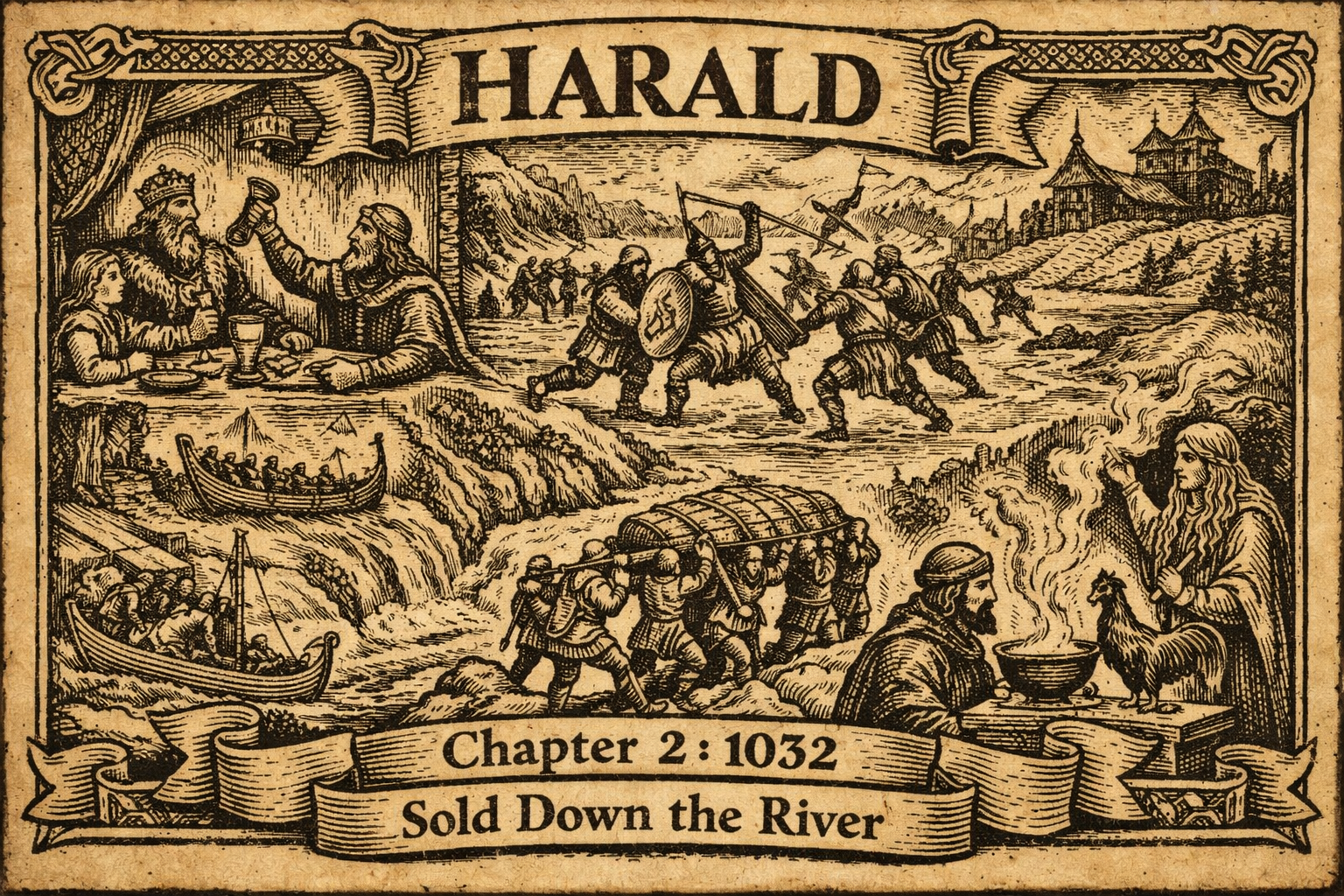
The Hospitality of Yaroslav
When the hard snows eased enough for men to move, Harald Sigurdsson and the remnants of Olaf’s following came down out of the Swedish uplands and into the river-lands of the Rus’. Their skis were traded away. Their Norwegian cloaks were patched with foreign cloth. They moved now as hired men rather than kin-bonded farmers—armed, hungry, and useful.
The last stretch into Novgorod was not a march but a threading of waterways. Ice still rimmed the banks where the current had not broken it. Men traveled with poles to test the shallows and with axes to clear driftwood. The boats they hired were narrow and blunt-ended, built for rivers rather than seas. A day’s movement was measured by daylight, by where a fire could be made, by whether the locals were friendly or watchful.
Novgorod was a city of timber and water. Its palisades rose from the earth like sharpened teeth, and its quays were crowded with craft: dugouts, plank-built boats, and larger vessels hauled up for repair. There were markets even in the cold season—fur, salt, honey, wax, iron, and silver cut into pieces for weighing. Harald saw scales used as readily as swords. A man’s worth could be argued over in coin-weight and not only in fame.
Yaroslav Vladimirovich received them in his hall with a formality that was neither Norwegian nor wholly foreign. He did not greet Harald as an equal, nor as a beggar. He greeted him as a man whose past was known in outline—Olaf’s half-brother, a survivor of Stiklestad—and whose future could be shaped into service.1 The benches were cleared. Warm drink was poured. Bread was broken and passed. That was hospitality, and it was also inspection.
Harald stood before the high seat with his band behind him. Their number had thinned since the forests, and their wounds were poorly hidden. Yet they still carried their axes, and they still bore themselves like men who had crossed danger and lived. Yaroslav questioned Harald about practical things: how many men remained, what weapons they carried, whether any were skilled at ship-work or horse-handling. He asked nothing about prophecy, nothing about gods. The hall was a place for what could be used.
There were Varangians already in Novgorod—Norsemen and Swedes who had come down earlier, men who wore foreign-cut coats and spoke with the flattening of vowels that comes from living among other tongues. They watched Harald closely. Some recognized him by name. None greeted him as a brother. The river-road hardens men, and it teaches them that tomorrow’s ally may be next season’s rival.
At the edge of one feast, among the women and younger members of the household, a girl watched the newcomers without speaking. She was not of an age to sit in counsel, but she was of an age to notice what adults tried to hide. Ellisif, Yaroslav’s daughter, did not smile. Her gaze moved from axe-head to scar to the ragged hems of foreign cloaks. She saw the band not as guests but as a weather-front—something arriving that would change the air.2
Harald did not approach her. He remained with the men and with the prince’s stewards, learning where the hall’s power lay: not only in the high seat, but in those who counted stores, arranged escorts, weighed silver, and measured loyalty as carefully as grain. He took note of the prince’s brothers and retainers, of who laughed too quickly, of who stayed silent. In Norway, men swore to kings because they were kin or neighbors. Here, they swore because the river carried wealth, and Yaroslav controlled the bends where that wealth passed.
The Voluspa came into the hall late, and the hall shifted when she did. She was not dressed as a Rus’ woman. She was not dressed as a Christian. Her hair was braided in the old way, and her jewelry was of mixed make—some Swedish, some traded from the east. Men avoided her gaze. She did not ask for permission. She took a place where she could see the high seat and the door.
Yaroslav let her be. That too was a judgment. He treated her not as a holy woman—he showed no reverence—but as a strange tool Harald carried, like an odd blade. If it cut, it would be kept. If it dulled, it would be discarded.
So the hospitality settled into routine. The Norwegians were fed. Their weapons were oiled. Their clothing was mended. They were assigned quarters under guard that looked like honor. Harald understood the transaction. He had been sheltered, and he was now on the hook. The river-kings did not give gifts without a rope tied to them.
Battle on the Ice
Winter did not end the wars of the Rus’; it changed their shape. When the river froze, the Dnieper and its tributaries became roads. The marshes stiffened. The trees stood bare. Horsemen could travel where summer would have swallowed them. Men spoke of campaigns as soon as the ice grew thick enough to bear weight.
Yaroslav called his men in late winter. Harald’s band was included without ceremony. They were given food for travel—dried fish, hard bread, salted meat—and small measures of silver, not as payment but as proof that they were now part of the prince’s force. Harald saw that the silver came cut and weighed. Coins mattered less than metal. A man’s value could be chopped into fragments.2
They marched out over the ice in columns that kept to the safest routes. Scouts went ahead with poles. At night, camps were made in sheltered hollows where wind would not strip heat away too quickly. Fires were kept small and masked when possible. The Rus’ fought among themselves as often as they fought outsiders, and the frozen world carried sound far.
Different mouths named different enemies. Some spoke of Svyatopolk as if he still walked and plotted, a shadow name used for rebellion and bad faith. Others named rival princes, rivals of rivals, men whose loyalties would shift if the weight of silver shifted.2 Harald listened to the names without repeating them. What mattered was that Yaroslav required victories to keep his seat stable, and victories required foreign axes as much as native spears.
The first clash came on open ice near a bend in a river where the current ran slow and the banks rose. Both sides advanced cautiously, testing distance. Arrow fire began early, and men learned quickly that an arrow striking ice can skid and glance unpredictably, biting calves and ankles rather than chests. Harald’s Norwegians moved as they had in Norway—shields forward, axes ready to hook and tear—yet the footing changed every rule. A shieldwall that held on mud might slip and break on ice.
Harald adapted by tightening the rank and shortening the stride. He kept the axe close rather than swinging wide. He watched how Rus’ fighters used spears not only to thrust but to brace themselves, using the shaft as a third leg. The battle turned into a series of brutal pushes, each side trying to force the other into broken ice near the bank where it would crack and swallow men.
The enemy line bent and then snapped in one place. Men fell, and once a man fell on ice, he became a hazard—something others tripped over, something that could be used as a wedge. Harald’s men pressed into the gap with the practiced ferocity of those who had survived Stiklestad. The fight ended not with a grand collapse but with retreat: men pulling back, gathering their wounded, leaving dead where they lay, because the ice did not allow easy burial.
Later came fights against the Pechenegs, sharper and more sudden. They did not meet in steady ranks. They struck at flanks and at baggage, at moments when men were cold, scattered, and tired. Their arrows came in flights, and their horses moved with a speed that made the frozen land seem like open steppe. When Harald’s men managed to close, the Pechenegs withdrew rather than be caught in axe-range.
One afternoon, after an ambush had been beaten off, Harald saw how the Rus’ treated victory: not as an end, but as leverage. Prisoners were counted. Horses were seized. Loot was not divided in joyous chaos; it was tallied. The men who could read marks on wood or parchment had a different kind of power than men who could split helmets.
In early spring, when the sun began to soften the ice and the river edges turned black with melt, Yaroslav called Harald to a private audience. The hall was less crowded. The fires burned differently. The air smelled of wet wood. The prince spoke plainly: the Norwegians had done their work. They had shown that they were dangerous and disciplined. Now they must leave, because their presence could become a problem as easily as it had been a solution.2
He offered them letters of passage, small gifts, and guidance: go south along the Dnieper. Seek service where foreign blades were prized. The prince did not say “Byzantium” with reverence. He said it the way a man says “market”—a place where men are bought and sold.
Harald accepted without thanks. A man who survives exile does not argue with the opening of a road. He gathered his band and prepared for the river.
Rapids and the River
When the river broke, the world changed in a week. Ice floes drifted past like shattered shields. The banks turned to mud. Men who had marched over white roads now sat in boats and moved by current and oar. Spring made travel possible and made it dangerous at the same time.
They hired river craft—monoxyla, hollowed from great trunks, and wider plank-built boats where they could be found. The Norwegians trusted sea-going ships with high sides. These riverboats felt exposed. Water sat close to the gunwale. A wrong wave at a rapid could take a man overboard and pin him under the hull. Each boat carried its own small world: weapons wrapped in cloth, spare clothing kept dry under skins, food in sacks tied high.
Harald learned the rhythm of river travel. At dawn, men ate quickly—cold fish, bread when it existed, sometimes only a mouthful of dried meat. They pushed off early to take advantage of calm morning wind. When the river narrowed or ran fast, they hugged one bank to avoid snags and to keep close to land if they had to leap out and drag the boat free. They stopped before dusk to choose campsites with wood and sightlines, places where the approach of strangers could be seen.
Payment on the river was not simply coin. Sometimes a steersman was paid with a knife, a ring, a share of captured goods. Sometimes passage was negotiated through threats and reputation. A band of foreign fighters could buy safe landing as much by what it might do as by what it might pay.
The Dnieper’s rapids were spoken of like enemies. Each had a name, and each demanded a method. Men disembarked before the worst stretches. Boats were unloaded and carried or dragged overland. This was the slow work of ropes cutting hands raw, of shoulders straining, of slipping in wet grass. The river itself roared nearby, a constant reminder that one misstep could take everything—men, weapons, food—into foaming water.
Harald set guards during each portage. He placed the most reliable men on the high ground. He kept weapons close. The Pechenegs were known to watch these places. The river forced travelers to become predictable, and predictability invites attack.
In the evenings, men spoke more freely. Some spoke of Miklagard as a dream of gold and marble. Some spoke of it as a prison where foreigners died nameless in foreign wars. The river carried stories both ways. Traders told of emperors who paid in gold by weight. Soldiers told of chains across harbors, of walls that no ladder could climb, of politics that killed more surely than spears.3
Harald said little. He watched. He counted remaining men. He measured their endurance. He knew that any future service—whether to an emperor or to another prince—would depend on arriving with a band that still looked like a band, not a scattering of starving survivors.
The Voluspa traveled with them, sometimes in a boat, sometimes walking the bank when she chose. She did not command. She did not beg. She was treated with wary respect by some, avoided by others. When men asked her whether Miklagard was real, she answered only with verse, as if the river demanded poetry rather than speech.
One night, beside a fire that burned low because dry wood was scarce, she spoke:
Rivers remember
the weight of kings;
oar-strokes whisper
old bargains.Gold lies waiting
under чужой roof;
blood pays passage
for bold men.
No man answered her. The river answered instead, moving on in darkness.
Ambush at the Portage
The attack came where attacks always came: at a place the river forced them to stop. The portage was long, and the land rose unevenly. Boats had to be hauled far from the water, over roots and stones, past brush that could hide watchers. Men had been working since dawn. Sweat chilled quickly in spring wind. Hands were raw from rope.
Harald had guards set, but guards grow tired like everyone else. A man can stare into trees for hours and still miss the moment when trees become horsemen.
The first sign was not the sight of attackers but the sound—an arrow striking wood, a shout cut short. Then came the rush: Pecheneg riders breaking from cover, arrows falling among scattered workers, and the sudden panic of men who had set down shields and axes to pull boats.
Harald did not call for a shieldwall. There was no time to build one. He drove toward the boats, because the boats were survival. He struck at a rider who came too close, the axe biting into horse-flesh and forcing the man to twist away. Another arrow hissed past his ear. A Rus’ man fell with a shaft through his cheek and made a sound like choking.
Men scrambled to retrieve weapons. The Norwegians, trained by disaster and retreat, moved faster than those who had not fled a battlefield before. They formed small knots of resistance—four men, six men—using trees and boat-hulls as cover. Harald used the chaos the way fire uses wind, turning it into momentum.
Still the attackers pressed. They were not trying to annihilate; they were trying to take. They reached for sacks, for horses, for loose silver. They seized a boat rope and dragged a half-loaded craft toward their side as if to claim it.
Harald drove them back from the rope with a savage efficiency. His axe took a man at the shoulder. Another at the forearm. The Pechenegs withdrew a little, then shot again from safer distance. Arrows struck boat-hulls and shivered. Men ducked and cursed.
When Harald saw that the portage could not be held, he forced a decision: boats into the water now, loaded or not. Some supplies were abandoned. Some wounded were dragged rather than carried. Men shoved craft down the muddy slope with desperate strength.
The river took them unevenly. One boat grounded and had to be pushed free as arrows peppered its stern. Another lurched out and spun, nearly spilling men. Harald found himself in the water up to his waist, pushing, then deeper, then forced to swim when the current caught him. Mail dragged at his shoulders. His breath came hard. The water was still cold enough to numb hands.
He reached the far bank with help, hauled out by two men who had kept their grip on him like hooks. Behind them, the portage burned with scattered violence—shouts, hooves, the sharp cracks of arrow impacts. Not all boats escaped. Not all men crossed.
When they regrouped, their number had thinned again. They took stock not only of losses but of what remained: axes, knives, a few measures of silver, and the grim competence that comes from having lived when others did not.
That night, no one spoke of glory. The river had demanded payment, and the Pechenegs had collected interest.
The Island of Khortytsia
South of the worst rapids lay an island used by travelers as a place to stop, repair, and bargain with fate. It rose from the river with steep banks and patches of flat ground above. Trees clung to it stubbornly. Its name was spoken in different ways. Some called it a threshold. Some called it a trap. Some called it Khortytsia.
Harald chose it because choice is sometimes only the shaping of necessity. Men needed rest. Boats needed inspection. The portage ambush had left gear damaged and spirits sharp-edged. An island offered a little safety: fewer directions for an enemy to approach, clearer sightlines, water as a barrier.
They beached the boats and built a small camp. Guards were placed. Firewood was gathered. Men dried clothing and oiled weapon-edges dulled by mud and blood. Harald walked the island’s perimeter and measured it like a fortification. He understood the kind of safety it offered: temporary, conditional, dependent on watchfulness.
Before dusk, the Voluspa demanded a rite. Not as a plea, not as a suggestion. As a fact. The men had crossed death-water. They had shed blood. The road ahead would be worse. A toll must be paid to the powers that watched the river.
A cock was brought, traded from a river-settlement earlier in the journey. Its wings were bound, its feet tied. Some men muttered. Some spat. Some crossed themselves in the Christian way when they thought no one would notice. Harald did nothing that could be named prayer, yet he permitted the act, and permission is a kind of participation.
The Voluspa spoke in verse, and her voice carried over the river as if the water itself wanted to listen:
Red is the ransom
for road of foam;
thin is the skin
of men on water.Fowl’s blood falls
for far-walkers;
the current counts
each carried breath.
She cut the cock’s throat with a small blade. Blood ran into the earth and darkened the roots. The bird jerked, then stilled. The act was not beautiful. It was deliberate. A payment made in the old currency.
It was then, at the edge of the camp, that another traveler appeared with an escort of a different kind. He was not a steppe raider. He did not carry himself like a warrior. He wore southern clothing layered for travel, and he kept a writing tablet and instruments as carefully as a fighter keeps weapons.
He was called Ibn Fadlan, a name that carried the weight of distant courts. He spoke through interpreters and through the shared language of trade. He had traveled among river peoples and steppe peoples and had written down what he saw. He watched the sacrifice without interrupting, observing the gestures, the handling of the animal, the words spoken before the blade fell.4
He asked questions later, not to argue but to record: why a cock, why this island, why blood on roots rather than into water. The men answered in fragments. The Voluspa answered with verse. Ibn Fadlan wrote anyway, because writing does not require understanding—only attention.
As darkness gathered, Harald stood apart from the others and listened as the Voluspa spoke again, this time to him directly. She did not flatter him. She did not promise him peace. She spoke of service and iron and gold weighed in foreign hands:
South stands the city
with sun-bright walls;
chain on the harbor,
claw of iron.There foreign oaths
feed foreign thrones;
axe-bearers bargain
their breath for gold.Not king yet—
but king’s seed hardens
in чужой fire.
Harald did not answer. He did not need to. The prophecy did not alter the river’s direction. It only named what the river already carried them toward.
At dawn, boats were pushed off again. The island fell behind. The river widened. The land shifted toward steppe. Traders spoke more often now of Miklagard, because the route was no longer a rumor but a road nearing its end. Harald set the pace, kept the men moving, and held what remained of his band together as if he were already practicing for a greater guard under a greater master.
The last of the rapids dwindled behind them. Ahead lay smoother water—and beyond it, the sea, and beyond the sea, the city where emperors hired northern axes to keep their crowns on their heads.3
- Heimskringla, Haralds saga Sigurðarsonar (tradition of Harald’s exile and early service among the Rus’). ↩
- Tale of Bygone Years (Primary Chronicle), accounts of Yaroslav’s rule, rivalries among princes, and the political economy of the river-lands. ↩
- Constantin VII Porphyrogenitus, De Administrando Imperio, descriptions of the Dnieper route, rapids, portages, and dangers from steppe peoples on the way toward Byzantium. ↩ ↩
- Ibn Fadlan, Risala (travel observations of river and steppe peoples; here adapted into the Dnieper setting per saga-project rules). ↩
- Poetic Edda (for the register and verse-form used by the Voluspa character, consistent with Eddic cadence rather than modern speech).