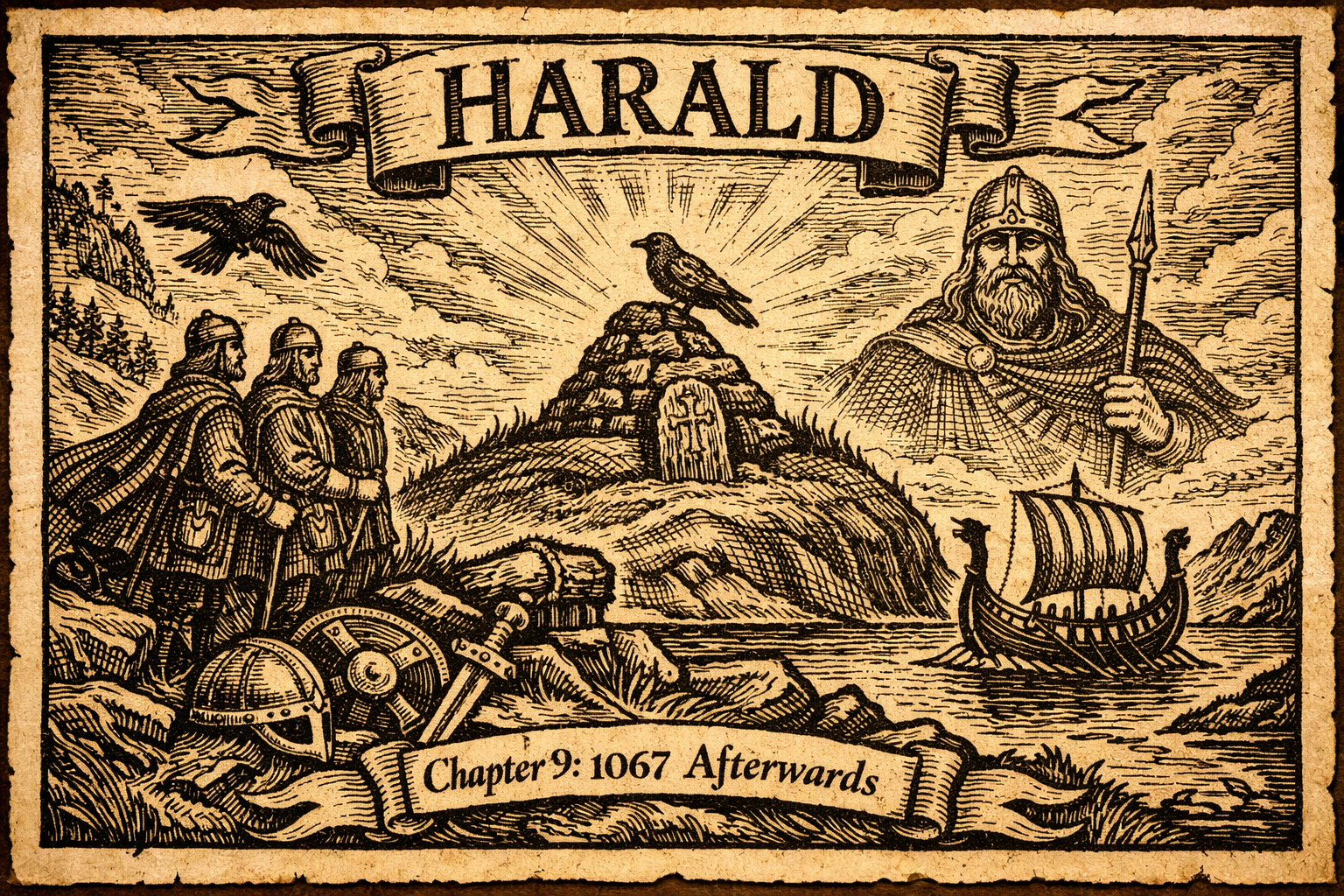
The Legend Lives On
Winter lay hard upon Norway when the tidings reached Nidaros.
The ship that bore them had left the Humber late in autumn, its hull riding low, its sail patched where English arrows had torn it. Frost silvered the rigging as it crossed the North Sea. The voyage was slow and bitter. Westerlies pressed against them for days; sleet scoured faces raw; ice gathered along the gunwales until oars struck at it like clubs. The crew bailed by turns and chewed dried fish stiff as boards. They spoke little. Their cargo was not tribute, nor captives, nor the bright boasting of victory, but a weight that sat on every tongue.
At Orkney the jarls had already heard rumors carried by fishermen—men who pulled nets in gray dawn and listened to every passing sail. At Shetland the monks made the sign of the cross and asked no questions. Farther east, when the ship finally took shelter in a lee and waited for weather to break, one of the younger oarsmen asked the captain whether a king could truly die with no last words spoken, whether a man so loud in life could fall as simply as a fir-tree cut at the root.
The captain did not answer at once. He only watched the sea. “A man dies,” he said at last, “and then the living begin to speak for him.”
By the time the ship turned toward Trondheim Fjord, the story had already begun to change in the telling. In one harbor they said he had worn no mail at Stamford Bridge, as though fate itself had stripped him. In another, they said he had fought in a golden byrnie taken from Miklagard. Some claimed an English archer crept beneath the bridge and shot upward like a serpent striking from water. Others claimed the shaft came from across the field, guided by a saint’s hand. The truth traveled behind them like a shadow—present, unmistakable, and always shifting as the light shifted.
The fjord lay iron-gray under low cloud when the ship made harbor. Snow had crusted the roofs. Smoke rose thinly from timber halls. The town was smaller than the great cities of the south, but it was rich in what the North valued: shelter, law, and the memory of kings. Word ran ahead of the crew like fire in dry grass. Men left their fish-stalls. Women paused in doorways with flour on their hands. Boys ran along the wharf calling a name, not yet understanding what it meant to call it so loudly.
Harald Sigurdsson—called Hardrada, Hard-Ruler—was dead.
Within the king’s hall stood Olaf Haraldsson, his son, not yet grown to full beard. Magnus, younger still, lingered at the edge of the gathered men, his gaze darting between faces as if searching for the one that could undo what was spoken. The hearth had been banked high against the cold; the air smelled of pine-resin and wool. Men were present who had once followed Harald east, men who had been paid in coin weighed on scales, men who had seen him speak softly when it suited him and roar like surf when it did not.
They were present when the captain of the returning ship spoke.
He did not embellish. Embellishment would come later, in safer mouths, when grief had stiffened into pride.
“We won at Fulford,” he said. “York bent the knee. We waited at the bridge with half the host. The English king came faster than any thought possible. We were unarmored in the sun. The fight was fierce. Your father stood in the front rank. An arrow struck him in the throat. He fell. We carried him from the field while we could hold ground. Then the English pressed us hard. Tostig fell beside him. The day was lost.”
No one wept openly in the hall. Among Norsemen grief often traveled inward first, like water sinking into frozen ground. Yet the silence was not empty: it was full of things unsaid. Some remembered Harald laughing in youth, a boy with a wound from Stiklestad that never truly healed. Some remembered him as he had been in Byzantium—leaner, hungrier, with a stranger’s polish and a wolf’s patience. Some remembered the king he became, a ruler who demanded order, built harbors, summoned coin, and broke men who would not bend.
Olaf’s hands closed on the pommel of his sword until his knuckles whitened. Magnus stared at the floorboards as if expecting blood to seep between them. Outside, snow began to fall again, large flakes that made the world quiet as wool.
In the weeks that followed, the hall filled with messengers. There were men from the valleys who had not seen the sea in years, men from the coast who measured life in tides, men from the far north where daylight itself could feel like a brief loan. Some came to offer oaths at once, eager to stand close to the new kings before rivals did. Others came with careful faces and cautious words, tasting the wind to see which way it would blow.
For Norway had known divided rule before, and division always tempted the ambitious.
Olaf had been named while Harald lived, but a living king casts a long shadow. Now the shadow was gone, and the shape of the land could be seen more clearly—its old grudges, its hungry jarls, its districts that remembered when law was local and the king only a distant rumor.
Olaf learned quickly that inheritance is not the same as possession. A crown does not settle on the head like a cap; it is held there by hands—some loyal, some merely near. He listened to counsel. He received gifts. He measured men. He spoke less than his father had spoken and watched more, but there was iron in him too, iron learned at Harald’s table whether he wished it or not.
Magnus, younger, made fewer speeches still. His eyes were quick, and in them some saw the sharpness that becomes either wisdom or bitterness, depending on what the world gives and what it withholds.
Meanwhile the tale began its long ascent from fact to legend.
In the towns and on the farms, people asked after the body. Had it been buried in England? Had his men borne him home? Had the English given him kingly earth? Some swore that seven feet of soil covered him, as though even the land feared the dead man’s reach. Others said the English allowed his followers to take him away because even victors sometimes prefer a quiet grave to a famous one. No single answer satisfied everyone. But in Norway the manner of burial mattered less than the manner of death.
He had died with a weapon in his hand. He had died seeking what he had sought his whole life: a widening of his fate.
That was enough.
Skalds who had once sung in Harald’s hall now shaped new verses, and with each new verse the man became a little less mortal. They spoke of the boy from Ringerike who followed Olaf at Stiklestad. They spoke of the wounded youth who fled through forest and snow, living on what he could hunt and what strangers would spare. They spoke of the wanderer who took service in the east, who learned foreign tongues and foreign tricks, who stood before emperors and did not bow more than courtesy required. They spoke of gold taken from palaces and of ships drawn over chains, of hard choices and harder laughter.
And they spoke, too, of the last voyage: sails dark against autumn sky, ravens wheeling over the English coast, the long march inland under a hot sun that felt wrong in that season of war. In the telling, the arrow that felled him grew straighter and brighter; the field grew wider; his stand grew longer. The bridge itself grew into a symbol. It became the narrow crossing between two ages.
In Trondheim, men began to say it openly: “After Hardrada, the sea-kings will be fewer.”
That sentence carried both pride and fear. Pride, because to name an ending is to claim one has witnessed something great. Fear, because endings mean the world you understand is slipping away, and what comes after may not honor you.
In the same winter, priests in their churches spoke of other endings. They spoke of Harold Godwinson fallen at Hastings, and of William of Normandy taking the English crown. They spoke of castles rising in stone, of foreign speech in English halls, of new laws that came with heavy hands and heavier taxes. Traders returning from the British Isles brought back stories of walls and towers, of men who fought not only with sword and spear but with parchment and seal.
These tales unsettled those who still loved the old freedom of the sea. A longship needs no parchment to move. A raiding leader needs no charter to take. But a world of stone and written law is a world where the ship’s prow cannot always bite deep.
Olaf heard these reports with a young king’s caution. He had not led men across half the world as Harald had done. He had not filled his hands with Byzantine gold. He had inherited, instead, the work of holding. The songs about his father tempted him toward the wide horizon—yet the messengers at his door spoke of disputes over land, of jarls testing their limits, of farmers grumbling at levies. A king can chase glory abroad only if the ground beneath his feet is firm.
So Olaf did what Harald had always done, in his own manner: he measured Norway before he measured the world.
He rode in spring when the roads softened. He took ship along the coast when the ice broke and the sea turned from iron to slate. The pace of travel was the pace of power: slow enough for men to see him, fast enough for rivals not to grow bold. In each district he received oaths and gave judgments. He accepted gifts when gifts were due and refused them when refusal carried more authority than acceptance. He listened to grievances that seemed small—fences, fishing rights, inheritance quarrels—because he understood what his father had understood: small wrongs are the seeds of great rebellions.
Magnus traveled too, sometimes with him, sometimes separately, learning where men were loyal and where loyalty was merely a word spoken for convenience. Between the brothers there was a bond, but also the faint beginning of rivalry, the way two blades made from the same iron may still strike sparks when they touch.
In Nidaros, the shrine of Saint Olaf drew pilgrims. The saint-king’s presence in the city was a different kind of authority, one Harald had sometimes resisted and sometimes used. Now, with Harald dead, the Church’s voice grew steadier. Priests spoke of God’s judgment at Stamford Bridge. Some hinted that Harald’s ambition had been pride, and pride leads to a fall. Others, more cautious, praised him as a strong ruler who kept peace within Norway even if he sought war without.
Olaf did not publicly quarrel with them. A new king learns quickly that not every contest is won with shouting. Yet in private, among his own men, he allowed the older songs to be sung: songs that praised courage without apology, songs that remembered pagan fire beneath Christian ash.
For Harald’s life had been lived along a fault-line. He had served Christian kings and pagan instincts alike. He had honored saints and also respected old fate. The North was not a place of clean divisions; it was a place where two faiths had overlapped like ice on water, sometimes holding, sometimes cracking.
And then, as always, there was the matter of payment—how a kingdom fed itself, how it rewarded loyalty, how it kept ships in the water and spears in men’s hands. Harald had brought coin habits from the east. He had pressed trade and demanded order. That order could become a cage, but it could also become strength. Olaf inherited this tightened realm, and he inherited the resentment it created.
Some men loved Harald for his severity because severity keeps neighbors from stealing your cattle. Others hated him for the same reason, because severity prevents you from stealing your neighbor’s cattle. After his death, those opinions did not vanish; they simply found new targets.
So the sons learned to stand where their father had stood—between the need for force and the need for consent.
Yet while the living struggled with law and levy, the dead king grew easier to love.
In Iceland, far to the west, men recited tales in longhouses where the wind howled like wolves outside. They argued over details as fiercely as if details were treasure. Did Harald truly leap the harbor-chain in Miklagard? Did he truly blind an emperor? Did he truly win more gold than any man in the North? Each question sharpened the edge of his fame. For even disagreement keeps a name alive.
In the Orkneys, jarls spoke of Harald as a man who had once been their guest and later their overlord in all but title. They measured themselves against him. In Denmark, where old rivalries simmered, some praised his death as the ending of a threat; others quietly respected a man who had dared to reach for England.
Across the sea, in England itself, people began to fold Harald into their own story. The English remembered him as the great foreign invader defeated at Stamford Bridge—a necessary victory made tragic by what followed at Hastings. In this way, Harald became part of England’s sorrow as well as Norway’s pride. His name marked the week when one world fell and another rose.
As spring turned to summer, the practical facts of kingship continued. Harald’s ships had returned battered; many men had not returned at all. Some farms would have fewer hands at harvest. Some households would have no father at the high seat. Widows received gifts from the royal stores, as custom demanded, and those gifts were not only kindness—they were policy. A king who forgets the dead soon has more dead.
Olaf made the rounds of the districts again and again. He learned which men told the truth plainly, which men wrapped it in honey, which men hid it behind silence. Magnus learned too. Between them, the realm held.
And still the legend grew.
It grew because the North needed it. A people who have lived long by sea and sword do not easily accept a world ruled by stone walls and written seals. They keep alive the memory of the man who best embodied what they fear they are losing. They keep him alive not only to praise him, but to remind themselves of what they once dared.
Thus Harald Hardrada became a boundary stone in the mind as much as in history.
Before him, the Viking age—of far-flung plunder, of kings who were first among raiders—still burned bright. After him, kingdoms hardened into states; bishops gained steadier footing; stone churches rose where once only timber stood; and the sea, though still wide, was no longer the same open road it had been when longships could appear like wolves at any shore.
In winter halls, when wind pressed at the shutters and snow lay deep against the door, men still spoke of Harald as if he might stride in at any moment—mail glinting, eyes bright, laughter hard as steel. They called him the Last Viking, and whether the name was wholly true mattered less than the hunger it fed.
For every age chooses a figure upon whom to hang its endings.
In Norway, in 1067 and long after, that figure bore the name Harald Sigurdsson.
The tide that carried him from Ringerike to Miklagard, from palace-gold to English earth, had ebbed. But the wake remained—etched in law, in lineage, in song. Olaf and Magnus lived in that wake. They steered within it. They tried, sometimes, to steer out of it, and found how difficult it is to escape a father who has already become a story.
Late in the year, as storms returned and the sea darkened again, a skald left Trondheim with a bundle of verses and a head full of names. He traveled westward, seeking halls that would pay him in silver and attention. He carried Harald with him, not as a corpse but as a flame caught in words. Each time he spoke the king’s deeds aloud, he made them a little more permanent.
And somewhere beyond the fjords—beyond the narrow seas, beyond even memory’s farthest horizon—the world Harald had known continued to pass away, while a different age gathered itself like a new weather-front.
In that gathering wind, the skald tightened his cloak, gripped his staff, and walked on—already shaping the first lines of the saga that would outlive them all.
- The account of Harald’s invasion of England, the battles near York, and his death at Stamford Bridge is preserved most famously in Heimskringla (Snorri Sturluson), Haralds saga Sigurdssonar. This chapter follows that tradition while keeping the aftermath centered in Norway.
- English perspectives on the 1066 campaigns—including the sequence from Stamford Bridge to Hastings—are recorded in versions of the Anglo-Saxon Chronicle; later Norman and English writers helped fix Stamford Bridge as a hinge-point in England’s own narrative of conquest.
- Olaf Haraldsson (later known as Olaf Kyrre) and Magnus Haraldsson are traditionally named as Harald’s heirs in Norwegian sources; their early co-rule and the consolidation of royal authority belong to the same post-1066 political settling described in saga material.
- The growth of Harald’s reputation through skaldic verse and oral transmission is a recurring feature of saga culture; skalds functioned as both entertainers and keepers of public memory, and their performances shaped how later generations understood earlier reigns.
- References to Nidaros and the cult of Saint Olaf reflect Norway’s ecclesiastical center in Trondheim and the political weight such sanctity could carry for rulers after the conversion period, a background present across saga narratives of the eleventh century.