Halley’s Comet
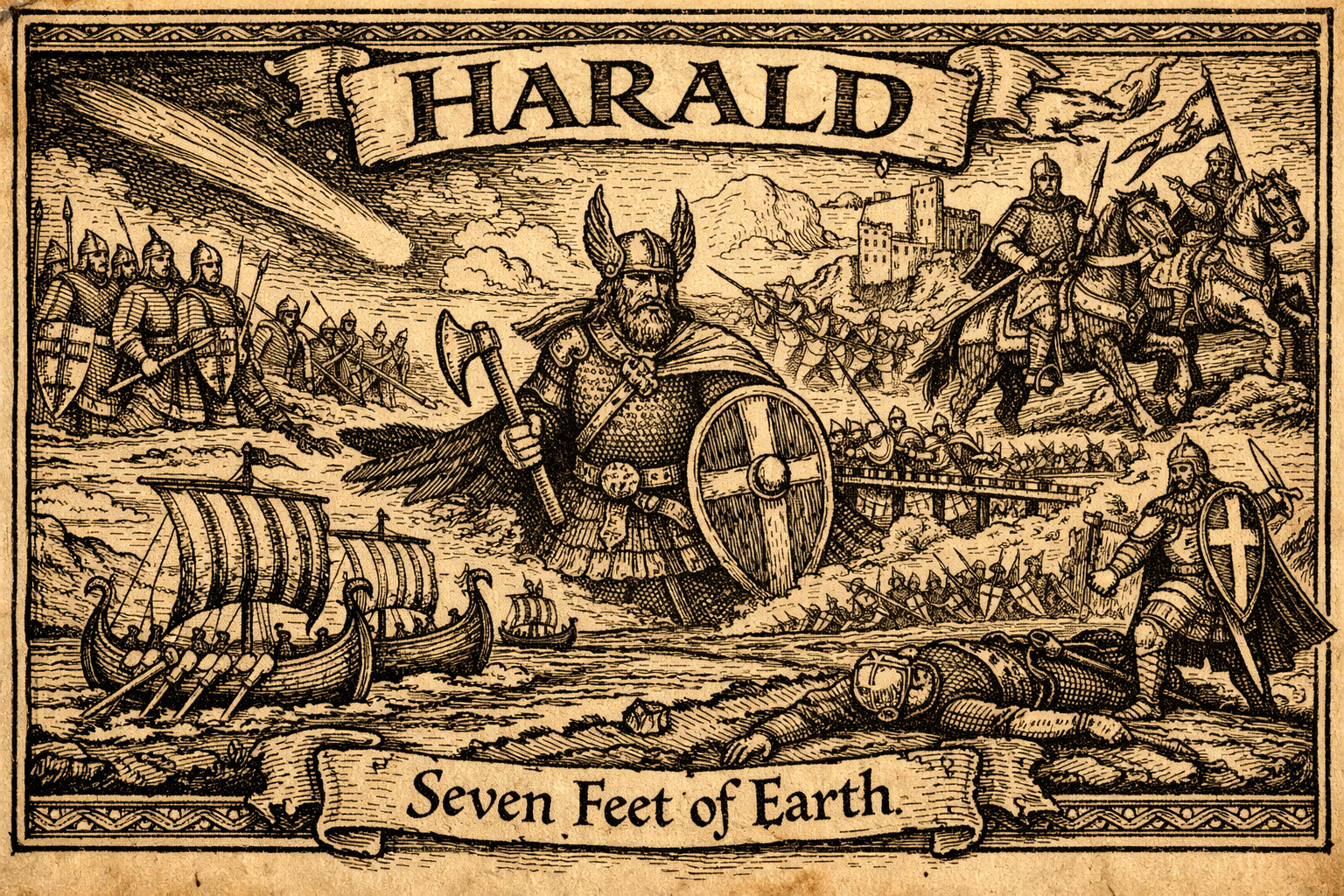
In the year 1066, before the hay was fully in and while the nights still held a cool edge in Trøndelag, a long-haired star came out of the west. It did not flicker like a wandering spark. It burned steady, with a pale tail drawn across the sky as if some unseen hand had combed fire into strands. When the sun lowered behind the islands, the thing stood plain above the sea-road, and men paused in their work to watch it.
In Trondheim, where the river Nið ran into the fjord and the halls stood thick with timber-smoke, the star became the talk of every hearth. Mariners leaned on oars and counted how far its tail reached. Farmers at the edge of the town pointed with pitchforks and said it looked like a spear cast by a god. Priests spoke of warnings. Old men remembered other comets and the deaths that had followed. The town had the uneasy air of a place that knows the weather will break, though the wind is still gentle.
Harald Sigurðarson was in Nidaros then, and the court sat with him. He had come north to call the leidang, to look upon the ship-sheds and the men who would row under his banner, and to hear again the voices of the Trøndelag chieftains whose loyalty had once been a bargaining matter and was now a habit of the realm. In the king’s hall there were Icelandic tongues and northern dialects; there were men who had fought in Denmark and men who had sailed with him in the East; there were younger sons hungry for silver and older captains careful with their counsel.
Harald went out one evening to the high ground above the harbor. The town lay behind him, roofs darkening in dusk. Ahead, the fjord opened wide toward the whale-road. The long-haired star hung above that water, and the tail seemed to point into the west and south, toward the islands and the English shore beyond. Harald watched without words. He had worn many crowns in his thoughts. Some had been taken and some had been denied. He had been young when he learned how quickly kingdoms change hands, and he had never let that lesson grow dull.
There were already tidings from abroad. Edward, king of the English, had died without a son. Harold Godwinson had taken the throne in haste, sworn in by the great men of the realm and crowned in the days after Edward’s burial. South across the sea, William of Normandy was said to be gathering ships. Across the North Sea, a banished earl was said to be seeking friends among old enemies.
Tostig Godwinson had come to Harald the previous year with gifts and bitter words: a brother cast out, a man stripped of his earldom, hungry to return with fire behind him. He spoke of English divisions, of the north that did not love the south, of earls who would rather bargain than bleed for a king who had risen too quickly. He spoke also of the old claim that Magnus, Harald’s nephew, had held by treaty and that Harald had inherited when Magnus died. A claim could be a blade if a strong hand held it.
The comet was not the reason, but it was the sort of sign men like to have when they are already set upon a road. The king’s council in Trondheim spoke of ships, of victuals, of men to summon and men to spare. The summer had been fair enough that stores were good. The realm was not threatened at home. Harald’s sons were grown. There was silver enough to purchase what could not be taken. There were hostages enough to keep wavering men still. The question was not whether Norway could strike outward; it was where the blow would land.
At the þing, Harald spoke plainly. He said England was a rich land and often poorly held. He said the old oaths and treaties gave him right. He said that if the English would not bend to law, they would bend to iron. The men of Trøndelag and the coastal districts answered as men answer a king who has led them to plunder before. War-arrows were carried inland. The leidang was called. Ships were demanded by name from each district that owed them. Those who were late would be fined; those who refused would be outlawed.
And so the work began, not with battle cries, but with pitch, rope, and timber. Shipwrights went down into the sheds and checked ribs and planks. Caulkers pressed oakum into seams and sealed it with tar. Oars were counted and measured; broken blades were replaced. Sails were hauled out, mended, and re-grommeted. Iron was sharpened and rust scraped away. The smell of tar rose over the water and clung to men’s hair and clothing. In every inlet the sound of mallets could be heard.
Harald moved among the crews in the days before departure. He spoke with the men who would captain the longships and the broad-bellied transports. He spoke with those who would command the land host once it came ashore: men who understood shield-wall, and men who understood the harder work of feeding an army that cannot live on glory. Orders were given as weights and measures rather than as boasts. How many barrels of ale per ship. How much dried fish for a week. How much flour for hard bread. How many horses could be carried without breaking a hull in a storm. Where to beach in England, and where to anchor where the tide would not strand them.
Payment was arranged in the old ways. Some men came because they owed service. Some came because they were promised a share of plunder. Some came because land in England was spoken of openly, measured in hides and marked in the mind like a map. Silver arm-rings were cut and weighed on small scales. Coin from the south—pennies, denars, the bright discs that travel in merchants’ purses—was counted out to buy grain and salted meat where the king’s own stores were thin.
When the days shortened and the air began to smell of autumn, the fleet was ready. The long-haired star faded into the brighter sky of late summer, but the talk of it did not fade. Men would remember its tail when the first blood fell.
No Halting at Hjaltland
Late in August, Harald’s fleet put out from Trondheim. It went first by oar, the ships sliding in a long line down the fjord while morning mist lay in folds over the water. Then, when the mouth opened and the sea grew broad, sails were raised. The square cloth bellied and snapped. The fleet turned west and north-west, taking a course that would carry it past the islands and then down toward the English coast.
The sea-road from Trøndelag to the islands is not a single track but a matter of judgment: the season, the wind, the strength of the crews, the wish to keep land within sight or to cut across open water. Harald’s captains chose to keep the coast for a time and then strike out, for speed. August can be kind, but it is a kindness that ends quickly in the north. A single gale can scatter ships as a child scatters straw.
For days the fleet moved under alternating sail and oar. When the wind slackened, men rowed until their shoulders burned. When the wind rose, oars were shipped and the sail took the strain. At night, where a safe shore could be found, some ships beached and men slept on land; others lay at anchor in sheltered bays. Fires were made from driftwood. Dried fish was softened in broth. Ale was rationed, for thirst at sea is not eased by salt water.
Storms did not strike at once, but the sea was never wholly quiet. Even on fair days, swells rolled under the hulls, lifting them and dropping them with a steady motion that turned the stomach of men unaccustomed to long passages. Those who had sailed the Baltic and the North Sea before knew the cure: eat sparingly, keep busy, do not lie down until night. Those who did not know learned quickly.
Hjaltland—Shetland—rose low and wind-cut from the water when at last they sighted it. The islands were grey-green under a washed sky, treeless and exposed. The fleet took shelter there long enough to make repairs and to gather what it could: fresh water, sheep, and news from the smaller sea-roads that run between the islands and the Scottish mainland. Men spoke of English ships along the east coast and of uncertainty in York. Some spoke of William in the south. Others dismissed such talk as distant thunder.
Harald did not call a feast. He did not rest long. The plan demanded speed, and speed demanded ruthlessness toward comfort. If the English gathered in full strength before he could strike, he would have to fight a harder fight. The king ordered that the fleet continue to Orkney, where he had faithful jarls and could draw more men.
In Orkney, Harald met the earls and took their oaths. Men came from the islands—hard sailors, used to lean living. Supplies were renewed. Barrels were rolled down to the shore. Sheep were slaughtered. Salt was rubbed into meat to keep it. Water casks were filled from springs. Horses were inspected, for a lame horse at sea is an expense without use. Harald spoke with Tostig there, and the banished earl urged haste with a man’s sharp impatience.
There was also the matter of what was left behind. Before Harald had sailed from Trondheim, Queen Ellisif and the king’s daughters had remained in Norway. The king had not brought women on this war-road. Yet at Hjaltland and Orkney, where the west wind has a different smell and the horizon feels wider, men spoke of home more often. The last sight of Norway’s mountains had vanished days before. The king sent messages back along the island routes—short words, carried by traders and islanders who could be trusted to find a ship heading east. Such messages were not tender letters but the king’s accounting of what he had done and what he intended. He left no uncertainty behind him. A realm cannot be ruled by absence unless the absence is made orderly.
From Orkney the fleet turned south. It kept the Scottish coast to port, taking advantage of familiar anchorages and the chance to put ashore when weather threatened. The sea grew more treacherous as September drew near. Rain came in hard curtains. A storm caught the transports in a stretch of open water and separated them from the longships. For a night and a day men saw only grey water and the next wave’s crest. Some ships found one another again by luck and by the sound of horns. One transport, heavy with horses, was never seen again. In war the sea takes its share before any enemy does.
They reached the English coast at last and entered the Humber estuary, a broad mouth where tides run strong and the river’s brown water meets the salt. The fleet rowed up on the flood tide and anchored on the ebb. Men learned quickly not to trust the riverbed, for it can swallow anchors and strand ships far from deep water. Harald’s captains chose a place where ships could be hauled ashore if needed, and where the army could march inland without bogging at once in marsh.
Harald’s host moved toward York. The land was flatter than Norway, cut by hedges and ditches, with fields that promised wealth and villages that promised food. Yet an army cannot take everything it needs without turning the land against it. Harald ordered that supplies be taken in measure and that those who submitted be spared. Men grumbled, but they obeyed. A king intent on ruling needs subjects who live long enough to pay.
When the English earls Edwin and Morcar came out to meet him, they did not come with the full strength of the realm, but with what the north could gather quickly. They chose ground near Fulford, south of York, where the land narrows between the river and marsh. On the twentieth day of September, the armies met.
The fighting at Fulford was a brutal pushing of lines. The English held firm at first, their shields locked, their spears thrusting. Harald’s men answered with axe and sword. The marsh sucked at men’s feet. The river hemmed one flank. When the tide rose, it crept into the low ground and cut off those who tried to retreat. Harald’s veterans, men who had held lines in Greece and on the rivers of the east, pressed their advantage without mercy. By afternoon, the English line broke.
York was forced to bargain. The city opened its gates. Hostages were offered. The promise was made that on a day soon after, at a place called Stamford Bridge east of the city, further hostages would be delivered and terms confirmed. Harald accepted. The decision was practical. A city that yields without sack can feed an army that intends to stay.
It was then that the first sweetness of false hope rose in the Norwegian camp, like the taste of ale after salt air. Men spoke as though the hard part was done. They had beaten the north. York had bent. Surely the south would not march so far in such short time. Surely Harold Godwinson, newly crowned, would stay near London to watch Normandy. Surely the English could not fight two wars at once.
These were the thoughts of men who have not yet met the next enemy.
False Hope at York
The days after Fulford were warm for late September. The sun rose pale and climbed into a sky that held little cloud. Harald’s men camped in ease, their ships secured downriver at Riccall on the Ouse, their tents spread on dry ground near York. They ate from English stores and drank English ale. They traded coin for bread and livestock where it was offered. They sharpened blades, but they did not wear mail at all hours. Some went about bareheaded. Some bathed in the river, laughing like men who believe they have time.
Harald did not waste the interval. He sent men to scout the roads and watch the approaches. He questioned locals and hostages about the countryside and the loyalties of nearby shires. He considered the next step: to press south toward the richer heartlands once the north was secured, or to receive the submission of the great men of the realm at York and then call a wider assembly.
Tostig urged boldness. He spoke of the bitterness between his old northern rivals and the Godwin house. He insisted that Edwin and Morcar would not fight for Harold if given a chance to bargain. He promised that Englishmen would come over to Harald’s side if Harald appeared strong and generous. His words carried the sharpness of personal grievance, but they were not wholly foolish. England was a realm held together by oaths and advantage, and such bonds can stretch.
On the morning set for the meeting at Stamford Bridge, Harald’s host marched out from York in orderly fashion. It was to be a day of receiving hostages and confirming terms, not a day of open battle. Many men wore only light gear: helmet, shield, spear or axe, but not full mail. The heat made armor uncomfortable, and complacency makes men careless. Some of the heaviest-armed troops had remained near the ships at Riccall to guard the fleet and supplies.
The road ran east to the River Derwent. Stamford Bridge was a stone and timber crossing there, a narrow place where a small force could delay a large one if it stood firm. Harald’s column stretched along the road, banners lifting in the faint breeze. The king’s banner, the Land-waster, moved near the center. The host was vast enough that it took time to settle into its positions near the bridge.
Then dust rose on the western horizon, not the thin dust of a handful of riders, but a thickening cloud that meant an army on the march. At first men thought it might be the promised hostages, or a levy from York coming to swear. But as the shapes grew clearer—ranks, banners, the bright glint of mail—uncertainty turned quickly into alarm.
Harold Godwinson had marched from the south with a speed that made even veterans speak of it afterward with grudging respect. He had gathered housecarls and fyrd, had driven them north hard along the Roman roads and the worn tracks of older kings, and had brought them to the edge of York so suddenly that the city’s own people were caught between fear and astonishment.
When Harald understood what he faced, he acted without delay. He ordered the men to form a line east of the bridge, taking ground that would not allow the English to outflank him easily. He ordered messengers sent back toward Riccall to bring up the men who had remained with the ships, and to bring mail shirts and heavier weapons if they could. Those messengers ran like hunted deer along the road, for the distance was several miles and time was already running out.
At the bridge itself, the first clash came quickly. English troops surged toward the crossing, hoping to take it before the Norwegians could settle into formation. A single Norwegian, great in strength, took position on the bridge with an axe and held it against all who came. He struck down man after man. The narrowness of the bridge made the English advance slow. The river churned below, catching the blood that ran between planks.
Harald’s main line tightened behind this delaying action. Shields locked. Spears angled forward. Men shouted orders and curses in Norse and in the mixed tongues of the host. The English, frustrated at the bridge, found another way. A man in a boat came under the bridge and thrust a spear upward through the planks. The Norwegian on the bridge fell at last, and the English poured across.
Even so, the delay had bought moments. The Norwegian line was formed in the meadow east of the river. Harald stood near his banner, visible to his men. He wore a helmet, and he carried a great sword. He had chosen not to wear mail that morning, whether for the heat or for haste; the result was the same, and fate does not care for reasons.
The English charged. Their housecarls fought with heavy axes, men trained and sworn to the king. Their fyrd pressed behind, spears thrusting. They struck the Norwegian shield-wall with the force of men who believe this battle must be decided at once, before the invaders can settle in and before word can spread that the south has been humbled.
The first hour was a grinding push. Lines buckled and held. Men went down under feet and were trampled. The sound of iron on wood and bone filled the air. Harald’s veterans answered the English’s discipline with their own. Men who had fought in the east kept their shields high against thrown spears and arrows. Men who had raided the Irish coast knew how to find a gap and widen it with an axe.
And still the English pressed, and more of them came over the bridge.
There was no room for speeches. A king in such a moment is measured by whether his men can see him and whether his banner still stands. Harald kept himself where he could be seen. The Land-waster snapped above him. Men closed ranks when they wavered because they could see the king still upright.
Then an arrow found him.
It struck him in the throat. The point drove deep. Blood came fast, dark and hot, and his breath failed. He fell where he stood, close enough to his banner that men later argued whether he died with his hand still on the staff or whether it was taken from him in the confusion.
When the king fell, the line did not collapse at once. That is what disciplined men do: they hold even when the center of their world has broken. Eystein Orri was not yet there. The reinforcements were still running from Riccall. Tostig fought in the front ranks, refusing to yield. He had asked for this war-road; he would not step away from it when it demanded payment.
Harold Godwinson sent word to Tostig that he might have mercy if he turned and took service under his brother again. Tostig refused. Whether he spoke in anger or in pride, the refusal was final. The fighting renewed with greater fury. Soon Tostig too fell, cut down amid the press of shields.
Only then did Eystein Orri arrive with the men from the ships. They came running, breathless, many in mail now, having dragged armor from chests and thrown it on in haste. Their arrival was like the sudden strike of a storm—strong, but late. They charged into the English line with desperate violence. Later men called this Orri’s Storm. It broke English ranks for a moment. It killed many. But exhaustion was already in the Norwegians’ limbs. They had marched, formed, fought, and now they fought again with lungs burning and arms heavy.
The English had numbers. They had the ground. They had the momentum of a surprise that had not been fully blunted. Orri fell. The Norwegian line finally broke into smaller knots of men, each fighting until surrounded, each retreating toward the river or toward open ground, each paying in blood for the earlier false hope.
By late afternoon, the meadow was strewn with dead. The Derwent ran red along its edges. The banners lay down. The long sea-road that had begun under a comet ended in grass and mud.
Treachery at Stamford Bridge
After the fighting ceased, the world did not immediately grow quiet. Men still moved among the fallen, searching for friends, stripping the dead, finishing those too wounded to live. The wounded cried out until the cries turned to hoarse whispers. The English gathered their own and guarded the Norwegians who still lived, for fear can make victors cruel and caution can make them restrained.
Harold Godwinson had won a great victory. He had destroyed the last large host that had come from the north to seize England. Yet even in triumph, he acted like a man who knew he had further enemies. He did not pursue the survivors to the ships with unthinking rage. He knew his army was weary. He knew there were other claims and other armies in the realm. He also knew that men who are cornered near ships can become desperate beyond reason, and desperate men can still kill kings.
Negotiation came quickly. The surviving Norwegian leaders asked leave to depart, promising oaths that they would not return. They offered hostages. They reminded the English that the war had been decided and that further killing would bring no profit. Harold Godwinson allowed them to go, taking hostages to ensure their word. Such an agreement was not mercy alone; it was calculation.
The Norwegian survivors withdrew toward Riccall. Their march was slow. They carried wounded on shields or on makeshift litters. They dragged what armor they could, for armor is wealth. They carried the king’s body with them, wrapped and guarded, for a king’s corpse is a thing that shapes memory and authority. If the body is lost, rumor takes its place, and rumor is hard to rule.
At Riccall, the fleet lay anchored along the Ouse. Ships creaked at their moorings. The survivors came in sight of the masts and felt the bitter relief of men who have found a gate out of a burning town. They counted ships, counted crews, and found the sum terrible. Of the great fleet that had set out from Trondheim, only enough men remained to man a small portion. The rest lay under English soil or had been taken by the sea.
They prepared Harald for the homeward journey. There was no grand embalming. They washed the blood away as best they could. They straightened limbs stiffening. They covered the face. The king’s weapons were gathered. The banner was taken down. Some wept. Others stared without expression, the way men do when the weight of loss has not yet settled fully into their bones.
They did not linger long on English riverbanks. Autumn storms threatened. The sooner they were at sea, the better their chances. They rowed downriver with the ebb and put out into the Humber again, turning north and east toward the islands.
The return voyage was harsher than the outward. The wind came colder. Rain struck in slanting sheets. The sea was more restless, as if offended by the blood it had helped spill. The survivors lacked hands. Oars went unmanned. When the wind died, they could not row as strongly. When the wind rose, they had fewer men to reef sails and fewer men to bail water if a seam opened.
They sheltered in Orkney again, not as conquerors gathering men, but as wounded travelers seeking a safe anchorage. News went out ahead of them by island routes and merchant ships. In Norway, the tidings struck like a sudden frost: the king dead, the host shattered, the great ambition ended in English grass.
At last the fleet reached Norway. The journey from Orkney to the Norwegian coast is shorter than the crossing from Trondheim, but it can still be deadly in autumn. The survivors made landfall in scattered groups, some at Bergen, some farther north, depending on where storms had driven them. From those ports, men carried Harald’s body overland or by coastal boat to Nidaros.
In Trondheim, the king was laid in earth. The grave was deep—seven feet of soil, as men later said, to keep him safe from wolves and from restless rumor. The church bells rang. Priests spoke words over him. Men who had followed him for decades stood in silence, remembering the young exile and the great raider and the hard king.
Harald’s death had consequences beyond grief. A realm must not be left without a clear hand on the helm. Harald had sons—Magnús and Óláfr—old enough to rule. Men who had once been Harald’s rivals now had to decide whether to stand behind the sons or to test the realm’s seams. In the north, where loyalty can be strong but ambition is stronger, such decisions are never merely ceremonial.
And across the sea in England, the victory at Stamford Bridge did not end the year’s blood. It only shifted it south.
The Battle of Hastings
While the fields at Stamford Bridge still held unburied dead, ships were already coming to the southern English coast. William of Normandy had gathered a great fleet and waited for a favorable wind. When it came, he crossed the narrow sea and landed at Pevensey with horses, knights, and men trained in war as a craft. He built fortifications and sent out foraging parties to feed his host, for an army that arrives by sea must either bring its food or take it quickly.
Harold Godwinson received news soon after his victory in the north. A messenger arriving from the south would have found him among tired men and wounded, with the smell of battle still in his clothing. A king cannot rest long in such a year. He turned his army south again, forcing another hard march. Some men did not go; the fyrd’s service is not endless, and the body has limits even when the will is strong. Others came because they feared Norman rule more than they feared exhaustion.
The road from York to London is long. The road from London to the south coast is long again. Harold drove his men as he had driven them north, but now they were weaker. Their feet were blistered. Their arms were bruised from shield and axe. Their stomachs were unsettled from poor food eaten on the move. The great victory in the north had not filled their bellies; it had emptied them.
William did not wait passively. He chose ground near Hastings, where he could hold a strong position and where the English would have to come to him. Harold advanced and took a ridge—Senlac Hill—forming a shield-wall along the top. There, on the fourteenth day of October, the battle began.
The fighting at Hastings was different from Stamford Bridge. The English fought mostly on foot, shields locked, axes heavy. The Normans had cavalry and archers, and they used them with discipline. Arrows rose and fell like a dark hail. Horses charged uphill and recoiled from the wall of shields. Time wore on. Men died not in sudden rout but in hours of strain.
At times the Norman line wavered, and rumor ran that William had fallen. He rode where men could see him and showed himself to keep them steady, just as Harald had done beneath his banner. Later in the day, Norman feigned retreats drew English men down from the ridge; when they broke their wall, they were cut down in the open. The battle became a series of wounds rather than a single blow.
Harold Godwinson fell before dusk. Some said an arrow struck his eye; others said he was cut down amid the press. However it happened, the English king died, and around him his housecarls fought until they were killed. When the wall finally broke, the Norman horsemen rode into the gaps, and the English line collapsed in pieces across the slope.
William’s victory at Hastings made him king in all but name, and soon enough he would take the crown. The year that had begun under a long-haired star ended with England remade by fire and law and foreign speech.
Harald’s part in this ending was already sealed beneath Norwegian earth, yet his invasion had mattered. It had drawn Harold Godwinson north at the very moment William needed the south unguarded. It had bled the English host before it met the Normans. The Norwegians had lost their king, and the English had lost theirs. William took the prize that both had claimed.
In Norway, men spoke of Harald as they carried him to his grave: the last great sea-king, the hard ruler, the warrior who had crossed the world and returned, only to fall on English grass. Some called his ambition folly. Others called it fate. The truth was simpler: Harald had always been a man who moved toward crowns as other men move toward fire, not because it is safe, but because it is bright.
Seven feet of earth covered him at Nidaros. Above that earth, winter would come, snow would settle, and the river would freeze at its edges. In spring the thaw would return, as it always does, and men would look up at the sky and remember the comet’s tail and the year it marked.
Yet a king’s death does not end a story cleanly. It turns the story into inheritance. Harald’s realm remained. His sons would have to hold it. The men who had followed him would have to decide how to speak of him: as warning, as glory, or as both. Across the sea, England would be ruled by a new line. The world Harald had raided and bargained with—Byzantium, Rus’, Denmark, England—had shifted, and the old sea-road of Viking conquest narrowed into legend.
In the months after, ships came and went from Trondheim carrying tidings: of Norman castles rising in English soil; of rebellions and reprisals; of earls dispossessed and lands remeasured. In Norway, the grave at Nidaros became a place men spoke of when they spoke of the end of an age. Harald’s banner was folded away, but his name did not fold so easily.
And in the king’s hall, where his sons now sat and listened to counsel, the question was asked in quieter voices than those that had called the leidang: what does it mean to rule after a man like Harald? The answer would not be found on a battlefield, but in the long work of peace and memory.
So the year turned, and the saga shifted from the clang of iron to the weight of what remained.
Footnotes
- Harald’s claim to England is treated in Heimskringla, Haralds saga Sigurðarsonar, which links it to earlier agreements involving Magnus and English-Danish kings; later English and Norman narratives frame 1066 as a year of competing claims rather than a single succession.
- The “long-haired star” of 1066 appears in multiple medieval traditions, including the embroidered depiction commonly associated with the Bayeux Tapestry and various annalistic notices; it is generally identified with the return of Halley’s Comet.
- Harald’s route via Shetland and Orkney, and the gathering of forces there, is described in Heimskringla and related saga material; the islands served as customary mustering points on the westward sea-road.
- The battle at Fulford (20 September 1066) is recorded in English chronicle tradition (commonly grouped under the Anglo-Saxon Chronicle) and in Norse narrative; it precedes the submission negotiations at York.
- The forced march of Harold Godwinson to the north, and the surprise at Stamford Bridge (25 September 1066), are central episodes in English accounts and are also told in Norse tradition; both emphasize the suddenness of the encounter and the scale of losses.
- The figure of the lone defender on Stamford Bridge appears prominently in Norse narrative (notably in Heimskringla) and later retellings; details vary by tradition, but the motif serves to explain how the Norwegian host gained time to form.
- Harald’s death by an arrow to the throat is the standard saga account (Heimskringla); English sources do not uniformly describe the wound in the same manner, but agree on Harald’s death in the battle.
- The truce allowing Norwegian survivors to depart, and the traditional count of ships permitted to sail home, appears in Norse narrative; the episode is often used to underscore the scale of the Norwegian disaster and Harold Godwinson’s strategic urgency.
- The Battle of Hastings (14 October 1066) and William’s subsequent kingship are treated across Norman and English narrative traditions; details differ, but the broad sequence—landing in the south, English march, set battle, English defeat—is consistent.
- Harald’s burial at Nidaros and the shaping of his memory as “the last Viking” belong primarily to Norse tradition; later historiography often uses 1066 as a symbolic closing of the great Viking age in the west.