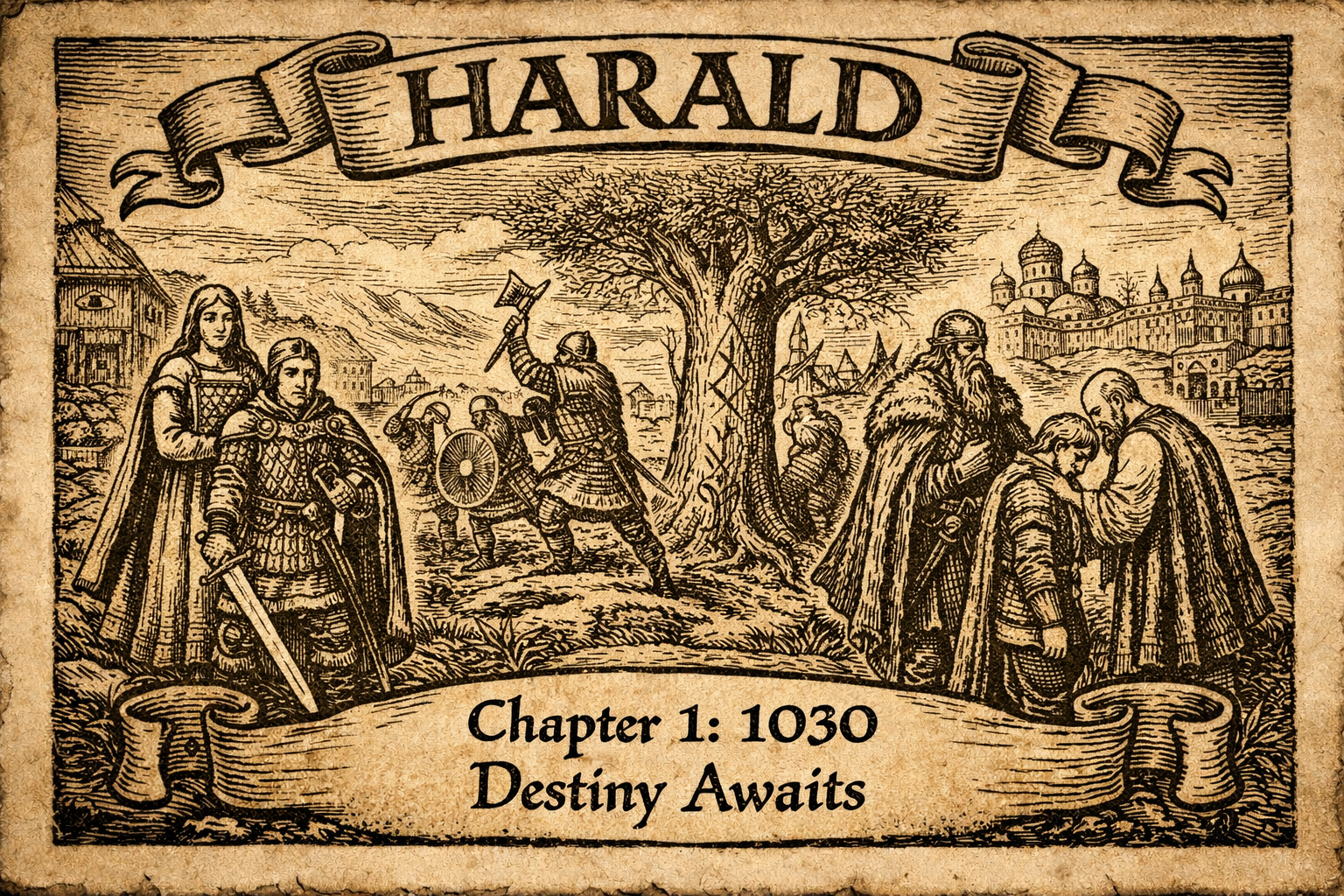
Harald
I was born in a farmhouse that was always full of people: family, extended family, foster family, housecarls, laborers, servants, slaves, minstrels, wanderers and hangers on. Dug into the earth and roofed with sod, my father’s house had a great hall with a hearth and high seat, benches and tables; a kitchen with its cook fire and food stores; an outhouse; and side rooms for both people and animals.
My mother, Asta, was a strong woman. She’d been married to a Viking from Grenland who didn’t come home, who left her pregnant and alone with just the story of how he had messed with the wrong woman and been burned alive, dead drunk in a mead hall. Asta took his gold, made his half-brother Hrani ferry her back to the uplands, and announced that this time she and her gold would only marry a good farmer.
My father was that farmer – Sigurd the Sow. And the child she was pregnant with became Olaf, King of Norway.
Heimskringla
Óláf, the son of Harald of Grenland, was brought up in the establishment of Sigurth Sýr, his stepfather, and his mother Ásta. Hrani the Widely-Travelled lived with Ásta and was Óláf Haraldsson’s foster father. Óláf soon grew to be an accomplished man, handsome and of middle height. Soon, too, he became clever and eloquent. Sigurth Sýr was a most efficient farmer who always kept his men busy, and he himself often went out to see to the fields, the meadows, and the cattle, as well as to the craftsmen and others who were busy with this or that.
Harald
They were good together. She was outgoing and bubbly, he was responsible and a little dour; she kept a clean house and was thrifty with his money, he would put on his nice clothes and serve the guests with meat and ale when she threw a party.
Heimskringla
As to what manner of man King Sigurth was, we are told that he was a hard worker, a good husbandman who managed his property and farm, attending to household matters himself. He was not given to display, and was rather taciturn. He was one of the wisest men then living in Norway, and the richest in chattels. He was of a peaceful disposition and not aggressive. Ásta, his wife, was open handed and of a proud disposition. Their children were these: Guthorm was the eldest, then came Gunnhild, then Hálfdan, then Ingiríth, then Harald.
Harald
When Olaf came to visit, Asta would lose her mind.
Heimskringla
And when King Óláf drew near to the estate, some servant men ran up to the house and into the [living] room. Within sat Ásta, the mother of King Óláf, together with some other women. The men told her about King Óláf approaching and that he could be expected forthwith.
Ásta immediately arose and ordered both men and women to bestir themselves and put everything in the best possible order. She had four woman servants take [down] the [cloth] ornaments of the room and quickly decorate [the walls] with tapestries and also the benches. Two man servants put straw on the floor, two set up the dressers for the decanters, two set the table, two brought in the viands. Still another two she sent off, two bore in the ale, and all others, women and men, went out into the courtyard. The two who had been sent off, looked up King Sigurth and brought him his robes of state and also his horse with gilt saddle and the bridle all set with enamel and precious stones and gilt. Four men she sent four ways into the district to invite all chieftains to come to the banquet she was preparing to welcome her son. All the others in the establishment she ordered to put on their best clothes, and to those who had no clothes that were suitable, she lent clothes befitting them.
Harald
Sigurd loved Asta, and would accommodate her enthusiasms, but putting on a monkey suit and spending his hard earned wealth on pomp and circumstance was not his idea of a good time. It made him a little grumpy.
Heimskringla
King Sigurth was out in the fields when the messengers came to him to tell him the news and inform him of all the preparations Ásta had made. There were many men with him. Some were cutting the grain, some bound it in sheaves, some carted the grain to the barn, some stacked it on ricks or piled it. And the king, together with two other men, now went about on the field, now to the place where the grain was piled up.
The king replied, “Important news you bring me, and much stress you put on it. A great to-do Ásta made before about people who were less closely related to her; and I see that she is still of the same mind. She certainly bestirs herself about this business with much energy, if only she will see her son off in the same grand fashion as she now welcomes him. It would seem to me that, if things are to proceed in this fashion, then those who take such hazards are little concerned about either their goods or their life.
Harald
The one thing they could all agree on was that I was a little bit different.
Heimskringla
We are told that when King Óláf was at this banquet, his mother Ásta brought forward her children to show to him. The king set on one knee his brother Guthorm, and on the other, his other brother, Hálfdan. The king looked at the boys, frowning on them, and showing an angry countenance. Then the boys whimpered. Thereupon Ásta led up to him her youngest son, called Harald. He was three years old then. The king frowned down on him. But he faced him [fearlessly]. Then the king took the boy by his hair and tugged it. The boy grabbed the king’s mustache and twitched it. Then the king said, “You are likely to be vindictive when you grow up, kinsman.”
Another day the king, accompanied by his mother, was walking about the estate. They approached a certain pond, and there were the boys, Guthorm and Hálfdan, her sons, engaged in play. They had made big farmhouses and barns, with many cattle and sheep, and played with them. Not far from there at a muddy bend of the pond, there sat Harald and played with chips of wood, and had many of them floating on the water. The king asked him what they were. He replied they were his warships. Then the king laughed and said, “It may well be, kinsman, that the time will come when you will be in command of ships.”
Then the king called Hálfdan and Guthorm to come to him. He asked Guthorm, “What would you most like to have, kinsman?”
“Fields,” he replied.
The king said, “How large a field would you like to have?”
He answered, “I would like to have this whole point of land sown with grain every summer.” There were ten farms on it.
The king answered, “A great deal of grain might be grown there.”
Then he asked Hálfdan what he would most like to have.
“Cows,” he replied.
The king asked, “How many cows would you like to own?”
Hálfdan replied, “So many that when they were watered they would stand thickly around the whole pond.”
The king answered, “You both want to own big farms, just like your father.”
Then the king asked Harald: “And what would you most like to have?”
“Housecarls,” he replied.
The king asked, “And how many?”
“So many that they would eat up all of my brother Hálfdan’s cows at a single meal.”
The king laughed and said to Ásta, “In him you are likely to bring up a king, mother.”
We are not told what else they said.
Harald
Sigurd was lord of Ringerike, the fertile river valley that empties into Oslofjord. We farmed: oats, barley, hay for the animals, vegetable garden of cabbage, kale, and carrots. When the salmon ran we would spread our nets across the mouth of the river and haul them back, full of fish to be sliced open, gutted, and hung out to dry. When the reindeer ran we hunted them in the hills. The rest of the time we did chores and told ourselves tales of gods and heroes to keep the boredom at bay.
Heimskringla
Now on a certain day, when King Óláf had not been there so very long, he asked King Sigurth his stepfather, his mother Ásta, and his foster father Hrani to have a private conference with him.
Then he spoke as follows.
“As you know,” he said, “I have returned to Norway after having been away for a long time. And all that time my men and I have had nothing for our support but what we gained in warfare, risking in many places both life and soul. Many a man through no fault of his own has been deprived by us of his property, and some, of their lives, too, while foreigners dispose of the possessions which my father, and his father, and one after the other of our kinsmen owned, and to which I am entitled.”
King Sigurth made this reply:
“These be matters of no little importance you are revolving, King Óláf. And which, so far as I can judge, bear witness more to your ambition than to your foresight; and indeed it was to be expected that there would be a big difference between my unpretentious ways and your grandiose plans; because even when you were scarcely out of childhood, you were full of ambition and overbearing in everything that concerned you. And now you have won much experience in battles and have adopted the ways of foreign chieftains. Now I know that if you have gone so far in this matter, it will be useless to try to stop you.”
At this point Ásta spoke as follows:
“So far as I am concerned, my son, I will tell you that I rejoice in you, and all the more, the more you prosper. I shall spare nothing I have to further your progress, though I can help little with my counsels. But if I had the choice, I would rather have you become supreme king of Norway, even though you lived to rule no longer than Óláf Tryggvason, than be no more of a king than Sigurth Sýr and die of old age.”
Heimskringla
The king answered in deep thought,
“Strange sights I have had a while ago. I beheld [all] Norway as I looked westward from the mountains. It then came to my mind that many a day I had been happy in that land; and then I had a vision: I saw all districts of Trondheim, and then all of Norway; and as long as that vision lasted I saw ever farther, until I saw all the world, both land and sea. I recognized clearly the places I had before been to and seen. And as clearly I saw places I had not seen before—some that I had heard about as well as such that I had not heard spoken of, both places inhabited and uninhabited, as far as the world extends.”
Heimskringla
“It seems advisable to me,” said the king, “that my brother Harald be not in this battle as he is still only a child.”
Harald answered,
“By all means I shall take part in it, and if I am so weak as not to be able to wield a sword, then I know what to do: let my hand be tied to the haft. No one is more minded than I to strike a blow against those farmers. I mean to be with my comrades,”
We are told that Harald on this occasion spoke this verse:
And Harald had his will to be in the battle.
Harald
I was but a boy when I left home. I thought I was a man, but I was 15 years old, so what did I know.
I collected all the youth of the village, we armed ourselves with field axes and whatever would pass for a sword, and we pledged our troth to Olaf, to battle for glory and reclaim the kingdom of Norway.
Heimskringla
But when it became known in Norway that King Óláf had arrived in Sweden from the east, all friends of his who wished to support him gathered together. The one of the highest rank among them was Harald Sigurtharson, the [half-] brother of King Óláf. He was fifteen years old at the time, tall and of full-grown appearance; and there were many other prominent men. Altogether they had collected some six hundred [720] men when they proceeded from the Uppland District and headed east to Vermaland through the Eith Forest. Then they journeyed east through the forests to Sweden [proper], inquiring [on their way] as to the whereabouts of King Óláf.
Harald
We carried the broken war arrow and gathered support. And by midsummer we were sailing to Trondheim, pulling our boat ashore alongside the warships, marching up into the hills, and looking down at our enemies in the valley below.
Heimskringla
We have to tell now, from the point where we turned aside, how the landed-men and farmers had gathered an unconquerable army as soon as they learned that the king had departed from Gartharíki in the east and had arrived in Sweden. And when they heard that the king had come from the east to Jamtaland and intended to proceed from there across the Keel to Vera Dale they moved this army to the inner reaches of the Trondheimfjord and there gathered together everyone, free men as well as thralls, and then proceeded up the Vera Dale. They had so great a host that there was no one who had ever seen so large a force gathered in Norway. And as is apt to be the case in such a large army, there were all kinds of people in it. There were a goodly number of landed-men and a great multitude of powerful farmers, yet the great mass was made up of cotters and laborers. And the main part of it consisted of men gathered in the Trondheim Districts. That army was violently enraged against the king.
Harald
The battle cry of Olaf's men was:
“Fram! Fram! Kristmenn, krossmenn, kongsmenn!”
“Fight, Fight, Christians, Crossmen, Kingsmen!”
The cry of the opposing army was:
“Fram! Fram! Bonder!”
“Fight, Fight, Farmers!”
You can guess whose war cry was more effective – even the troops on our side identified as farmers before they identified as Christians, and they fought accordingly.
Heimskringla
Harald
The lines broke, Olaf was slain, and the troops that could ran off into the trees. That night, as I lay on the bare ground, my arm wound bound by a torn slip of cloth, I looked up at the stars and remembered the prayer I had learned at home by the hearth:
Poetic Edda
Harald
The fallen tree branches formed shapes and answered me:
Poetic Edda
Harald
With that truth I pledged my troth to the old Gods, chose Odin as my lord, and left Christ dead on the field with Olaf and his foolhardy corpses. My friends and I made our way out to Sweden. We took over a farmhouse for the winter.
Heimskringla
Rognvald Brúsason helped Harald to escape from the battle and led him to a certain farmer who lived in the forest far from other people. There Harald was healed, and stayed till he was entirely recovered. Then the son of the farmer accompanied him on the way east of the Keel. They took to paths in the woods, avoiding, as far as possible, the commonly travelled roads. The farmer’s son did not know whom he was following. And when they were riding through some wild woods, Harald spoke this verse:
He journeyed east through Jamtaland and Helsingjaland till he came to Sweden.
Harald
Our reception from the farmer’s wife was a little frosty.
"What was the terrible rumbling in the night?" she asked.
"Didn't you know the two kings were fighting all night?".
"Who won, then?" the woman asked.
"Canute," came the reply.
The housecarl brought the men water and a towel to wash themselves. As I was drying my hands, the woman tore the cloth from me,
"You should be ashamed of yourself for using the whole towel for yourself," she scolded.
The farmer’s wife mocked us for our defeat in battle but fed us in fear of our axes and in exchange for our labor around the farm. Most of the troop took the shameful trip down frozen rivers home to Oslofjord. When the spring thaw arrived, the remainder took our leave and headed east towards Uppsala in Sweden, to visit Odin in his sacred grove and receive his blessing for our journey.
Adam of Bremen
Now we shall say a few words about the superstitions of the Swedes. That folk has a very famous temple called Uppsala, situated not far from the city of Sigtuna and Björkö. In this temple, entirely decked out in gold, the people worship the statues of three gods in such wise that the mightiest of them, Thor, occupies a throne in the middle of the chamber; Wotan and Frikko have places on either side. The significance of these gods is as follows: Thor, they say, presides over the air, which governs the thunder and lightning, the winds and rains, fair weather and crops. The other, Wotan—that is, the Furious—carries on war and imparts to man strength against his enemies. The third is Frikko, who bestows peace and pleasure on mortals. His likeness, too, they fashion with an immense phallus. But Wotan they chisel armed, as our people are wont to represent Mars. Thor with his scepter apparently resembles Jove. … For all their gods there are appointed priests to offer sacrifices for the people. If plague and famine threaten, a libation is poured to the idol Thor; if war, to Wotan; if marriages are to be celebrated, to Frikko. It is customary also to solemnize in Uppsala, at nine-year intervals, a general feast of all the provinces of Sweden. From attendance at this festival no one is exempted.
The sacrifice is of this nature: of every living thing that is male, they offer nine heads, with the blood of which it is customary to placate gods of this sort. The bodies they hang in the sacred grove that adjoins the temple. Now this grove is so sacred in the eyes of the heathen that each and every tree in it is believed divine because of the death or putrefaction of the victims. Even dogs and horses hang there with men. A Christian seventy-two years old told me that he had seen their bodies suspended promiscuously. Furthermore, the incantations customarily chanted in the ritual of a sacrifice of this kind are manifold and unseemly; therefore, it is better to keep silence about them.
Near this temple stands a very large tree with wide-spreading branches, always green winter and summer. What kind it is nobody knows. There is also a spring at which the pagans are accustomed to make their sacrifices, and into it to plunge a live man. And if he is not found, the people’s wish will be granted.
A golden chain goes round the temple. It hangs over the gable of the building and sends its glitter far off to those who approach, because the shrine stands on level ground with mountains all about it like a theater.
Feasts and sacrifices of this kind are solemnized for nine days. On each day they offer a man along with other living beings in such a number that in the course of the nine days they will have made offerings of seventy-two creatures. This sacrifice takes place about the time of the vernal equinox.
Harald
It was a hell of a party. If you weren't there, you don't know what it was like. And if you say you remember it, you weren't really there.
Voluspa
Poetic Edda
Voluspa
Harald
That summer I prayed to Odin every chance I got. Before you knew it we were sailing to Novgorod in the Rus. Yaroslav welcomed us warmly and then dispatched us into the field to help him suppress one of the local rebellions that were endemic to his kingdom.