Heimskringla
In the following spring they procured for themselves a ship and in summer travelled to Gartharíki to the court of King Jarizleif and stayed there during the winter. As says Bolverk:
Harald
Yaroslav sold himself as a saint, but he was religiously flexible, and he knew the old gods. He believed in the virtues of Viking hospitality.
Poetic Edda
Harald
Yaroslav had a weakness for exiled princes with good blood and bad luck. He was one of us. Any wanderer who dropped in at his court, no matter how stinky or skanky, he would greet you, invite you to the feast, and give you warmth and clothes and a nice dry towel and listen to your sad tale while pumping you for information about the outside world.
Adam of Bremen
To deny wayfarers entertainment is to them the basest of all shameful deeds, so much so that there is strife and contention among them over who is worthy to receive a guest. They show him every courtesy for as many days as he wishes to stay, vying with one another to take him to their friends in their several houses.
Harald
I was there by the fire, telling Yaroslav my sad tale, when I saw Ellisif for the first time. She was nine, in a balcony with her mother, but our eyes met, and she looked back at me with a calm curiosity. I decided to stay for a while.
Heimskringla
King Jarizleif made Harald and his followers welcome. Harald became chieftain of the men charged with the defence of the country, as did Eilíf, the son of Earl Rognvald. As says Thjóthólf:
Harald remained several years in Gartharíki and made forays in the eastern Baltic.
Tale of Bygone Years
While Yaroslav was still at Novgorod, news came to him that the Pechenegs were besieging Kiev. He then collected a large army of Varangians and Slavs, returned to Kiev, and entered his city. The Pechenegs were innumerable. Yaroslav made a sally from the city and marshalled his forces, placing the Varangians in ·the centre, the men of Kiev on the right flank, and the men of Novgorod on the left. When they had taken position before the city, the Pechenegs advanced, and they met on the spot where the metropolitan church of St. Sophia now stands. At that time, as a matter of fact, there were fields outside the city. The combat was fierce, but toward evening Yaroslav with difficulty won the upper hand. The Pechenegs fled in various directions, but as they did not know in what quarter to flee, they were drowned, some in the Setoml', some in other streams, while the remnant of them disappeared from that day to this.
Harald
We helped him recapture Kiev; we helped him dispatch Svyatopolk; I was there on the ice when it started to crack.
Tale of Bygone Years
Now it was already beginning to freeze. Svyatopolk was stationed between two lakes, and caroused with his fellows the whole night through. Yaroslav on the morrow marshaled his troops, and crossed over toward dawn. His forces disembarked on the shore, and pushed the boats out from the bank. The two armies advanced to the attack, and met upon the field. The carnage was terrible. Because of the lake, the Pechenegs could bring no aid, and Yaroslav's troops drove Svyatopolk with his followers toward it. When the latter went out upon the ice, it broke under them, and Yaroslav began to win the upper hand. Svyatopolk then fled among the Lyakhs.
Harald
But when spring came to Kiev, Yaroslav kicked us out and sent us on our way.
“Harald, you have a unique talent. I am truly grateful for the help you gave me against the Pechenegs. To show my appreciation I have traded you and all of your companions to Byzantium in lieu of my annual tribute to the empire.”
He equipped us with a fleet of refurbished dugout canoes, pointed us south down the Dnieper, and wished us great success in our future endeavors.
Viking hospitality says you are welcome to come in. It doesn’t mean you are welcome to stay.
De Administrando Imperio
They cut the monoxyla on their mountains in time of winter, and when they have prepared them, as spring approaches, and the ice melts, they bring them on to the neighbouring lakes. And since these lakes debouch into the river Dnieper, they enter thence on to this same river, and come down to Kiev, and draw the ships along to be finished and sell them to the Russians.
The Russians buy these bottoms only, furnishing them with oars and rowlocks and other tackle from their old monoxyla, which they dismantle; and so they fit them out. And in the month of June they move off down the river Dnieper and come to Vitichev, which is a tributary city of the Russians, and there they gather during two or three days; and when all the monoxyla are collected together, then they set out, and come down the said Dnieper river.
Harald
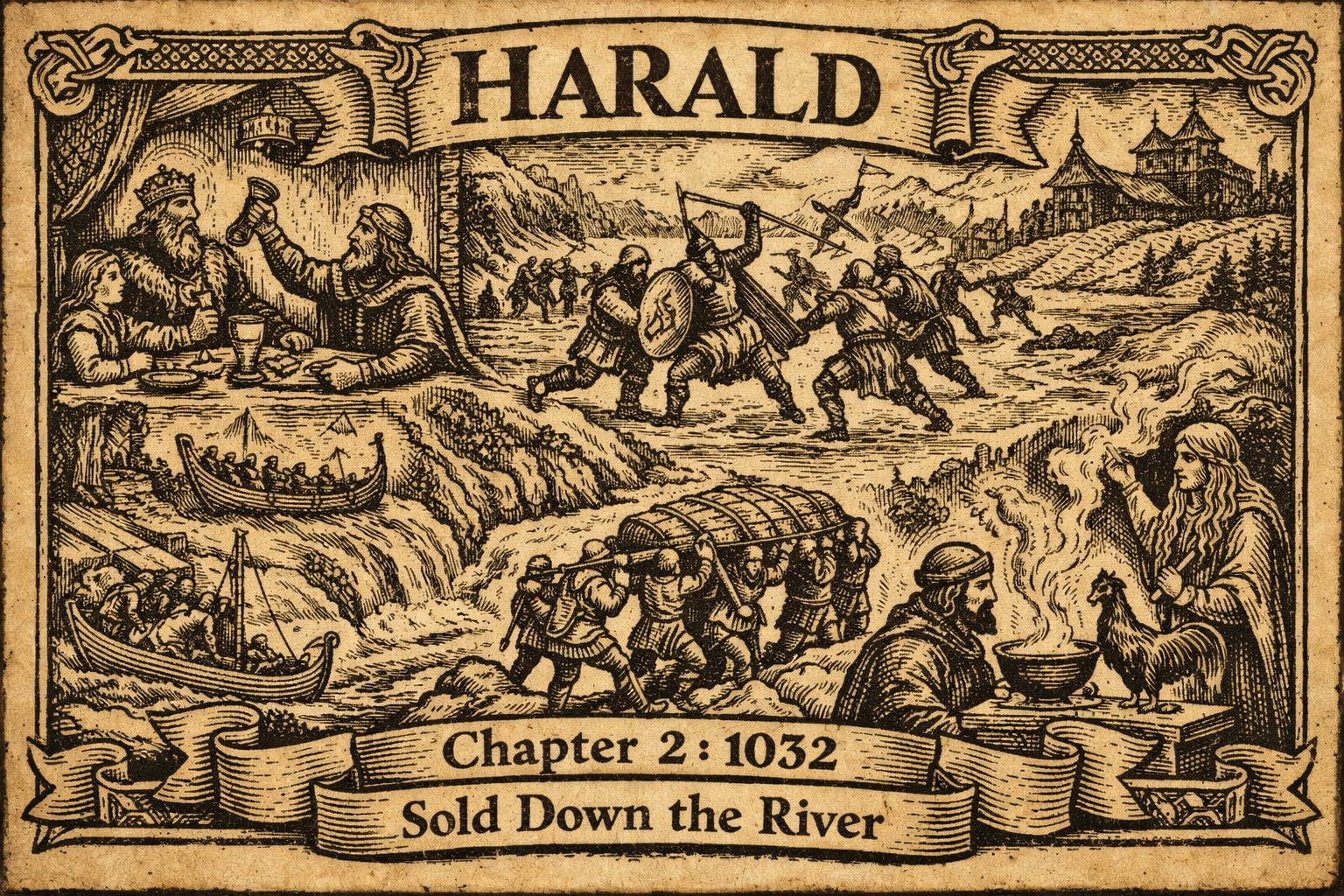
It is a long trip. Yaroslav pointed us down river and said “yeah, it’s around a few bends but just keep going with the current – you can’t miss it”. Like I said, master bullshitter. Endless cycles of paddle-rapids-portage, paddle-rapids-portage, rinse and repeat and get up and do it again.
De Administrando Imperio
And first they come to the first barrage, called Essoupi, which means in Russian and Slavonic “Do not sleep!”; the barrage itself is as narrow as the width of the Polo-ground; in the middle of it are rooted high rocks, which stand out like islands. Against these, then, comes the water and wells up and dashes down over the other side, with a mighty and terrific din. Therefore the Russians do not venture to pass between them, but put in to the bank hard by, disembarking the men on to dry land leaving the rest of the goods on board the monoxyla; they then strip and, feeling with their feet to avoid striking on a rock. This they do, some at the prow, some amidships, while others again, in the stern, punt with poles; and with all this careful procedure they pass this first barrage, edging round under the river-bank.
Harald
Turns out that the blisters you get paddling the river are totally different from the blisters you get rowing the sea; stroking uselessly trying to keep your nose pointed where you want to go while not flipping over; swimming after your log as it merrily floats downstream when you inevitably do tip into the drink; and if you think that log is hard to move in the water try schlepping it on your shoulders with twenty other guys walking across muddy trails and curving through steep bluffs.
De Administrando Imperio
It is at this point, therefore, that the Pechenegs come down and attack the Russians.
Harald
Because of course it is. They know where the rapids are. They know where to hide. They know that you are struggling under your log and have left all your weapons behind at the pull-out point. Total bloodbath, we had no chance. I ran for my life, ripped through the reeds, dove into the river, swam underwater as far as I could, and didn’t look back until I reached the other side.
De Administrando Imperio
After traversing this place, they reach the island called St. Gregory, on which island they perform their sacrifices because a gigantic ash-tree stands there; and they sacrifice live cocks. Arrows, too, they peg in round about, and others bread and meat, or something of whatever each may have, as is their custom. They also throw lots regarding the cocks, whether to slaughter them, or to eat them as well, or to leave them alive.
Harald
And that was where I ran into our old friend Svyatopolk. I can’t say it wasn’t awkward at first. The last time he had seen me I was hacking down his guys and shoving them out onto the cracking ice of a semi-frozen lake. But hey, we’re all Vikings, we can let bygones be bygones, and anything can be settled with gold. The fact that I had no gold was a little bit of a problem, but he decided I might be able to pay it off in kind, and next thing you know I’m partying with my new crew on day two of a three day bender. Svyatopolk had a motley crew: Swedes, Slavs, steppe trash, an emissary from the Khazars who could interpret, and a wizened Arab with paper and a writing pen who call himself Ibn-Fadlan.
Ibn-Fadlan
I have never seen bodies more perfect than theirs. They were like palm trees. They are fair and ruddy. They wear neither coats [qurtāq] nor caftans, but a garment which covers one side of the body and leaves one hand free. Each of them carries an axe, a sword and a knife and is never parted from any of the arms we have mentioned. Their swords are broad bladed and grooved like the Frankish ones. From the tips of his toes to his neck, each man is tattooed in dark green with designs, and so forth.
Interpreter
He says you are tall and straight like palm trees.
Harald
(smirks)
Ibn-Fadlan
Every day without fail they wash their faces and their heads with the dirtiest and filthiest water there could be. A young serving girl comes every morning with breakfast and with it a great basin of water. She proffers it to her master, who washes his hands and face in it, as well as his hair. He washes and disentangles his hair, using a comb, there in the basin, then he blows his nose and spits and does every filthy thing imaginable in the water. When he has finished, the servant carries the bowl to the man next to him. She goes on passing the basin round from one to another until she has taken it to all the men in the house in turn. And each of them blows his nose and spits and washes his face and hair in this basin. They are the filthiest of God’s creatures. They do not clean themselves after urinating or defecating, nor do they wash after having sex. They do not wash their hands after meals. They are like wandering asses.
Interpreter
He also says you guys are gross.
Harald
(shrugs)
Ibn-Fadlan
There are beautiful slave girls, for sale to the merchants. Each of the men has sex with his slave, while his companions look on. Sometimes a whole group of them gather together in this way, in full view of one another. If a merchant enters at this moment to buy a young slave girl from one of the men and finds him having sex with her, the man does not get up off her until he has satisfied himself.
Interpreter
He does not want to buy a slave girl.
Harald
Voluspa is not for sale.
Ibn-Fadlan
They brought in a dog, which they cut in two and threw into the boat. Next they took two horses and made them run until they were in lather, before hacking them to pieces with swords and throwing their flesh on to the boat. Then they brought two cows, which they also cut into pieces and threw them on to the boat. Finally they brought a cock and a hen, killed them and threw them on to the boat as well.
Harald
In a clearing on the island of Khortytsia, underneath an ash tree, we sacrificed to Odin. The arrows and pegs were spread, the fire was burning, dogs, a live cock, horses, cows were ritually slaughtered, swords swinging, blood spurting, and fire spitting into the glory of the all-father’s sky.
Poetic Edda
Harald
I provoked Svyatopolk and slew him in single combat. I set aside one boat for his funeral and the rest of the boats and the crew were mine. Religious trances, blood axes, and alcohol don’t mix without violence; when you get a bunch of Vikings together, things are going to happen. By the time we were done with the island, we had a few corpses to dispose of, including Svyatopolk. Burn the evidence and move on. Of course, Ibn-Fadlan had questions.
Ibn-Fadlan
What did he say?
Interpreter
You Arabs are fools!
Ibn-Fadlan
Why is that?
Interpreter
Because you put the men you love most, and the most noble among you, into the earth, and the earth and the worms and insects eat them. But we burn them in the fire in an instant, so that at once and without delay they enter Paradise.
Harald
(laughing) His Lord, for love of him, has sent a wind that will bear him hence within the hour.
Interpreter
Insha'Allah
Ibn-Fadlan
Next, at the place where this boat had been drawn out of the river, they build something like a round hill and in the middle they set up a great post of khadank wood, inscribed with the name of the man and that of the king of the Rūs. Then they departed.
Harald
We built a burial mound and remembered the fallen. I bid farewell to Ibn-Fadlan and gathered the crew. We packed up the boats and headed back down the river.