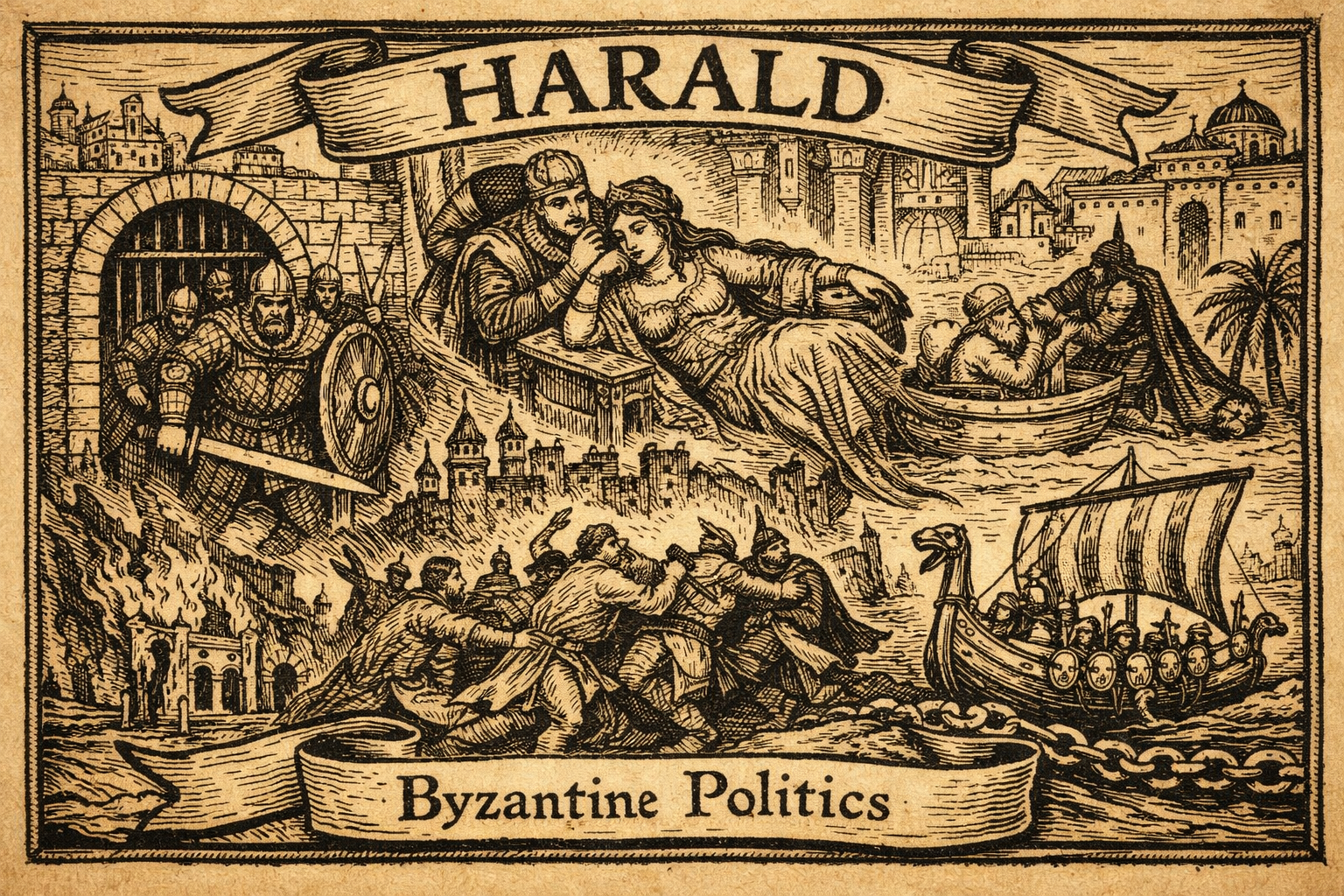
Harald
Zoe complained about her husband constantly.
Chronographia
As for the empress, two things more than any other vexed her: the fact that Romanus did not love her, and that she herself was unable to squander money. The treasure-chambers were closed to her, sealed by the emperor’s orders, and she was compelled to live on a fixed allowance. Not unnaturally, she was furious with him and with the counsellors whose advice he followed in the matter.
Harald
That’s where Michael came in.
Chronographia
This eunuch had a brother, a mere youth before Romanus became emperor, but now in his early manhood. He was a finely-proportioned young man, with the fair bloom of youth in his face, as fresh as a flower, clear-eyed, and in very truth “red-cheeked’. This youth was led by his brother into the emperor’s presence when he was seated with Zoe that they might see him, at the express command of Romanus. When the two men came in, the emperor, casting him one glance and asking a few brief questions, bade him retire, but stay on in the court. The effect of the interview on Zoe was quite different. Her eyes burning with a fire as dazzling as the young man’s beauty, she at once fell victim to his charm, and from some mystic union between them she conceived a love for him. But most people knew nothing of that at the time.
Harald
Michael, John’s brother. John pimped out his own brother.
Chronographia
Zoe could neither regard the young man with philosophic detachment, nor control her desires. Consequently, though in the past she had more than once shown her dislike for the eunuch, she now approached him frequently. Her conversations would begin with reference to some extraneous matter, and then, as if by way of digression, she would end with some remark about his brother. Let him be bold, she said, and visit her whenever he wished.
Harald
And he did. I brought him there. John made it clear that I was just the hired help.
Chronographia
I had a conversation with one of the gentlemen who regularly attended the imperial court at that time, a man well acquainted with the whole question of Zoe’s love-affairs, and one who supplied me with material for this history, and he told me that Romanus did wish, in a way, to be convinced that she was not Michael’s paramour. On the other hand, he knew she was greatly attracted to the opposite sex, on fire with passion, so to speak. So, to prevent her sharing her favours among many, he was not particularly disgusted at her association with one. Although he pretended not to see it, he allowed the empress to satisfy her desires to the full.
Harald
She was a lusty woman.
Harald
As a member of the Varangians, it was traditional that I guard the emperor’s bath. Sometimes Romanus would shower, but he also had a whole swimming pool, and he liked to splash around and float there.
Chronographia
Whether the loving couple themselves and their accomplices committed a very horrible crime against Romanus, I would not say with any certainty, because it is no easy thing for me to bring accusations in matters that I still do not thoroughly understand.
Harald
I do understand.
Chronographia
Romanus got up in a perfectly normal way to anoint and bathe himself and take his aperitives. So he entered the bath. First he washed his head, then drenched his body as well, and as he was breathing strongly, he proceeded to the swimming bath, which had been deepened in the middle. To begin with, he enjoyed himself swimming on the surface and floating lightly, blowing out and refreshing himself with the greatest of pleasure.
Later on, some of his retinue came in to support him and give him a rest, according to his own orders.
Harald
Guess who let them in?
Chronographia
Whether they made an attempt on the emperor’s life after they entered the bath I cannot say with any conviction. At any rate, those who see some connection between these events and the rest of their version, say that when Romanus plunged his head under the water— his usual custom— they all pressed his neck and held him down for some considerable time, after which they let him go and went away.
Harald
I was outside the door when John came out of the bath, soaking wet.
He said:
The emperor is dead.
I said:
Long live the emperor.
He said:
For your loyalty, take whatever you like from the dead emperor’s chambers.
Heimskringla
Harald had been three times in the poluta-svarf while he was in Constantinople. It is the custom, namely, there, that every time one of the Greek emperors dies, the Varings are allowed poluta-svarf; that is, they may go through all the emperor's palaces where his treasures are and each may take and keep what he can lay hold of while he is going through them.
Chronographia
The funeral ceremony for the defunct emperor, who had been laid out on a magnificent bier, was already prepared, and the whole assembly went out to pay their respects to their dead emperor in the usual fashion. One of those who preceded this bier was John the Eunuch. I saw this funeral procession myself. I had not yet grown a beard and only recently had I applied myself to the study of the poets. Examining the dead man, I did not really recognize him, either from his colour or outward appearance. It was only because of the insignia that I guessed the dead man had once been emperor. His face was completely altered, not wasted away, but swollen, and its colour was altogether changed.
Harald
Zoe gets to go shopping and to amuse herself with her new boy toy; John gets to be the power behind the throne and play his simple minded brother like a puppet master; Michael gets to spend lots of quality time wearing a silly looking crown and presiding over religious ceremonies and diplomatic dinners; everyone lives happily ever after.
John thought he had the perfect plan, but he didn’t understand who he was dealing with. The next step was to get rid of the evidence. John had to go.
Chronographia
The emperor agreed that the plan was a good one, and when they informed Zoe of the scheme, they found it a very simple matter to convince her. So at once they proceeded to put it into practice. An announcement was made about the public ceremony, and all the dignitaries were gathered together in the church at Blachernae.
Accordingly John set sail. The emperor, meanwhile, watched the sea from a high vantage-point in the palace, and when the ship carrying his uncle was about to anchor in the Great Harbour, he gave a signal from above to the sailors, as they were putting in, to turn about. Actually, this signal had been arranged beforehand. A second trireme, ready to put to sea and in the wake of the first, then hailed John’s ship, took him on board, and carried him off to a distant place of exile.
Harald
That was my ship. In the end I blinded him and imprisoned him in the Monobatae monastery.
Chronographia
The Guardian of the Orphans was banished to the monastery of Monobatae. John was blinded in prison on the orders of Michael Cerularius the Patriarch who never forgave him for his own imprisonment during the reign of Michael IV. The date was 1043.
Harald
The steps of power are slippery with blood, and once the trust is broken and you start turning on each other it is hard to stop. Theodora becomes a problem, exile her to a nunnery. Michael becomes a problem, bring in a new Michael. They thought their plans were foolproof. They didn’t account for the factions and the Greens and the Blues and the fury that can transform a capital city into a raging mob.
Chronographia
As I have said, the people revolted against the tyrant, but they were afraid their efforts might be wasted. His force might get the better of them and the affair might develop into nothing more than an uproar. Since, therefore, they could not lay hands on the senior empress — the tyrant had anticipated that move and he was watching her with all the vigilance of a tax-gatherer waiting to collect dues from a ship in harbour — they turned their attention to her sister. She was, after all, the second child of an emperor
The guard commander was one of the nobles and I myself accompanied him (I was a personal friend of the man). Actually, he had invited me to advise him and help in the carrying out of his orders. On our arrival at the doors of the church, we saw another guard, composed of volunteers, a company of citizens who had completely surrounded the sacred building. They were ready to do everything but tear it down. So it was not without difficulty that we made our way into the church. Along with us a great multitude of folk poured in, roaring abuse at the accursed fellow. All manner of indecent epithets were hurled at him.
Up till then I too had gone along with the mob with no particularly moderate feelings about him. I was not indifferent to his treatment of the empress, and a certain mild resentment against the man stirred me on my own account. But when I reached the sacred altar where he was, and saw both the refugees, one, who had been an emperor, clinging to the actual Holy Table of the Word, the other, the Nobilissimus, standing on the right of the altar, both with their clothes changed, their spirit gone and utterly put to shame, then there was no trace whatever of anger left in my heart. I stood there dumbfounded, mute with astonishment, as though I had been struck by a hurricane. I was transformed at the strangeness of the thing. Then, recovering my spirits, I began to curse this life of ours, in which these strange and terrible things so often come to pass, and as if some spring had welled up within me, a flood of tears beyond control poured from my eyes. This outburst finally gave way to groans.
Now the mob that had entered the church gathered in a circle round the two men, like wild beasts longing to devour them, while I was standing by the latticed gate on the right of the altar, lamenting.
Harald
I was in the mob. We dragged them out of the holy sepulcher and into the street.
Chronographia
The Nobilissimus quietly looked round for the man to whom the miserable job had been entrusted. “You there,’ he said, “please make the people stand back. Then you will see how bravely I bear my calamity!’ When the executioner tried to tie him down, to prevent him moving at the moment of blinding, he said, “Look you. If you see me budge, nail me down!’ With these words he lay flat on his back on the ground. There was no change of colour in his face, no crying out, no groaning. It was hard to believe the man was still alive. His eyes were then gouged, one after the other. Meanwhile the emperor, seeing in the other’s suffering the fate that was about to overtake him too, lived through Constantine’s anguish in himself, beating his hands together, smiting his face and bellowing in agony.
The Nobilissimus, his eyes gouged out, stood up from the ground and leaned for support on one of his most intimate friends. He addressed those who came up to him with great courage — a man who rose superior to the trials that beset him, to whom death was as nothing. With Michael it was different, for when the executioner saw him flinch away and lowering himself to base entreaty he bound him securely. He held him down with considerable force, to stop the violent twitching when he was undergoing his punishment. After his eyes, too, had been blinded, the insolence of the mob, so marked before, died away, and with it their fury against these men.
Heimskringla
In these two drápas in honor of Harald, and in many other poems about him, it is mentioned that Harald put out the eyes of the very emperor of the Greeks. They might have named a duke or count or some other man of princely rank as having done it if they knew that to be more true. But Harald himself told this story, as did the other men who were with him there.
Harald
It was time to leave Byzantium. I’d fucked the empress, blinded the emperor; if I stayed there weren’t many realistic scenarios where I would be able to follow the example of Zoe’s father and die in my own bed.
Heimskringla
Harald felt the desire to return to the North and his own ancestral possessions. He had learned that Magnús, the son of Óláf, had become king of Norway and also of Denmark. So he gave up service for the Greek king. But when Queen Zóë learned of this she became enraged and accused him of having misappropriated the property of the Greek king which Harald had acquired on these expeditions when chieftain over his army.
Harald
Zoe, of course, had other ideas.
Heimskringla
Máría was the name of a beautiful young maiden. She was the daughter of Queen Zóë’s brother. Harald had asked for the hand of this maiden, but the queen had forbidden it. According to Varangians who had served as soldiers in Miklagarth and returned to Iceland, it was said by well-informed men there that Queen Zóë herself wished to marry Harald and that this was the chief reason for her accusation of Harald when he desired to leave Miklagarth, though the people were given another reason. At that time Konstantínus Mónomákús1 was the king of the Greeks. He ruled together with Queen Zóë. For the reasons alleged, the king of Greece had Harald taken prisoner and put into a dungeon.
But when Harald approached the prison, Holy King Óláf appeared to him, saying that he would succor him. On the street there a chapel was built later and consecrated to King Óláf, and that chapel has stood there ever since. The prison was made in such fashion that it was a high tower, open above, with a door leading into it from the street. Harald was locked in there, and with him, Halldór and Úlf.
In the following night a certain lady of high degree came to the top of the prison, having climbed the tower with ladders, together with two servants of hers. They let down a rope into the dungeon and pulled them up by it. This woman, Holy King Óláf had healed, and he had appeared to her and told her that she should free his brother from prison. Then Harald at once went to the Varangians, and they all arose and bade him welcome.
Harald
They were my guys. Vikings stick together.
Heimskringla
The same night King Harald and his men went down to where the galleys of the Varings lay, took two of them and rowed out into Sjavid sound. When they came to the place where the iron chain is drawn across the sound, Harald told his men to stretch out at their oars in both galleys; but the men who were not rowing to run all to the stern of the galley, each with his luggage in his hand. The galleys thus ran up and lay on the iron chain. As soon as they stood fast on it, and would advance no farther, Harald ordered all the men to run forward into the bow. Then the galley, in which Harald was, balanced forwards and swung down over the chain; but the other, which remained fast athwart the chain, split in two, by which many men were lost; but some were taken up out of the sound. Thus Harald escaped out of Constantinople and sailed thence into the Black Sea.