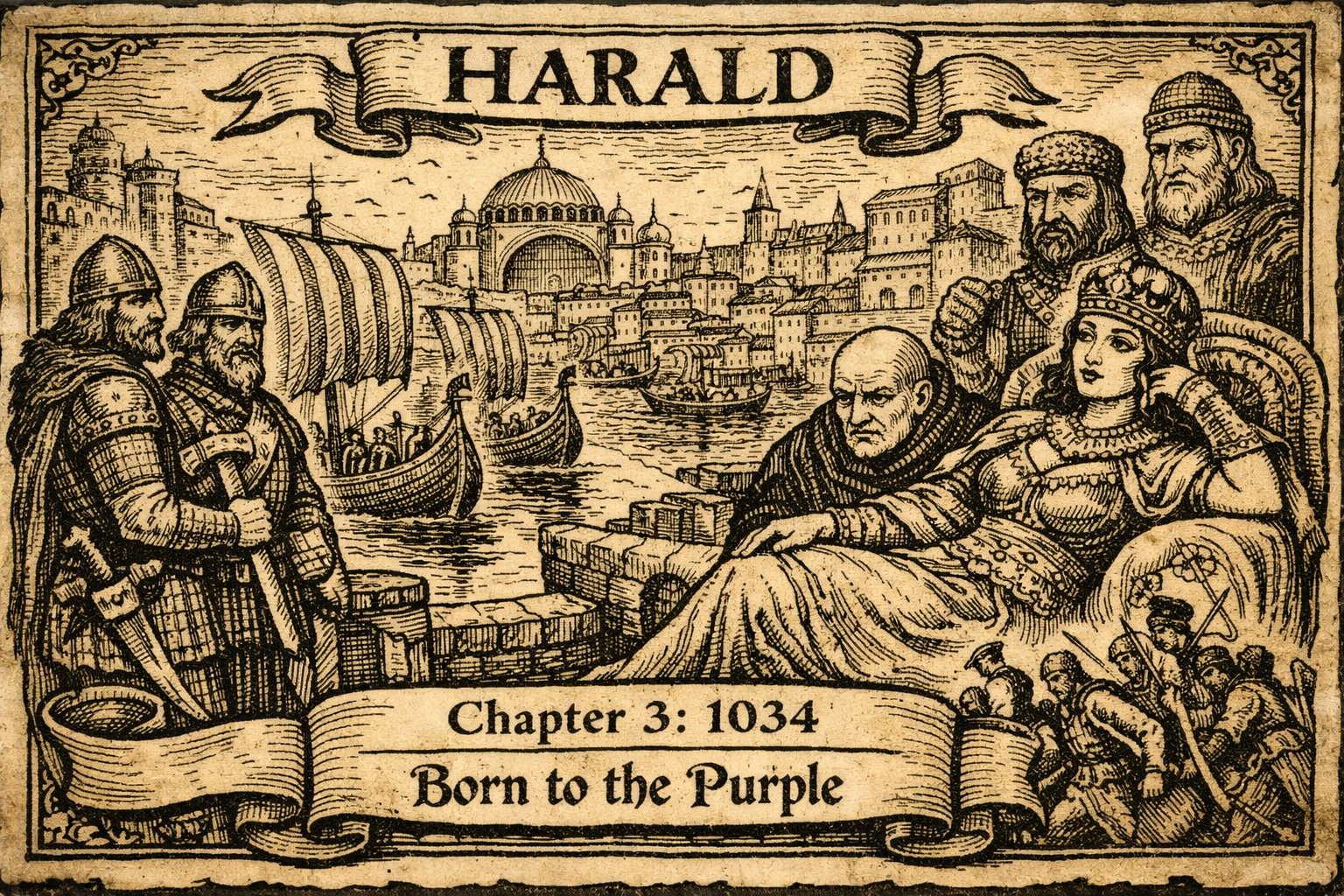
De Administrando Imperio
From this island onwards the Russians do not fear the Pecheneg until they reach the river Selinas. So then they start off thence and sail for four days, until they reach the lake which forms the mouth of the river, on which is the island of St. Aitherios. Arrived at this island, they rest themselves there for two or three days. And they re-equip their monoxyla with such tackle as is needed, sails and masts and rudders, which they bring with them. Since this lake is the mouth of this river, as has been said, and carries on down to the sea, and the island of St. Aitherios lies on the sea, they come thence to the Dniester river, and having got safely there they rest again.
But when the weather is propitious, they put to sea and come to the river called Aspros, and after resting there too in like manner, they again set out and come to the Selinas, to the so-called branch of the Danube river. And until they are past the river Selinas, the Pechenegs keep pace with them. And if it happens that the sea casts a monoxylon on shore, they all put in to land, in order to present a united opposition to the Pechenegs. But after the Selinas they fear nobody, but, entering the territory of Bulgaria, they come to the mouth of the Danube. From the Danube they proceed to the Konopas, and from the Konopas to Constantia, and from Constantia to the river of Varna, and from Varna they come to the river Ditzina, all of which are Bulgarian territory. From the Ditzina they reach the district of Mesembria, and there at last their voyage, fraught with such travail and terror, such difficulty and danger, is at an end.
Heimskringla
Harald
Three weeks hugging the coast of the Euxine sea, sailing and rowing and rowing some more, did not prepare me for the sight of the Hagia Sofia as we entered the Bosphorus. The harbor quays were two and three ships deep, our raggedy ass trader pulled up with fine hempen rope. Out on the street, dressed in rags, wearing my wealth in two gold arm rings, the future opening up in front of me like John Travolta heading into the city in Saturday Night Fever. This was the big time.
Laxdoela Saga
They were all comely men, but Bolli was in a class by himself. He wore a suit of silk brocade given to him by the emperor of Byzantium, with a cloak of red scarlet outermost. About his waist he had girded the sword Leg-biter, now inlaid with gold at the top and shank, and gold bands wound about its hilt. On his head he wore a gilded helmet and he held a red shield at his side with the figure of a knight drawn on it in gold. He had a lance in his hand, as is common in foreign parts. Wherever the group stopped for the night, the women could do nothing but gaze at Bolli and the finery which he and his companions bore.
Harald
Bolli was the first guy I met when I got to Byzantium. A sharp dresser and leader of the Varangian Guard.
Alexiad
The Varangians, who carried their axes on their shoulders, regarded their loyalty to the Emperors and their protection of the imperial persons as a pledge and ancestral tradition, handed down from father to son, which they keep inviolate and will certainly not listen to even the slightest word about treachery.
Heimskringla
At that time there ruled over the Greek Empire Queen Zóë the Powerful together with Michael Kátalactús. And when Harald arrived in Byzantium and had had a meeting with the queen he took military service with her and right away. Harald had joined the expedition but a short time before the Varangians became greatly attached to him, so they all fought together in battles. And at last Harald became the leader of all Varangians.
Harald
They took me to the empress so I could swear the oath. Zoë Porphyrogenita – born to the purple.
Chronographia
Her eyes were large, set wide apart, with imposing eyebrows. Her nose was inclined to be aquiline, without being altogether so. She had golden hair, and her whole body was radiant with the whiteness of her skin. There were few signs of age in her appearance: in fact, if you marked well the perfect harmony of her limbs, not knowing who she was, you would have said that here was a young woman, for no part of her skin was wrinkled, but all smooth and taut, and no furrows anywhere.
Harald
Empress Zoe. Fifty years old, didn’t look a day over forty-five. With my Varangian friends, and before her God, I pledged to protect her life and to obey her commands. I didn’t understand what I was getting myself into, but I was optimistic. It felt right and I liked the way she looked at me.
Immediately after my audience a guy named Julius pulled me into a side room. My Greek wasn’t too good then, so Bolli came along as a translator.
Julius
This guy?
Bolli
He says the empress likes you.
Harald
Smirks
Julius
He’s a barbarian!
Bolli
He says you need a better wardrobe.
Harald
Shrugs
Julius
There are some things you need to understand about Zoe. Porphyrogenita. Born to the purple. Her father was the emperor, Constantine VIII.
Bolli
Her father was emperor.
Julius
Constantine VIII liked carousing with his cronies, cavorting with his concubines, watching obscene performances in his private theatre and avoiding whenever possible the affairs of state.
He had no sons; of his three daughters, the eldest had long been a nun. The second, Zoe, since her thwarted marriage, had spent twenty-six years in the imperial gynaeceum, in the company of her more intelligent but less attractive sister Theodora, whom she detested. Theodora had now become distinctly spinsterish, but Zoe, through now approaching fifty, still dreamed voluptuously of the marriage that she had never had and longed for liberation. This must, she knew, come sooner or later, for she was her father’s heir, and it was through her that the crown could be transmitted to her husband.
Bolli
She has some daddy issues.
Julius
When Constantine VIII was dying, the bureaucracy proposed a sexagenarian senator and aristocrat named Romanus Argryus. As it happened, he was already happily married, but Constantine’s mind was made up; either Romanos divorced his wife and married Zoe or he would be blinded. He agonized, but his wife did not hesitate. Cutting off her hair, she immediately entered a convent. On 10 November Romanos married Zoe in the imperial chapel of the palace, on the 11th he stood as his new father-in-law’s bedside as he breathed his last; and on the 12th he found himself Romanus III, seated beside his beaming wife on the imperial throne. His next duty, despite his wife’s advanced age, was to found a dynasty. To increase his chances, he made himself easy game for all the charlatans in Constantinople, swallowing their aphrodisiacs, applying their ointments and performing extraordinary exercises that would he was promised, restore him to the vigor of his youth. Zoe, meanwhile, did much the same in her determination, somehow, to conceive – though no one was much surprised when she failed to do so.
Bolli
She’s married.
Harald
Empress Zoe, liked to fuck and needed a son by any means necessary. Dangerous, no doubt: the trail of dead emperors and disappearing co-conspirators should have given me a hint, but I was just a kid from the sticks.
There were things she needed done, sexually, but there were also things she needed done around the town. At first I just had to show up and look threatening; as a seven foot tall Viking with a sharp axe on my shoulder that wasn’t too much of a stretch. Pretty soon I moved up to delivering letters, and as my Greek and my cunnilingus improved, I was tasked with delivering the threats contained in those letters and coming back with whatever had been requested. I was your basic street level enforcer; I had my battle-axe, I had the other guys in the Guard, I’m comfortable with violence, I was pretty good at it.
But when she turned me out to work for John the Orphanotrophos, the conniving eunuch who claimed to be the guardian of the orphans but was actually the hand behind the throne – that was my entrée to some next level shit.
Chronographia
It is my desire in this history to give a somewhat fuller description of John, without recourse to empty or lying statements. You see, when I was starting to grow a beard, I saw the man himself, and I heard him speak and witnessed his actions. I marked his disposition closely, and I am aware that although some of his deeds are praiseworthy, there are other things in his life which cannot meet with general approval. At that time there were many sides to his character. He had a ready wit, and if ever a man was shrewd, he was; the piercing glance of his eyes betrayed those qualities. He paid meticulous care to his duties; in fact, he went to extremes of industry in their performance. His experience in all branches of government was great, but it was in the administration of public finance that his wisdom and shrewdness were especially evident.
Harald
He was greedy for many things: wine, debauchery, money, information, secrets, knowledge, but above all power; access to power, influencing power, wielding power, holding power.
Chronographia
It has often been a cause of surprise to me, when I have sat with him at banquets, to observe how a man, a slave to drink and given to ribaldry, as he was, could bear the burden of Empire. In his cups he would carefully watch how each of his fellows behaved. Afterwards, as if he had caught them red-handed, he would submit them to questioning and examine what they had said and done in their drunken moments. They came to fear him more, therefore, when he was tipsy than when he was sober. Indeed, the fellow was an extraordinary mixture. For a long time he had garbed himself in a monkish habit, but not even in his dreams did he care one jot for the decent behaviour that befits such a dress. Yet he acted the part, if long-established custom demanded a certain ritual. As for those libertines who indulged unrestrainedly in sensual pleasures, John had nothing but scorn for them. On the other hand, if a man chose to live in a decent way, or pass his time in the free exercise of virtue, or profit his mind with scientific studies, he would find in John an implacable foe. The eunuch would wilfully misrepresent the other’s worthy ambitions in some way or other. This paradoxical conduct in his dealings with other men was not repeated when he had to do with the emperor, for with him he preserved one and the same attitude, never varying, never changing. In his presence there was no dissimulation at any time.