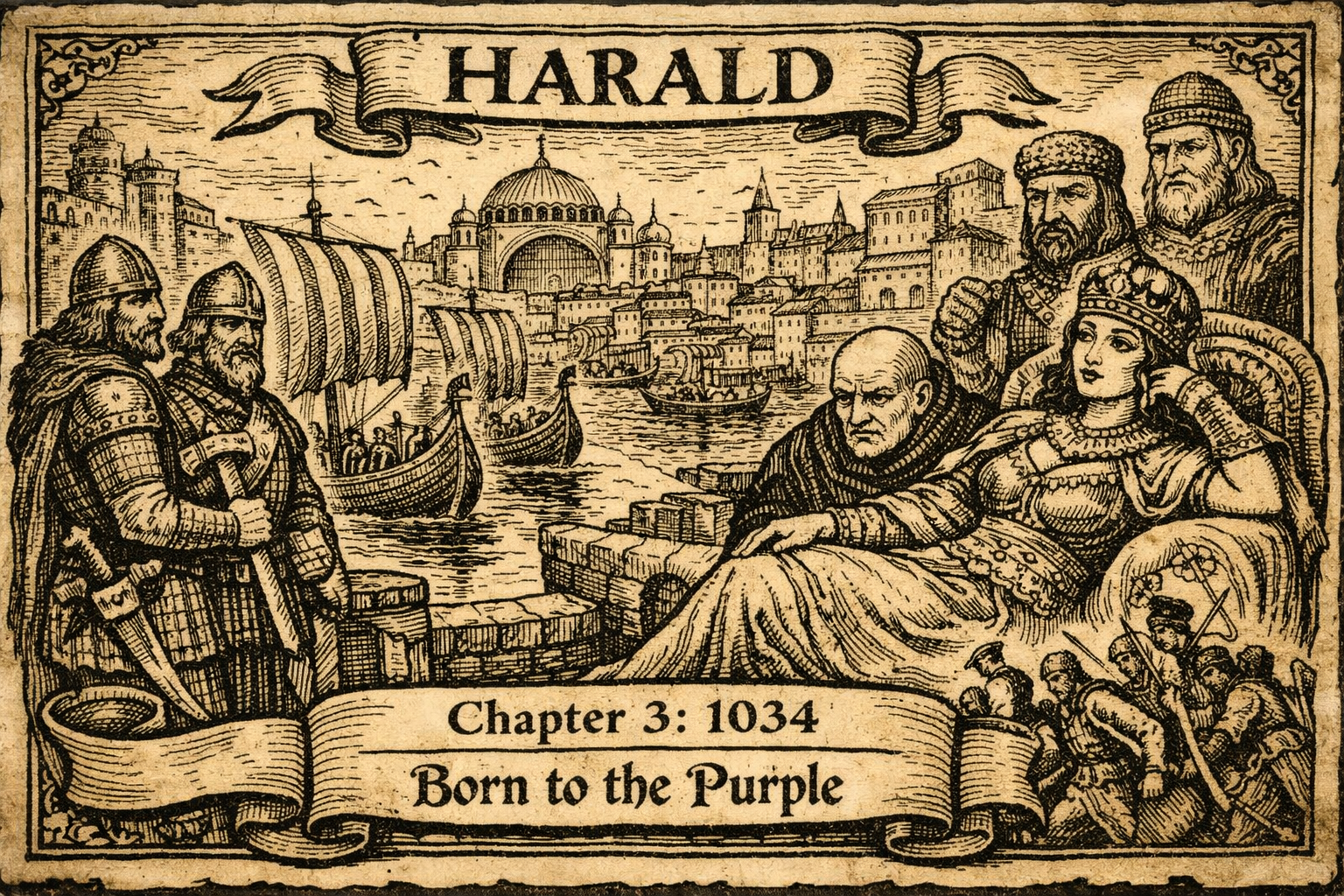
Golden Byzantium
The river journey ended where fresh water surrendered to salt. Beyond the low marshes and reed-beds at the Dnieper mouth, the wind tasted different—less of mud and willow, more of iron and brine. The men had grown used to the river’s long patience: the pull of current, the measured hazards of rapids, the slow barter at every landing. The sea was impatient. It took the oar-blade harder and threw spray over the gunwales as if to remind them that beyond the river’s law lay another.
Harald Sigurdsson stood at the prow as their hull lifted and fell on unfamiliar swells. Around them moved ships of many kinds, some broad and heavy as barns, some sleek as knives. Their own craft—patched from river travel, stained with pitch and river weed—looked suddenly poor among vessels that carried painted prows and high sterns, and whose rigging seemed a forest of ropes. Bolli Bollason, who had walked the streets of Miklagarðr before, watched the horizon without wonder. The others watched like men approaching a judgment.
The city appeared first as a line that did not belong to nature: walls on the horizon, pale in the sun, hard-edged where cliff and cloud were soft. Then the walls grew into towers and gates, and then into a living boundary: a seaward face crowded with quays, cranes, and masts; a landward rampart that ran like a stone river across the neck of the world. The Golden Horn lay to one side, a deep bite of water filled with ships riding at anchor in orderly ranks, as if the sea itself had been turned into a stable. A chain lay along the mouth of the harbor—coiled now, but present as a threat, each link thicker than a man’s forearm. The men spoke of it in low voices; Bolli told them it could be drawn taut, and then no hostile ship would enter or leave.1
As they approached, the air thickened with new smells: resinous smoke from pitch pots, sour fish from baskets, spiced oil from amphorae, and the sweet rot of refuse that a great city cannot wholly hide. Voices carried across the water—Greek, Slavonic, tongues Harald could not name. On the quays, officials in dark cloaks stood beside soldiers whose bronze and steel caught the sun. The harbor did not welcome; it evaluated. Ships were counted; cargo was recorded; men were sized up as if they were goods.
They came in under escort, for no ship entered unmarked. Greek officers shouted from a small boat that paced them, and scribes on the quay held wax tablets and styluses ready. Bolli answered the questions with practiced calm. He named their origin, their intent, their willingness to swear the oaths. Harald understood little of the words, but he understood the shape of the exchange: the empire demanded clarity, and in return offered passage into its belly.
A dromon slid by, low and long, its oars dipping in perfect time. Its prow rose like a beak, and the men on its deck moved with discipline unlike the casual swagger of northern crews. Harald watched the ship’s stern as it passed—how its rudder was managed, how the deck was laid, how its fittings were made for war and not for trade. A kingdom of craftsmen, he thought. A kingdom of scribes. The axe could still bite here, but it would be made to bite in the empire’s service, on the empire’s command.
When their feet finally met stone, it felt like stepping into a different measure of life. The quays were paved. Warehouses rose in stacked stories. Goods moved under cover, not in the open. Coins rang constantly; orders were given and obeyed; guards watched the whole as if it were a single household. Harald had seen rich courts, but this was not merely rich. This was arranged.
They were led along streets that climbed and curved between buildings of brick and marble. Above, domes rose like upturned bowls; in courtyards, fountains splashed. Statues of emperors stared down with stone eyes. Harald’s men gaped, and some crossed themselves in the way they had learned in Rus’. Others spat, as if to ward off sorcery. Harald did neither. He set his face as if he belonged here, and let the city do its work upon him.
The Varangian Guard
If the harbor was the city’s mouth, the palace was its heart—guarded, layered, and difficult to reach. They were taken first to quarters assigned to foreigners: clean stone rooms, straw laid fresh, water brought in jars, bread issued without bargaining. It was a kindness that felt like a tether. In the morning they were marched to the Great Palace, past the Hippodrome where the factions of the city gathered like storms, and into courtyards where mosaics glittered underfoot.
Harald had fought in mud and snow. Here the ground itself was precious. The walls were faced with colored stone; arches carried painted saints; lamps burned even in daylight. The empire showed its wealth not as a boast but as a condition of life, the way the north shows winter.
At the inner gates stood men who were not Greeks. Harald recognized them by their height and their stillness. They were fair-haired and red-haired, thick-shouldered, their beards braided or forked, their eyes forward. Each held an axe taller than himself, with a blade crescent-wide and bright as if freshly sharpened. They wore mail like northern men, but over it some had tunics of rich cloth, and their belts bore buckles worked in patterns unfamiliar in the north. They did not speak. They did not need to. Their silence said: we are here to kill, and we will not be distracted.2
Bolli Bollason stepped among them as if stepping back into kin. There was respect in the way the axe-men shifted to make room. Bolli had the look of one who had learned new customs without losing the old: gold at his throat, a cloak pinned with a brooch that would buy a farm in Norway, and hands that still bore the thickened scars of weapons. He spoke with the officers in Greek, then turned and spoke in the tongue of the north to Harald and his band. “Here,” he said, “men become more than they were—if they do not die first.”
A man named Julius—Greek, smooth-faced, with eyes that weighed rather than watched—received them. He asked for names and deeds. Harald named Stiklestad, named the long river, named battle on ice and ambush at portage. The translator carried his words across, flattening them into Greek. Julius listened as if to a merchant reading a list of cargo.
Then came the test, not of strength alone but of control. A rope was hung, weighted to swing. Harald was given an axe whose haft felt different from northern ash—denser, perhaps, or simply better seasoned. The rope swayed. Harald waited for the right moment and cut through it in one stroke, the blade biting clean. The rope fell. The axe did not wobble in his hands. He did not grin. He did not shout. He let the deed speak.3
Julius nodded once, as if acknowledging the settling of an account. Oaths were brought. The words were Greek, but their meaning was the same as any oath sworn on iron: loyalty bound by death. Harald laid his hand on the book they offered—gilt, heavy, smelling of incense and vellum—and spoke as he was instructed. He did not feel the god of the Christians at his shoulder, but he felt the weight of the empire. The oath did not ask him to believe; it asked him to obey.
That night, coin was issued—gold that caught lamplight like a captured sun. Bread came warm, and meat salted and thick. Wine was measured out. A clerk recorded everything: who received what, who owed what, who was now inside the imperial household. Bolli explained the rules in blunt northern terms. The Guard stood nearest the emperor. The Guard did not join faction fights. The Guard took orders, and the empire took notice. Betrayal was punished without ceremony. Loyalty was rewarded, sometimes without warning.
Harald lay awake on straw that did not smell of farm animals. Beyond the shutters, the city murmured like a sea made of voices. He thought of the north’s open spaces and of the way a man could be lost there. Here a man was never lost. Here he was always seen.
Empress Zoe
Harald learned quickly that Byzantium had many rulers and only one throne. The emperor sat in public ceremonies like a figure carved from wood, crowned and robed, while others moved around him like hands around a tool. Eunuchs carried messages. Priests blessed decisions already made. Generals bowed, then went away to count soldiers. The palace was a machine built of people, and it ran on secrecy.
Among these hidden forces, the name that returned most often was Zoe. She was porphyrogenita—born in the purple chamber itself, daughter of Constantine VIII, and sister to an emperor who had left no sons. Her blood gave her a kind of authority that office could not easily erase. Men who would shout at generals lowered their voices when her name was spoken. Courtiers spoke of her marriages as if reciting the turns of a storm: husbands made and unmade, alliances sharpened and broken. In that recounting was both admiration and fear.4
Harald saw her first in procession. The palace gates opened, and the city’s air changed, as if people inhaled and held it. A litter came forward, borne by servants whose faces showed strain. The litter was draped in cloth that glittered with woven gold. Inside sat a woman dressed like an altar: jewels at throat and wrist, earrings heavy as small knives, hair arranged with care that suggested ritual. Her eyes were dark and steady. She did not look away when she met Harald’s gaze.
Bolli murmured at his side, naming her lineage, naming her father, naming the purple itself. Harald understood the phrase “born in the purple” as a kind of sorcery. In Norway a man was born in smoke and snow and blood, and kingship was won by spear and luck. Here kingship was a birthright guarded by walls and priests, and yet still contested by men with knives.
The summons came days later, carried not by a herald but by a palace attendant who spoke as if reciting an instruction from a ledger. Harald was to stand duty at a private audience—close enough to kill, close enough to be killed. He was issued fresh clothing: a tunic of good wool, a cloak, a belt whose buckle bore the imperial mark. They were not gifts. They were uniform. The empire dressed what it owned.
In a chamber lit by oil lamps and hung with silks, Zoe waited with a small court—two women, a priest, an official whose face was a mask. She questioned Harald through a translator, but she watched him directly as if she could hear the north in his mouth. She asked his age, his homeland, the names of his dead. She asked whether he had served kings before. Harald answered plainly. He did not embroider his deeds. He let her imagine the rest.
At one point she rose and approached his axe. Her hand, jeweled and careful, touched the edge of the blade. It was a small gesture, but it carried a message: she was not afraid of steel, or she wished him to believe she was not. The blade did not cut her. She smiled once, and the smile was not kind.
When the audience ended, Harald was dismissed with no promise and no threat. Yet as he walked back through the corridors, he felt as if a hook had caught under his ribs. He had been seen by a power that did not need to speak loudly.
Consort and Enforcer
No law named what happened afterward. Byzantium did not always write its true business down. Yet within weeks, Harald’s duties shifted. He was placed closer to certain doors, assigned to escort certain messengers, sent to stand guard at hours when guard duty usually slept. He received gifts that were not issued by clerks: a ring of worked gold, a cloak lined in fur, a purse heavier than his regular pay. Other Varangians noticed and said little. They had seen such patterns before.
At night he was summoned again and again, and the path he walked through the palace grew familiar: the quiet corridors, the soft-footed servants, the rooms that smelled of incense and perfume. Zoe’s chambers were warm and bright, with hangings that muffled sound and lamps that turned skin to gold. She spoke to him more directly now, sometimes without translator, as if she enjoyed watching him struggle with her tongue. Harald had learned enough Greek to understand commands and praise, and that was all she required.
What passed between them was not a northern love-story of oaths and longships. It was closer to bargaining, but not in coin alone. Zoe drew him near because he was foreign and therefore usable. He drew near because she was a ladder: each favor meant coin, each coin meant distance from poverty, each distance meant the possibility of returning north as a man strong enough to seize a throne. Desire sharpened the exchange, made it dangerous, made it feel like fate.
By day, the empire reminded him what he was for. When bread ran short and the factions raged, stone flew and torches burned. Varangians were sent into the streets because Varangians did not hesitate. Harald marched with axe-men through lanes choked with shouting. They struck with hafts, not blades, until the crowd broke like surf against rock. Later, bodies were carried away, and the city pretended it had never trembled. The palace fed the people again and claimed mercy.5
Other tasks came in quieter forms. A courtier would be accused of treason, and Harald would be ordered to escort him “for questioning.” The man would weep, then stiffen, then walk with forced dignity. Below the palace there were rooms that swallowed sound. Harald did not ask what happened inside them. He was not paid to ask. He was paid to ensure that a man entered and did not leave unless commanded.
Harald learned the city’s underside: taverns where sailors from Egypt drank beside Rus’ traders, markets where silk was weighed like grain, alleys where knives flashed and then vanished. He learned the cost of everything. Here even water was bought, carried by men who made their living with shoulders and clay jars. Harald had thought wealth meant freedom. In Byzantium wealth meant deeper entanglement. The more gold he took, the more eyes followed him.
Still he endured, and he saved. He had learned in Rus’ to hide silver. Here he learned to hide gold. Some he buried in sealed pots beneath the floor. Some he placed with trusted merchants who ran between north and south. Some he turned into jewelry that could pass as ornament until it needed to become coin. He kept careful count, as if counting days of life.
In the quietest hours, he remembered the north—fields under frost, the smell of pine smoke, the taste of thin ale. He remembered that he was a king’s half-brother and a king’s survivor. He told himself that all this—Zoe, the palace, the bloodless violence of politics—was a road. Roads ended somewhere.
John the Orphanotrophos
If Zoe was flame, John the Orphanotrophos was smoke. He was not a warrior, not a priest, not a king, and yet his name carried in the palace like a whispered command. He had raised or managed imperial children—so people said—and from that office came his title. But titles in Byzantium were often masks. John’s true power lay in doors that opened for him and in ledgers that answered to his hand.
Harald first noticed him not in ceremony but in passing: a slender figure in dark robes moving through a corridor while others stepped aside. His face was smooth, his expression mild. He looked at Harald once with eyes that did not linger, and yet Harald felt weighed, as if a merchant had tested his quality with a thumb. Later Bolli identified him and spoke the name with care. “He keeps accounts,” Bolli said. “He keeps men.”
John spoke to Harald in a tone of courtesy, using an interpreter at first and then, when Harald’s Greek improved, choosing simpler words as if to flatter him. He praised discipline. He asked whether the Varangians were satisfied with their pay. He asked whether Harald missed the north. These were questions that sounded harmless. Harald answered as a soldier answers: briefly, politely, without complaint. Yet he sensed that each answer was placed somewhere in John’s mind like a coin in a box.
Rumor worked faster than messengers. In taverns near the palace, men said Zoe had too much influence. In corridors, men said the emperor’s household was divided. Some said John wished to curb Zoe’s spending. Some said he feared Zoe’s favorites. When Harald heard his own name in those murmurs, he felt the floor tilt slightly beneath his feet.
The first warning came as a search. Harald returned from duty to find his quarters disturbed: a chest lid left slightly ajar, clothing folded wrong, a pot moved from where it had been. Nothing was stolen. The message was not theft. It was inspection. The empire could enter his life at will.
After that he began to move as a hunted man moves: outward calm, inward calculation. He shifted his gold again, sending more away, keeping less close. He spoke less in public. He did not linger in taverns. He watched who watched him. He knew that Zoe’s favor could protect him only while it pleased her—and that John’s displeasure could ruin him even if Zoe smiled.
One evening he stood on a terrace where the palace overlooked the dark water. Ships lay at anchor, masts like black spears against the moon. The city’s lights trembled on the surface as if the sea itself carried lamps. Harald felt, with sudden clarity, that Byzantium was not a place a man could simply leave. It held men with chains made of gold, of obligation, of secrets.
He did not yet know which chain would tighten first—Zoe’s desire, John’s suspicion, the empire’s need for a scapegoat—but he knew the hinge had turned. He began, quietly, to plan his exit: routes, allies, bribes, the timing of a ship’s departure. In the north, a man fled into forest. Here a man fled through corridors.
Far below, in the harbor, a dromon shifted on its moorings and the water hissed along its hull. Harald watched until his eyes stung, then turned back toward the palace doors—toward the warm rooms, the whispering power, and the trap that still felt like privilege.
- On the defenses of Constantinople’s harbors and the imperial chain, see De Administrando Imperio. ↩
- On the Varangians’ role as foreign axe-bearing guards in imperial service, see Psellos, Chronographia. ↩
- On Harald’s entry into the emperor’s service and later fame in Byzantium, see Heimskringla (sagas of Harald Sigurdsson). ↩
- On Zoe as porphyrogenita, the court’s marriage politics, and the atmosphere of palace intrigue, see Psellos, Chronographia. ↩
- For the Hippodrome factions and the political force of urban crowds in Constantinople, see Psellos, Chronographia. ↩