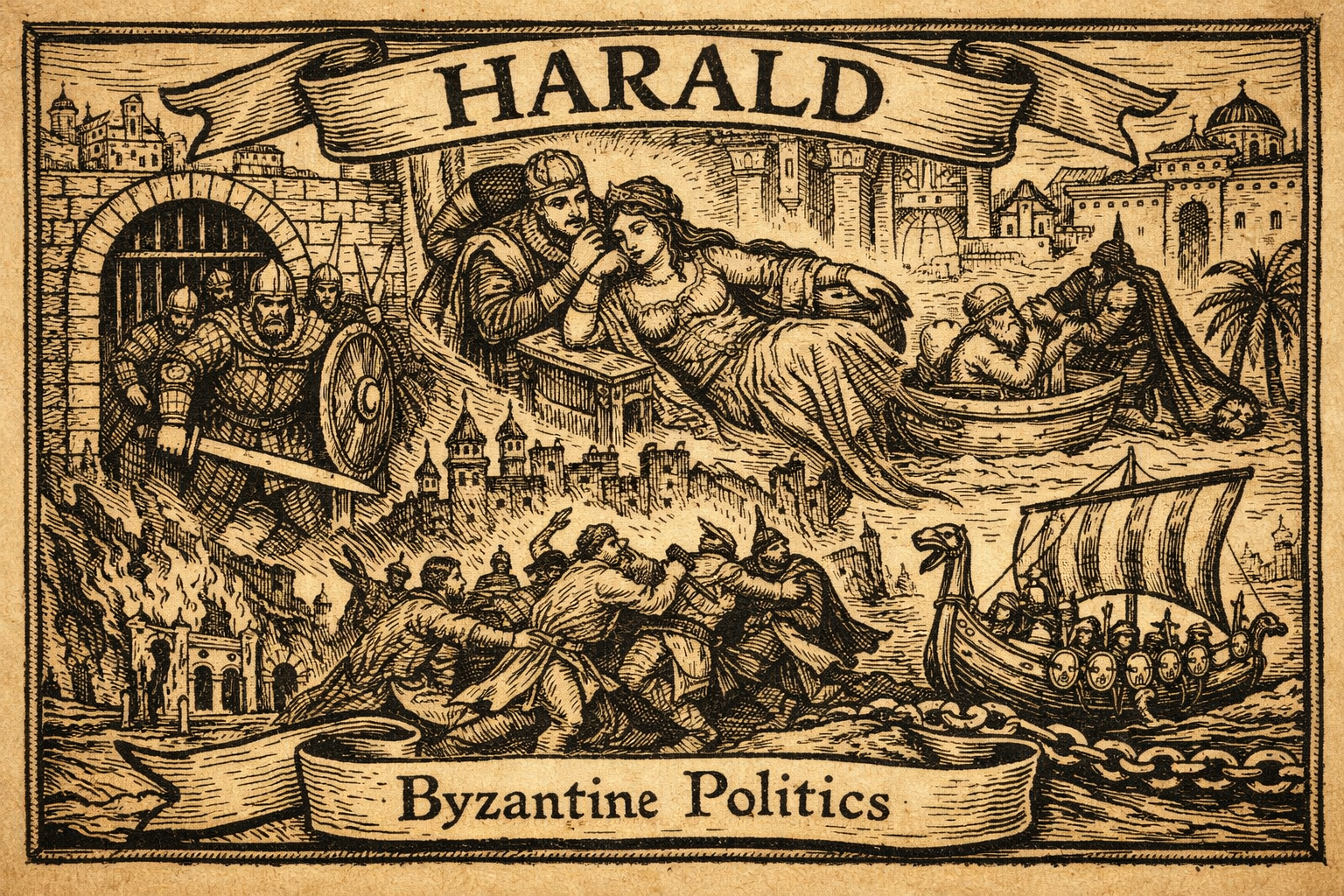
Byzantine Politics
In Constantinople, the year did not matter as much as the mood. The city was old enough to have outlived dynasties and confident enough to believe it would outlive the next. The walls stood, the harbors filled, the markets ran like a river of coin and spice and sweat. Yet inside the palaces, power moved as quietly as poison. Men disappeared behind curtains. Edicts rose like smoke, and when the smoke cleared, new names were carved into wax and stone.
Harald Sigurdsson had come from the cold roads and the long rivers, and he had learned to stand still in the heat. The Varangians were conspicuous—tall northern men in foreign armor with axes fit for splitting shields—but they were expected to be silent, obedient, and terrifying. If they were praised, it was for steadiness, not for speech. If they were blamed, it was for being too near the door when a ruler fell.
By now he was no mere recruit. The sagas would later call him a captain, a leader, a man trusted with hard work and hard decisions. In Greek accounts, the northern guards appear less as individuals than as a weight placed on one side of a scale. Still, both traditions agree on the same thing: there were moments when the empire’s most delicate affairs depended on men who did not belong to it.1
The people of the city named factions as they named winds: Greens and Blues, chariots and clubs, symbols that meant more than sport. The palace named offices with greater precision, as if precision could keep a knife from the ribs: nobelissimos, parakoimomenos, eunuch and secretary, chamberlain and orphanotrophos. And beneath the titles, the same old hunger ran: gold, legitimacy, the right to command men to kill.
This was the city Harald served in, and this was the year its inner arrangements turned again.
Long Live the King
The court’s machinery depended on closeness—who could enter which room, who could speak in whose presence, who held the key to a chest, who controlled the seal that made an order real. John the Orphanotrophos, the eunuch who had climbed from humble work to the high places, understood this better than most. He had made emperors strong by standing behind them, and he had kept them strong by ensuring others remained weak. Psellos, writing as both participant and observer, describes him as a man whose influence was everywhere felt even when his body was absent: an organizer of appointments, a master of the treasury, a maker of fates with a pen and a whisper.2
Harald was useful to John because Harald did not belong to the rival families of Constantinople. He had no local cousins to enrich, no patriarch to flatter, no debt to the city’s long memory. The Varangians were loyal to the hand that paid them, loyal to their own company, loyal to the oath that bound them to the emperor’s person. A eunuch who could command the emperor’s person could command the Varangians.
In the saga tradition, Harald is shown drawn deeper into this web: not only guarding doors, but moving money, enforcing decisions, taking part in the harsh work that the palace preferred not to see. In the Greek tradition, these matters remain shadowed behind the more formal story of succession and policy. The disagreement itself is instructive. Where the saga likes to show the outsider’s hand, the court chronicle prefers the inside language of offices and decrees. Yet in both, the empire’s private violence leaks into the open world.3
There was also Zoe Porphyrogenita—born in the purple chamber, daughter of an emperor, symbol of legitimacy in human form. Psellos writes of her with a mixture of fascination and caution: a woman of immense status, capable of lavish generosity and sudden wrath, a ruler who loved splendor, who understood the power of being seen, who could elevate a man and ruin him by turning her face away.4
The court’s alliances were not built only on law. They were built on proximity, favor, and the management of desire. In the saga, this becomes personal: Harald drawn into intimacy with Zoe, and thereby made both privileged and endangered. In the Greek accounts, the same structure appears in different garments—Zoe’s marriages and adoptions, her influence over succession, her role as the living conduit of legitimacy. Whether the details are told as bedchamber or as ceremony, the result is the same: Zoe’s presence made the palace unstable, because it made power portable.5
An emperor was alive, then not. Psellos gives attention to sickness, to a ruler’s decline, to the sense that the palace could not be trusted even by those who lived within it. The sagas do not linger on medical detail; they prefer the clean shock of a turn. And then the famous rumor: that an emperor was drowned in his bath while the Varangian Guard stood outside the door, loyal enough to obey and silent enough to be blamed.6
Here the traditions do not neatly align. Psellos does not present the bath-drowning as a simple, singular fact in the way later retellings do, and the imperial story is crowded with illness, policy, and contested responsibility. Yet the saga’s image has the feel of a tale that grew in the mouths of soldiers: a door guarded, water steaming, a sudden stillness, and afterward a new arrangement of men calling it necessity.
Whether an emperor truly died by such hands or whether the story condensed other ends into one striking scene, the consequence in the palace was the same. When a ruler fell, the palace did not mourn long. It secured itself. Chests were opened “for the safety of the state.” Documents were gathered “for preservation.” Wealth was redistributed “for order.” The line between safeguarding and plunder was thin, and it could be crossed by any man holding a warrant.
Harald’s company was involved, because the Varangians were always involved when rooms were being secured and accounts rearranged. They were the wall between the inner circle and the outer world. If the work was ugly, they performed it. If the work was shameful, they could be blamed. If the work required someone to stand motionless while others decided a man’s life, they were perfect.
By day, processions continued—incense, banners, clergy, officials with tablets. By night, decisions were made with fewer witnesses. The empire’s surface remained smooth; beneath it, the gears ground.
The Evidence Must Go
In Constantinople, victory is often temporary. One faction wins, then must immediately secure the win against all the enemies created by winning. John the Orphanotrophos had raised men and broken men; now the same mechanisms turned against him.
Psellos tells the story of sudden reversals: a powerful man accused, stripped of office, and destroyed by the same court that had depended on him. He records the empire’s habit of transforming political questions into moral accusations. It was not enough to say, “John has too much influence.” One must say, “John is corrupt,” “John is a poisoner,” “John has stolen,” “John has offended God.” Once the moral story was accepted, punishment could be framed as purification.7
The punishment that ended many political careers in Byzantium was not death, but blinding. A blinded man could live; he could even pray for the ruler who destroyed him. Yet he could not credibly take the throne. This made blinding a tool that suited a state that wanted order, not martyrdom.
John was seized and blinded. He was sent away to Monobatae, and his former influence was treated as a stain to be scrubbed from the palace. The men he had advanced scrambled to swear loyalty elsewhere. The men he had harmed emerged like survivors from a fire, eager to point out where the ashes still lay.8
Theodora—Zoe’s sister, long held aside—was also removed. She was placed in a convent, as if prayer could neutralize legitimacy. Confinement in a nunnery was exile by another name: a woman of imperial blood could be kept alive while kept out of the public eye. It was a common solution in a court where women could embody authority as dangerously as any man.
In this section of the story, the sagas and the Greek court history run parallel without fully meeting. Psellos speaks the language of policy, propriety, and public crisis. The saga speaks the language of the soldier who watches the turning of favorites: a man strong yesterday, blind today; a woman sovereign in name, confined tomorrow; a palace that eats its servants. Where Psellos offers explanation, the saga offers the feel of iron under the hand.
Harald moved through this as a man in service must. When officials came with warrants, the Varangians enforced them. When men were arrested, the Varangians held the corridors. When a fallen minister was dragged away, it was better for the palace if foreign guards did the escort. The city would not avenge a eunuch easily, and the noble families could tell themselves they were not personally involved.
If Harald gained status here, it was the status of being useful to dangerous men. He became a tool that could be trusted with tasks other men did not want to be seen doing. Yet the status was unstable, because a tool can be discarded when it becomes inconvenient.
When John fell, Harald’s position shifted. He no longer had the eunuch’s protection. And the court, having removed one powerful figure, began at once to suspect the men who had served him. The palace did not distinguish neatly between a man who planned a purge and a man who merely guarded the door during it. Both had been present.
Thus the evidence had to go. Not only the evidence of John’s acts, but the evidence of anyone who had been close to him. In Byzantium, closeness could be read as complicity.
The saga tradition amplifies this pressure into direct accusation: that Harald was charged with holding back treasure, with dishonesty toward the imperial household, with ambitions incompatible with his station. The Greek narrative is less interested in a single Varangian’s legal troubles, but the same logic underlies it: after upheaval, the palace seeks scapegoats and redistributes blame along with wealth.9
So, while the city’s stones remained where they had been, the political ground beneath Harald’s feet began to break.
The Power of the Mob
Then the palace’s private quarrels spilled into the streets.
Constantinople contained multitudes: artisans, sailors, clerks, monks, nobles, foreigners, beggars. The city’s peace depended on the belief that the emperor—or those ruling in his name—preserved order and legitimacy. When that belief failed, the people did not petition quietly. They moved as crowds, and crowds carried their own authority.
The Greens and Blues were not merely sportsmen. They were civic identities, networks that could mobilize men quickly. When trouble came, these factions could become armies. Psellos records the terror of such moments, when the logic of the palace is replaced by the logic of the street: shouting, stone-throwing, the sudden reversal of power as officials flee men who own nothing but rage.10
A rumor ran through the city that Zoe had been wronged—confined, insulted, perhaps removed from her proper place. Because Zoe carried legitimacy in her blood, the rumor mattered. People who had never seen her face took her name as a banner. The city that could tolerate a new emperor could not tolerate the idea that the purple-born woman had been treated as disposable.
The palace attempted to control the narrative. It issued statements, made appearances, arranged ceremonies. But ceremonies do not stop riots. When the factions gathered, they did not wait for official permission. They surged toward the places where they believed truth lay—in front of palaces, in churches, at the edges of the Hippodrome.
In such a crisis, the Varangians were again central. They were among the few forces in the city whose discipline did not dissolve into faction. Yet they were also foreigners, and the crowd could see them as enemies if they stood between the people and the symbol they demanded.
Harald was ordered to restore order. The saga would later emphasize the brutality and the courage of the Varangian response; Psellos emphasizes the sheer scale and volatility of the mob, the way even the nobility feared it. Both views fit the same event from different angles: the street became a battlefield without banners, and the palace discovered it could not command the city by decree alone.
The outcome of this unrest is one of the most famous scenes in the tale of Zoe and her successors: the capture and blinding of an emperor. Here the sources converge on the act, even if they differ on emphasis. Psellos describes the deposition and the horror of punishment; the saga tradition highlights the Varangians’ role in carrying out the sentence and names Harald among those who did the work.11
The blinding was not performed as a mere outburst. It was a political ritual, grimly standardized. It turned a ruler into a non-ruler with blood and pain instead of a formal abdication. It allowed the empire to pretend that the state did not kill, even as it destroyed. Those who performed it were instruments of legality as much as of violence.
If Harald participated, he did so as part of the Varangian machine: ordered, witnessed, remembered. The saga makes him the active hand; the Greek account makes the act the state’s hand. The truth may be tangled between them. A northern warrior could boast later that he had blinded an emperor, because in the world of saga it sounds like proof of fearlessness and proximity to fate. A court writer might omit the name of such a man because names of executioners do not improve the empire’s dignity. The deed itself remains the fixed point.
Afterward, the city needed calm. Zoe was restored to public power, and Theodora was recalled to share rule. This strange arrangement—two imperial sisters side by side—answered the immediate demand for legitimacy. The crowd could disperse satisfied, believing it had defended the purple-born line.
But those who had served the previous order were now exposed. Anyone tied to the fallen party could be punished. Anyone with wealth could be suspected of having taken too much. Anyone whose loyalty was useful yesterday could be declared treacherous today.
Harald watched the city settle like mud in a river after a storm. The water looked clear again, but the debris had not vanished. It had only sunk. And in the palace, men began to speak of accounts, of missing treasure, of foreigners who had grown too rich.
The mob had shown its power, but the palace had learned from it. The palace would now restore its own power by quieter means.
Over the Iron Chain
The saga tells this part with the sharpness of an escape story. Harald, accused and imprisoned, decides that his destiny is elsewhere—northward, toward the land of his birth and the kingship he believes awaits him. Zoe, offended or threatened, orders him confined. The Varangian Guard, loyal to their captain and resentful of the court’s treachery, breaks him out. They flee to the harbor and escape by getting their ship over the iron chain that blocks the Golden Horn.12
The Greek tradition does not dwell on Harald’s departure with the same narrative relish. Psellos is concerned with emperors, ministers, legitimacy, theology, and public order; the coming and going of foreign guards is secondary unless it intersects with the great names. Yet the saga’s shape fits the empire’s known habits. Accusations of withheld treasure were common. Imprisonment of inconvenient men was common. The need to flee quickly, before a decree could become a death sentence, was common.
Harald’s imprisonment—whether in a palace cell or in a fortress holding—marks the turning point of the chapter’s objectives. Until now, he has gained status by serving as an enforcer within the imperial machine. Now he gains honor, in the saga sense, by refusing to die inside that machine.
The Varangians were capable of loyalty that surprised the Greeks. They were mercenaries, yes, but mercenaries bound by oath and pride. Their company identity was fierce. If a leader had shared danger with them, paid them fairly, and kept faith, he could command more than a paycheck’s obedience. The saga insists that Harald had earned that kind of loyalty.
The break-out is told as night work. Quiet steps, bribed guards, a door opened at the right moment, iron scraping as bars are lifted. Such details are the currency of escape tales; they suggest memory shaped into story. Whether each detail is literal is less important than the overall impression: Harald could not have left lawfully. He had to be taken out of the empire by force or cunning.
Once free, the harbor became the next obstacle. Constantinople’s waters were guarded as carefully as its walls. Across the Golden Horn stretched the famous chain—massive links raised to prevent enemy ships from entering or leaving when the city was threatened. The chain was an answer to raids, sieges, sudden incursions. It was also a symbol: the empire could close its own mouth and keep what it had swallowed.
The saga’s image is vivid: Harald’s ship driven forward, then heaved over the chain by shifting weight and timing. The ship scrapes iron, shudders, then slides and drops into free water. It is the kind of exploit that makes a man larger than life.
Here again, the traditions may be placed side by side rather than forced into a single certainty. Perhaps the ship truly passed the chain by a feat of seamanship, under cover of night and confusion. Perhaps the tale preserves a smaller truth: that Harald escaped by sea despite the city’s defenses, and later storytellers shaped the manner of escape into the most dramatic form possible. The chain stands as both literal obstacle and narrative emblem. Whether his keel scraped iron or not, the meaning remains: Harald left in defiance of the empire’s attempt to hold him.
Arrows may have followed them; cries may have risen along the quay; a patrol boat may have turned too late. The city’s response would have been swift but not instantaneous, because the empire’s strength lay in systems, not in spontaneous pursuit. In the time it took an official to find the correct seal, Harald could be out on open water.
When dawn came, Constantinople would still stand. Priests would still chant. Merchants would still weigh coin. The palace would still argue. But Harald would be gone, and with him would go a portion of the Varangian strength the court had relied on.
He left behind the city’s strange justice: emperors drowned, ministers blinded, sisters raised and confined, mobs crowned as judges. He carried with him wealth gathered in service and in opportunism, and the conviction—saga-born, fate-fed—that his life belonged elsewhere.
He would go first toward the lands of Rus’, where he had once found refuge and hospitality, and where alliances could be renewed. Beyond that lay Norway. And beyond Norway, the pull of greater claims.
The city had tried to keep him. The city had failed.
Yet the hinge into what follows is not only flight. It is calculation. The saga tradition will soon speak of treasure, of hidden gold, of a final, deliberate taking from the empire’s wealth—acts framed as both cunning and necessity. Whether those acts are told as theft or as seized wages, the next chapter begins with the same hard truth learned in Byzantium: that power is paid for in gold, and gold is safest when it is in one’s own hands.
- Heimskringla, Saga of Harald Hardrada (Varangian service as a career frame); Psellos, Chronographia (Varangian Guard as palace force).
- Psellos, Chronographia (portrayal of court influence and the role of senior ministers such as John the Orphanotrophos).
- Heimskringla, Saga of Harald Hardrada; Psellos, Chronographia (different narrative emphases on agency and official causality).
- Psellos, Chronographia (characterization of Zoe and the dynamics of legitimacy).
- Psellos, Chronographia; Heimskringla, Saga of Harald Hardrada (Zoe as a political center of gravity in different registers).
- Heimskringla, Saga of Harald Hardrada (bath-drowning motif and palace rumor); Psellos, Chronographia (court crisis and imperial ends in this period).
- Psellos, Chronographia (court reversals and the moral language of accusation).
- Psellos, Chronographia; Heimskringla, Saga of Harald Hardrada (John’s fall and punitive blinding, with differing detail and focus).
- Heimskringla, Saga of Harald Hardrada (charges involving treasure and betrayal); Psellos, Chronographia (post-crisis purges and scapegoating dynamics).
- Psellos, Chronographia (riot, factional violence, and civic upheaval).
- Psellos, Chronographia (deposition and blinding as political resolution); Heimskringla, Saga of Harald Hardrada (Varangian involvement and Harald’s remembered role).
- Heimskringla, Saga of Harald Hardrada (imprisonment, Varangian rescue, escape over the harbor chain).