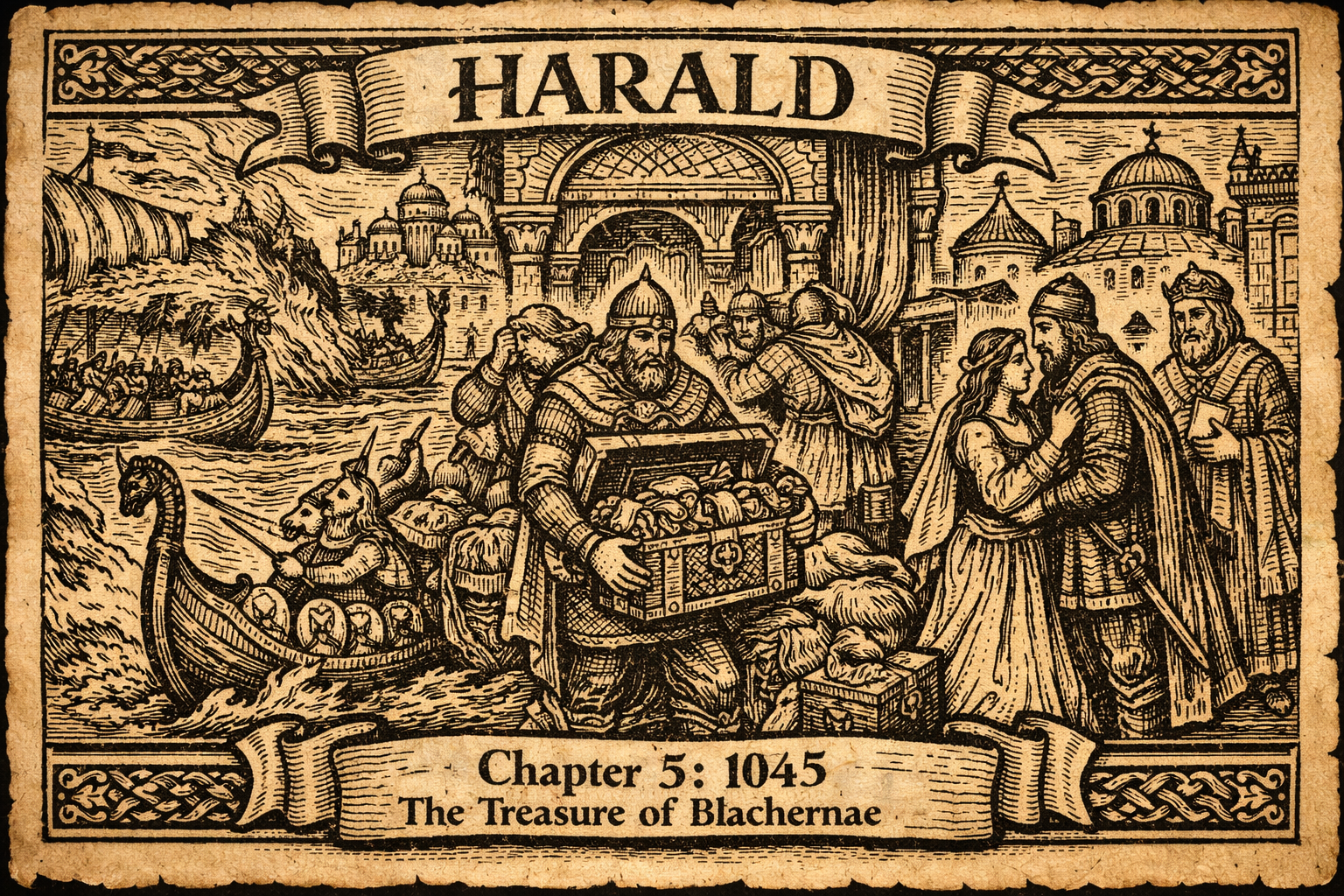
Yaroslav the Schemer
Kiev in midwinter held its breath under snow. The river was a white road, hammered flat by sled runners and the iron shoes of horses, and the smoke from a hundred hearths lay in a low veil over the timber roofs. In the palace-yard, men carried firewood as if it were tribute, and on the frozen quays carpenters chipped ice from hulls and checked caulking that the cold had cracked. Harald Sigurdsson watched all this with a soldier’s eye: supplies, labor, discipline—how a realm endured the season when the fields gave nothing.
Prince Yaroslav received him amid warmth and lamps, wrapped in furs, a man whose mind seemed to range farther than his body. Between them sat a board with weights and scales, and a cup of silver coins—more a habit than a necessity, for Yaroslav’s wealth was counted in towns and tolls. He spoke first of the south, of the Roman Empire that still called itself universal, and of the city that made all other cities feel like camps: Constantinople. There, he said, rulers changed as quickly as river ice. The court was a sea with hidden currents. Men drowned without being touched.
Harald did not need this explained. He had worn the emperor’s colors and eaten the emperor’s bread, and he had seen how a palace could become a trap the moment a faction turned. He had escaped once by iron chain and night water—so the northern tradition says—and he carried that escape in his bones like an old wound that aches before snow.1 Yet he was back now, summoned north by a ruler who understood that a man like Harald could be used like a tool and then set aside—if the hand was strong enough.
Yaroslav spoke of marriage. Not in the soft language of kinship, but in the hard language of state. His daughter Ellisif had grown since Harald last saw her: no longer a child peering from behind pillars, but a princess whose value lay in the binding of houses. “A king’s daughter does not marry a man who arrives empty,” Yaroslav said, and the words were a judgment on all exiles. Harald answered with silence, because a soldier knows when to let a ruler finish building the cage before testing its strength.
The plan was not offered like counsel. It was laid out like a map. Vladimir, Yaroslav’s son, would take ships downriver when the ice broke, gathering men from the towns and tributary lands. He would go openly, loudly, with banners and oaths, toward the Black Sea and the Bosporus. The Romans would answer as they always did: fleets would be readied, chains tightened across harbors, watchmen doubled. All eyes would be dragged toward the sea.
And during that turning of the head, Harald would return to the imperial city by a narrower road—by old contacts, old routes, and the half-forgotten privileges of the Varangian Guard. His task was not to win a war, but to win a fortune. Yaroslav named the palace quarter of Blachernae, where treasuries and storerooms lay close to the sea walls, and where an emperor might withdraw when the city seethed. The scheme was simple in its cruelty: one fleet as distraction, one man as dagger.
Harald asked what Yaroslav would take as his share. The prince’s smile was thin. “I do not need Roman gold,” he said. “I need you bound to my house and able to stand before any man in Norway as an equal.” The bargain was sealed not with ink, but with the understanding that both men profited by the other’s risk. If Harald succeeded, he would return with wealth enough to buy oaths. If he failed, Yaroslav could mourn him as a useful foreigner and lose nothing essential.
That night Harald walked the palace-yard alone, listening to the creak of trees and the distant bark of dogs. He thought of Norway—of narrow fjords, of longhouses and iron and the memory of his half-brother Olaf. Exile had been his crucible; now the metal needed shaping. He looked south in his mind, past rivers and steppes, toward the city of gold. It was time to take what the world would not give freely.
War at Sea
When spring came, it came violently. Ice broke like shields under axes, and the Dnieper groaned as it shrugged off winter. Men who had waited all season for movement now moved too quickly, as if speed could make up for lost months. Vladimir’s fleet assembled from river craft and sea-going ships: long, shallow vessels built for rapids and portage, their planks stitched and pegged, their seams smeared with pitch and fat. They loaded food in the old way—barrels of dried fish, sacks of grain, honeyed drink, salt, and smoked meat—knowing that hunger was a more faithful enemy than any Roman blade.
The journey south was not a straight line. It was a chain of hazards: rapids that demanded portage, sandbars that could trap a ship, and stretches where steppe riders watched from the banks like wolves. Harald was not sailing with Vladimir—not openly. He watched the departure from a distance, counting the ships, weighing their crews, judging whether the spectacle would be loud enough to pull an empire’s gaze. The oars dipped; the prows turned. The Rus’ were on the move again toward the sea roads that had made them feared and rich.2
News traveled faster than ships. By the time Vladimir reached the Black Sea, word had already reached Constantinople by merchant and spy. The Romans prepared as Romans prepared: not with bravado, but with method. Harbor chains were inspected, watchtowers stocked, and the fleet brought into readiness. They had fought the Rus’ before, and in the memory of the empire those attacks had never fully vanished—like scars that itch when touched. The city did not panic; it tightened.
The battle in the Propontis—so later tellers call it—was less a single clash than a series of violent encounters across days, shaped by wind and current as much as by tactics. Rus’ ships could dart and withdraw, depending on oar power and shallow draft, but the Roman fleet was built for the sea and manned by professionals who had learned to turn formation into a wall. The Romans brought out their most feared weapon, the thing that seemed to defy nature: Greek fire.
It is described differently in different traditions. Some speak as if it were poured from bronze mouths like liquid flame; others as if it were a mist that ignited on contact, or a burning substance flung in pots that shattered and spread. What remains constant is the terror of it: fire that clung to wood and skin, fire that did not die in water. When it struck a ship, men could not save their vessel by jumping overboard. They carried the burning with them.3
Smoke dragged across the sea like a low cloud. The sound was not only of battle—shouts, splintering planks, the crash of ramming—but also of panic: the frantic slap of hands on burning cloth, the high animal cries of men who understood too late that the sea itself had become their enemy. Yet Vladimir did not simply vanish. The Rus’ withdrew when they had to, regrouped when they could, and harried the edges rather than breaking themselves against the Roman center.
Later writers claimed complete victory for the emperor, as imperial writers always did, and later saga tellers emphasized Rus’ resilience, as northern tellers always did. Between those claims lies a truth shaped by politics: the Romans kept their city; the Rus’ proved they could still threaten it. And in the midst of that threatened confidence, the city’s attention was consumed by the sea.
That was the point. While Roman eyes watched for sails and fire, Harald moved by smaller routes and older doors.
Goodbye to Zoe
Harald returned to Constantinople not as the wide-eyed foreigner he had once been, nor as the condemned man he had once become, but as someone who knew how the city breathed. He arrived with little visible retinue and no triumphal entrance. A man who intends theft does not announce himself like an ambassador. He moved through the outer districts where markets never truly slept, where languages tangled—Greek, Norse, Slavic, Armenian—and where coin changed hands faster than prayers.
The Varangian Guard remained his bridge. They were still foreigners, still trusted because they were not woven into the city’s family feuds, and still feared because their axes were not ornaments. Harald knew old comrades and old grievances. He spoke in the plain manner of soldiers: what would you do for enough silver to buy land, to purchase a wife’s dowry, to retire before your bones were broken? Some men refused. Many listened.
Zoe Porphyrogenita—born in the purple, her blood a claim in itself—was not easily reached. Her court had layers like armor: eunuchs, secretaries, priests, guards. Yet Harald had once been inside those layers, and the threads he had pulled before could be pulled again. He was granted a brief audience, presented not as a lover returning, but as a man with something to say that the palace could not afford to ignore. War at sea made even proud rulers attentive.
She received him in a chamber whose luxury seemed to have grown more rigid with time: mosaics like frozen sunlight, curtains heavy as shields, incense that could not fully drown the smell of wax and oil. Zoe’s face bore the weight of ceremony. Her eyes, however, were the same eyes that had once measured him and decided he was useful—dangerous, perhaps, but useful.
Their words were careful. They spoke of the fleet, of the threat, of the way rumor moved through the capital. Harald offered observations like a loyal captain might: where the city was nervous, where the people might turn, how the Varangians were being watched. Zoe listened, and in her listening he felt something like farewell. Neither of them spoke the true matter—what he intended to do—but both circled it like hunters around a hidden pit.
In some tellings, she begged him to stay; in others, she warned him that the palace had become a nest of knives and that he was no longer protected by her favor. The truth may be neither in full. Zoe was an empress of survival. She did not plead like a girl in a saga. She did not weep in the manner of poets. She understood bargains, and she understood that Harald was a man who would not die in a foreign palace when he could live as a king elsewhere.4
When he rose to leave, she did not attempt to stop him. Her hand, ringed and heavy, rested for a moment in his. The gesture was small—almost nothing amid the weight of empire—yet it carried the finality of an oath unspoken. Harald bowed, not deeply, but with the respect due to power. Zoe watched him go as if she were watching a ship depart from harbor, already knowing that no signal could call it back once it passed the headlands.
Outside, the city’s bells and shouted orders carried on the wind. The Romans were looking seaward. Harald turned inland toward the palaces.
Looting the Palace
Blachernae stood at the city’s edge, close to the land walls and the northern waters, a place of retreat and defense. It was not the ancient ceremonial heart alone, but a complex of residences, chapels, storerooms, and guarded corridors. When the empire feared attack, emperors withdrew there. When the empire felt secure, it stored its riches behind those same doors, trusting in stone and routine.
Harald’s advantage was not brute strength. It was knowledge. He knew the rhythm of guard shifts, the lazy confidence that comes when a garrison believes its danger is elsewhere. He knew which doors were watched by men who could be bribed and which were watched by men who could not. He knew that a palace’s greatest weakness is not its walls but its servants: the men who carry keys, the men who clean, the men who believe they are invisible.5
The Varangians who followed him that night were not a mob. They moved as soldiers. Their boots were wrapped to dull sound. Their axes, usually borne openly as symbols of office, were carried like tools for work. The plan required speed and silence. If alarm bells rang too early, the palace would become a slaughterhouse with Harald’s men inside.
They entered through a service passage and crossed a courtyard where statues looked down with blind imperial faces. Harald paused long enough to hear only wind. No footsteps. No shouted challenge. The sea war had done its work; the city’s nerves were stretched outward. He led them into the interior, toward chambers where chests sat like sleeping animals.
The first lock was broken not with shouting, but with a careful wedge and the strength of a man who had split oaken beams in Norway. The lid lifted. Inside lay coin in piles, jewelry wrapped in cloth, and small objects whose value was not only in gold but in meaning: crosses, reliquaries, enamel work that carried saints’ faces. Harald did not linger to admire craftsmanship. He measured by weight. A man does not buy a kingdom with beautiful things; he buys it with metal that can be melted and redistributed.
The work went on from room to room. Sacks filled. Cloaks bulged. Some men took too much and had to be forced to abandon bulky prizes, for a heist dies when greed slows the feet. Harald kept order with low words and hard looks. In the distance a door slammed—perhaps by chance, perhaps by a wakeful servant—and a hush went through the raiders like a ripple through a line of shieldmen. Harald waited, listening. No alarm followed. They moved again.
The sagas tell this as rightful payment: that Harald had earned wealth in the emperor’s service and that the empire withheld it, forcing him to take what was due.6 The Roman tradition, where it mentions such things at all, tends to speak of foreigners and disorder, of soldiers who exploited moments of crisis. Between these views lies the uncomfortable truth that empires and mercenaries always argue about wages. The empire pays in promises; the soldier prefers silver.
Before dawn they withdrew. They did not fight their way out; they slipped out, leaving behind a palace that would only later discover its lightness. Harald’s men scattered into the city like drops of oil into water, each carrying a piece of the imperial store. By the time the sun touched the mosaics, the theft had already become rumor—if it had become anything at all.
Harald moved quickly toward the harbor districts and the secret routes north. He had no desire to test how long Roman patience could be stretched.
Achievement Unlocked
Leaving Constantinople was its own battle, fought not with axes but with timing. The city’s harbors were guarded, and in wartime they were guarded more tightly still. Harald did not attempt to sail out with trumpets and banners. He used the kind of vessel that did not draw imperial attention—small coastal craft that hugged shorelines and took on supplies quietly. Money opens doors; caution opens the ones money cannot.
The voyage across the Black Sea was never safe. Winds could shift and turn a planned crossing into a desperate drift. Pirates and opportunists prowled along the coast, especially when war stirred the waters. Harald’s crew kept weapons close and sails reefed, moving when the weather allowed, hiding when it did not. They made for Cherson, that old outpost where Greeks, steppe men, and northern traders all collided. There, Harald purchased fresh provisions—bread, salted meat, perhaps wine—and arranged onward travel with the efficiency of a man who had crossed half the world already.7
From Cherson the route back to Kiev was a thread stitched through river systems and roads. Travel meant wagons where paths allowed, boats where rivers carried, and long days of riding when neither was possible. Harald paid in weighed silver and in promises of future favor. Along the way he heard news of Vladimir’s fleet: losses, retreats, claims of heroism. No one spoke of complete disaster. No one spoke of complete triumph. That was enough. The distraction had held.
When Harald returned to Kiev, he did not arrive as a ragged exile. He arrived with wealth so heavy it required men to carry, and with a name already swollen by rumor. Yaroslav received him with the calm of a man whose gamble had paid out. He asked no questions about the methods. Rulers are often scrupulous only when it benefits them.
The marriage to Ellisif was conducted with the ceremonial weight such unions demanded. There were feasts, gifts, and the formal exchange of promises between houses. Harald presented gold and rings and coin enough to make even skeptical nobles consider the solidity of his claim. Ellisif herself—raised amid Christian courts but living among men who still remembered older gods—stood composed, her expression guarded in the way of women who have learned that public life is a stage where feelings are weaknesses. She had watched Harald once as a girl. Now she watched him as a wife watches a husband whose destiny will drag her across seas.
In the northern telling, the marriage is an achievement of state and fortune: Harald returns from Byzantium laden with treasure and wins the king’s daughter as reward, sealing his rise from exile to princely stature.8 The Rus’ tradition emphasizes Yaroslav’s web of alliances—marriages as bridges between realms, not romances but instruments.9 Both are true in their way. A marriage can be both a bond and a chain, and the same clasp holds either.
After the vows, Harald did not immediately speak of Norway in the feast hall, but the thought was present like a drumbeat behind song. His wealth was now transformed into legitimacy. He had a powerful father-in-law, a noble wife, and a treasure hoard with which to purchase ships, men, and oaths. He had learned the Byzantine art of power—how to use distraction, how to strike at treasuries instead of walls, how to move through politics like a man moving through fog with a knife.
In the nights that followed, Harald walked the riverbank again, this time with Ellisif beside him, their breath pale in the air. The Dnieper flowed dark and relentless under moonlight. It did not care for empires or marriages; it carried everything toward the sea. Harald looked north in his mind, to the fjords and the halls where his name would need to become more than rumor. He had unlocked one gate. Another waited—made not of palace doors, but of men’s loyalties.
Soon the spring roads would open. Soon he would turn his face toward Norway with a fleet and a queen, and the last Viking’s kingship would begin to harden into fact.
Footnotes
- Heimskringla (Snorri Sturluson), Saga of Harald Sigurdsson: Harald’s flight from Constantinople and the tradition of his escape; presented as part of his rise from exile to kingly fortune. ↩
- Tale of Bygone Years (Primary Chronicle): river travel, the Rus’ capacity to assemble fleets, and the political logic of southern expeditions. ↩
- Byzantine tradition on Greek fire and naval defense; cf. Michael Psellos, Chronographia, for court-era context and imperial war posture (weapon details preserved across Byzantine military memory). ↩
- Michael Psellos, Chronographia: Zoe’s stature as Porphyrogenita and the atmosphere of factional power in the capital; used here to frame the tenor of a final audience. ↩
- Psellos, Chronographia: palace life and the machinery of access—eunuchs, offices, and controlled movement—invoked to ground the feasibility of covert entry. ↩
- Heimskringla: Harald’s accumulation of wealth in imperial service and the saga logic of “wages withheld / treasure taken,” presented as justification rather than neutral account. ↩
- Heimskringla and Byzantine frontier tradition: Harald’s movements around the Black Sea littoral and the role of Cherson as a staging point between steppe, Rus’, and the empire. ↩
- Heimskringla: the marriage to Ellisif as culmination of Harald’s wealth-making abroad and as a political elevation that enables his return to Scandinavia. ↩
- Tale of Bygone Years: Yaroslav’s dynastic strategy and the use of marriage to bind alliances; applied here to interpret Yaroslav’s motives. ↩
- Heimskringla (and saga convention broadly): the conversion of treasure into loyalty—rings, coin, gifts—functioning as the material basis of kingship in the north.
- Psellos, Chronographia: the recurring instability of emperors and court factions, used as backdrop for why a seaward threat could pull attention from internal security.
- Synthesis note (tradition-bound connective tissue): the precise sequencing of Vladimir’s distraction and Harald’s palace action is reconstructed to align saga motives with chronicle-scale war pressure, without claiming a single definitive “official” version.