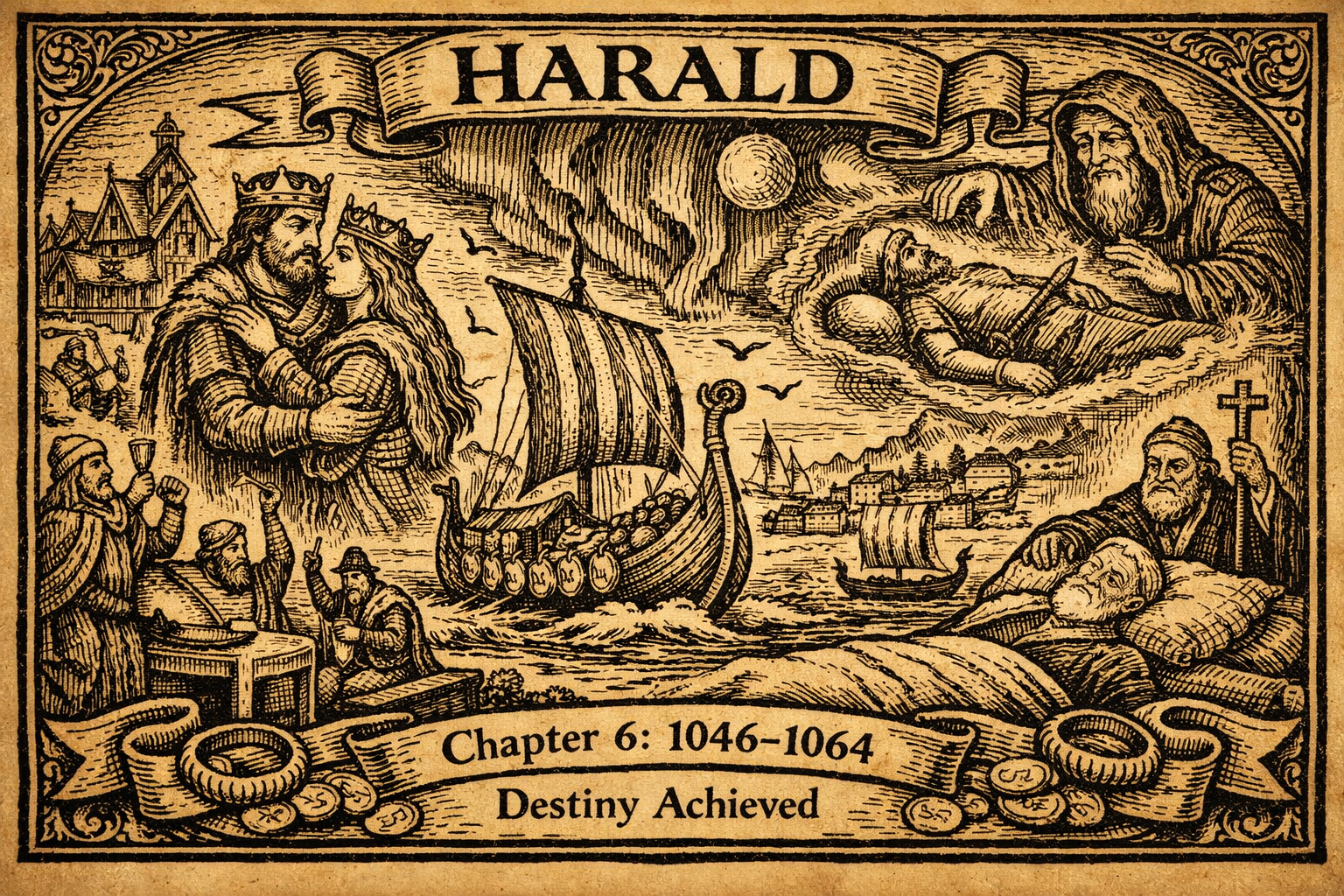
When He Died, It All Came To Me
Kiev lay under a lid of winter when Harald Sigurdsson made ready to leave it. Ice filmed the Dnieper’s edges; the main channel moved dark and heavy, shouldering its way south beneath a skin of mist. Smoke rose from the city in thin, straight threads that broke and vanished in the pale air. Churches with their bright domes stood above the timber roofs, and the bells carried far in cold weather. In the yards near the river, merchants hammered at frozen barrels, and horses steamed as they stamped.
Harald had once come to this place as a youth with a wound and a handful of followers—hungry men with torn cloaks, their hands stiff on spear-shafts, asking hospitality from Prince Yaroslav. Now he prepared to depart like a lord returning to his land, with a fortune taken by service and a bride taken by treaty. The same river that had carried him south toward the emperor’s gold now would see him travel toward his own crown.
He did not leave quietly. A king’s leaving is a thing the city must see. There were chests—oak bound in iron—with locks large as a fist. There were leather sacks of coin and weighed silver, tied and sealed. There were bolts of silk, stiff with embroidery, and Byzantine cups of thin gold that rang when tapped. There were weapons gathered from half the world: mail shirts of close-wrought rings, a helmet with an iron nasal, a sword whose hilt was chased with twisting beasts, and axes with broad blades that had bitten shields in Greek streets and on Slav shores. There were also letters—safe-conducts and contracts—written by scribes in careful hands, for not all borders yielded to steel. The hoard was arranged so that it could move: heavy things low in wagons; lighter things in packs; coin where a hand could reach it quickly, for tolls are answered faster by silver than by argument.
Ellisif Yaroslavsdottir rode beside him, wrapped in sable and fox, her hair braided and hidden beneath a hood. She was not a child now. She had watched Harald in her father’s hall for years, first as a stranger, then as a man returned from Miklagard, and then as a groom whose price was measured in politics, not affection. She carried with her a small carved icon and a cross worked in gold. Harald did not ask her to cast them away. He had learned in Byzantium that faith could be a weapon, and that a ruler who mocked the god of his house invited knives in the dark. Yet he also knew that he himself had made vows under the ash at Uppsala, and those vows still held him. Their marriage was a bridge between worlds, and bridges must be walked with care.1
From Kiev they traveled north by river and road. Winter still clung to the land, but the sun had begun to rise higher, and the snow crusted hard enough for sled runners to hiss and sing. They moved with the season: when the river was still firm at the edges, they used it like a road, keeping to shallows and backwaters where ice held. Where ice failed, they hauled boats on rollers and greased skids, cursing and sweating in wool beneath their furs. At night they lodged in farm halls or in the houses of friendly merchants. Food was salted fish, barley porridge, smoked meat, hard bread that needed ale to soften it, and onions when they could be found. Harald paid well; he did not bargain like a starving exile. His men were told to keep their hands from theft, not from virtue, but from prudence. A quarrel on the road could cost more than a sack of silver.
In Novgorod, Yaroslav’s city of timber and markets, they paused longer. There Harald had first learned to be patient under another man’s roof. Now that roof welcomed him with a different gaze. The boy who had asked for a place at the fire had become the sort of man who built fires for others. Merchants came to look at his goods; craftsmen admired the Greek workmanship; Varangian comrades found old acquaintances among the river-men. Ellisif stood beside her mother’s kin and listened to their talk, her eyes steady. She understood that she was leaving the heart of her people and traveling to a colder, harder land where her name would be spoken with foreign edges. That is the fate of princesses.
When the first true thaw came, Harald chose water. He hired pilots who knew the lakes and rivers that linked Novgorod to the Baltic. Boats went down with the meltwater, fast and treacherous. The current pulled at oars; floating ice could crush a hull if a man was careless. They traveled in convoy—long boats and broader cargo boats—spacing themselves so that if one struck trouble another could help without being dragged into the same peril. Each night they drew up on shore, turned hulls for repairs, and set a watch. A king travels with enemies even when no enemy is in sight.
On the Baltic, the sea opened like a gray field. The wind tasted of salt and distant ice. Harald chose a knarr for the treasure and longships for the men. The knarr rode deeper, its belly made for cargo; the longships were lean and quick, made to fight or flee as needed. Sails were hoisted when the wind was fair; when it died they rowed, shoulders aching, hands blistering. They kept near the coast when possible—past islands and low shores where smoke from small settlements could be seen—because a lee shore could save you from a storm, and also because a lee shore could hide men who meant to kill you. Every choice held two faces.
Toll-kings and petty jarls demanded payment at narrows and harbors. Harald paid when it was cheaper than blood. He remembered the emperor’s city, where an iron chain could close a harbor like a fist closing on a throat. He did not waste strength on every gate. His strength had a purpose. Yet there were times when he did not pay. When a band of Danes came out in light ships to test him—more bold than wise—Harald let them come close, then turned his longships in a sudden line and drove forward under oar. The Danes saw too late that they had run toward men who had fought Greeks and Saracens. Harald’s archers sent shafts that fell like hail; his axemen boarded with hooked poles. Two Danish ships were taken, their crews thrown into the sea or chained for ransom. The survivors fled. That lesson traveled faster than Harald’s sails, and the next toll-king was more polite.
At last the Skagerrak opened and the coasts changed shape—fjords biting deep into land, hills rising dark with pine. Norway smelled like home: resin, wet stone, fish on drying racks, smoke from peat. Harald’s ships entered the Oslofjord under a sky washed clean by rain. The water was calmer inside; it lapped against hull planks like a quiet tongue. Men gathered on the shores and low ridges, drawn by rumor and the sight of tall masts. Some came out in small boats to stare. Others stood in cloaks and watched in silence, measuring the returning exile with the cold eyes of farmers who know that kings are expensive.
Word had already gone ahead: Harald Sigurdsson had returned with treasure enough to buy a kingdom and with a Rus’ princess as proof that he had not merely survived the world but mastered it. Yet Norway already had a king—Magnus Olafsson, called the Good, son of Olaf who fell at Stiklestad. Magnus was young, fierce, and not eager to share. Harald did not come begging, but neither did he come with madness. He came with the weight of blood and law. He was Olaf’s half-brother; he had fought under Olaf’s banner; and he had taken service in the East that had made him feared. In Norse lands, fear is a kind of argument.
The Thing was called. It was not a single meeting in a single place, but a chain of assemblies and councils where men spoke, argued, and weighed their chances. Harald moved among them like a man laying out a board game in which the pieces were human lives. He did not shout promises like a young man. He opened chests. Gold lay in the daylight, bright as sun on water. He gave arm-rings thick enough to bruise a wrist. He paid for ships and for men. He made it clear, without saying it bluntly, that he could fund war longer than Magnus could. Coins and rings passed from hand to hand, and with them oaths.
Magnus came to speak with him. There was no warmth between them, only hard recognition. Magnus had his father’s name and the Church’s favor. Harald had his own name and the treasure of Blachernae. One had sanctity at his back; the other had the world’s iron in his hands. They made terms: they would rule together, and Harald would be king beside Magnus. It was not friendship. It was a knot tied because neither could untie it without bleeding.2
For a time, Norway had two kings, and the land watched to see which would eat the other. Then fate chose as it often chooses: quickly, without warning, and without pity. Magnus fell ill and died. Some said it was God’s will. Others said the gods of older days had claimed what was owed. Harald did not speak much when the news came. He attended the rites required of a ruler—public grief is part of rule—and he watched the faces of jarls and farmers. He listened to what was not said.
After the burial, he stood before the assembled men and accepted what the knot had always meant. The crown, now, rested on his head alone. No one could call him co-king any longer. Men remembered a saying that Harald himself was reported to have spoken: when Magnus died, all came to him. Whether he said it then or later, the meaning was the same. The exile had become the king, and Norway had gained a ruler who had learned kingship in the streets of Constantinople and on the long rivers of Rus’.3
It’s Good to Be King
A king’s first work is to be seen. Harald traveled. He rode through districts where farmers still spoke of Olaf’s death and where jarls measured a king by his generosity. He went by horse along winter roads and by ship along coasts when water opened. He called Things and listened to disputes. He confirmed old rights and broke those that threatened him. He rewarded men who had stood with him and made examples of those who tested him too boldly. He did not rule by softness. He had seen what softness did in Byzantium: it invited eunuchs and mobs. In Norway, it invited jarls with ambitions.
He chose Oslo as a hinge-point of power. The place was not grand. It was a settlement at the inner end of a fjord, a gathering of farms and a harbor where boats could shelter. Yet it sat where routes met: east toward the Baltic, south toward Denmark and the Saxon coast, west toward the North Sea. A king who held that harbor could turn trade into weapon and weapon into trade. Harald ordered works begun—wharves of heavy timber, storehouses raised on posts against damp and rats, and fenced yards where ship gear could be kept. Men felled trees in the surrounding woods. Oak and pine came down with groaning cracks, hauled by oxen and horses, dragged over snow and mud, their bark torn on stones. In spring, when the ground softened, the work became harder, for wheels sank and animals slipped. Harald paid for it anyway. Kingship is built in mud as much as in blood.
He called shipwrights from along the coast—men who knew the old ways of clinker-planking and men who had seen new tricks from Denmark and the south. They laid keels in the sand and measured ribs with practiced eyes. Longships were made for war: narrow, fast, built to be pulled up on beaches and launched again in minutes. Knarrs were made for wealth: broader-beamed, deeper-bellied, able to carry cargo and ride long ocean swells without snapping like a reed. Harald walked among them, asking of mast-step and sail, of how much wool-cloth was needed for a square sail that could carry a ship west to the islands. He spoke of what he had seen in Miklagard—great ships with many oars, and chain defenses across harbors—and his shipwrights listened, not because they wished to copy the Greeks, but because a man who had seen the world might also see things worth stealing.
Harald’s fleets were not only for fighting. They were for the circulation of goods and law. He established terms in harbors: weights must be true; scales must not be set crooked; silver must be cut clean and measured. In market places, he sent men to watch merchants who shaved coin or switched weights. When he punished offenders, he did so publicly, so that the punishment became a story. Stories travel. A king’s reach in a scattered land is measured in the distance his stories go.
Yet Harald did not forget the older way of wealth. Viking trade routes were braided with raiding routes; the difference was often only the mood of the receiving shore. In summer, he sailed east into the Baltic. He dealt with Gotlandic merchants who weighed silver in little balance pans and spoke in calm voices. He traded for wax, furs, and amber. He also reminded the Baltic coasts that Norway was not weak. A harbor that refused fair terms might find itself facing axes. In the North Sea, he sent ships toward England and along the Danish shores. He took what he could without spending too much, for a king who wastes his strength on small loot is like a farmer who eats his seed grain.
His court became a place where different tongues were heard. Men who had served with him in the Varangian Guard stood beside farmers from the inland valleys. Rus’ traders came with their river goods. Priests came with their Latin words, testing the pagan king with quiet persistence. And skalds came from Iceland and the western islands, drawn by rumor that Harald paid well for songs.
The skalds were not merely entertainers. In a land where law was spoken, memory was power. A skald could turn a deed into a legend that outlived the king. Harald understood this, and he fed them as he fed warriors: with meat, ale, and silver. In winter halls, when the sea was closed by ice and storms, the skalds recited of Harald’s youth at Stiklestad, of his flight through forests, of his rise in Miklagard. They praised his generosity, for praise bought reward, and reward bought more praise. Harald listened, sometimes smiling, sometimes stone-faced. He did not correct them when they sharpened his story. A king’s fame is a blade—better to keep it honed even if it cuts too deep.
Harald also governed with marriage and household, as all kings do. Ellisif remained his queen, but Norway was not Kiev. A king’s bed was part of his politics. Some sagas would say that Harald took another woman into his household, a concubine of Norwegian birth, and that this created threads of tension between court factions. Whether or not those threads were visible in public, the fact remained: Harald’s children would be the future, and the future was always contested in advance.
In the clear nights of the north, the sky sometimes burned with wavering light—green and pale, like banners of ghostly cloth. Men called it the northern lights, and some muttered that it was Odin riding with the Wild Hunt, or that it was the dead feasting in the heavens. Harald stood often outside in those nights, looking out over the fjord where his ships lay. A king can never fully sleep. Even when the hall is warm, his mind goes out like a prow into dark water.
And always there were routes: the Baltic’s island-studded waters; the North Sea’s long heave; the North Atlantic’s hard crossings toward the western islands. Harald built ships not only to show wealth, but to keep his hands on those routes. Where ships move, news moves. Where news moves, opportunity moves. It was good to be king, and Harald meant to be a king whose reach was measured by coastlines, not by valleys.
Death of Yaroslav
The year 1054 brought word from the east: Yaroslav was dead.4 It came first as rumor carried by a merchant ship that had crossed from the Gulf of Finland, then as a letter sealed and written in the hand of a priest. Letters were still rare enough that a sealed message made men gather as if around a fire. Harald received it in Oslo, near the wharves he had begun to shape into something greater. The messenger’s boots were split from travel. He bowed low, as if to a man who might decide whether he lived.
Ellisif took the news without display. She withdrew to her chambers, where she kept her icon and her cross, and where a small lamp burned before painted saints. She had been a daughter of a mighty prince, and she understood that mighty princes die like all men. Yet death is not only grief. It is politics made raw. Yaroslav’s lands were not like Norway. They were vast, and they were held together by a man’s will as much as by law. When that will ended, the land would pull apart like a rope with its binding cut. Sons would claim what they thought theirs; brothers would turn on brothers; and the river routes that had once been secure would run with war.
Harald understood this as well. He had lived in Rus’. He had watched how Yaroslav balanced factions, how he used marriage and gift and threat. Now that balance would shift, and a king who wished to keep ties to the east had to decide how to act. A king’s allies can become a king’s problems, and distance does not always protect you.
That night, Harald and Ellisif spoke privately. There were no skalds in that chamber, no farmers clamoring for judgments, no priests pressing for favor. There was only a man and a woman, and behind them the weight of their houses. Ellisif asked what would become of her father’s legacy, and what place she and her children held in the new order. She asked, in careful words, about patrimony—what their children would inherit, and whether that inheritance would be secure.
Harald answered as a ruler, not as a lover. Norway would not be divided among sons. He had seen what division did in Rus’ and in Byzantium. In Miklagard, emperors who shared power ended with daggers under bath water and crowds tearing down palaces. In Rus’, princes who split lands ended with brothers killing brothers and tribes burning towns. Harald would not allow his own realm to become a carcass for wolves. He spoke of law and of force. He would make Norway whole in his line, and he would back his will with steel and silver.
Ellisif listened, and she did not argue. Yet she was not merely passive. She reminded Harald that alliances were also inheritance. Their daughters would marry; their sons would rule; and those marriages could bind Norway to distant power. To be king of Norway was one thing. To be part of the wider northern web—the sea web of England, Denmark, and the islands—was another. Harald heard her. He had chosen a Rus’ princess because he understood that bloodlines were roads as real as rivers.
In the years after Yaroslav’s death, Harald strengthened ties to the east where he could. Merchants from Rus’ found favorable terms in Oslo’s harbor. Men who traveled the river routes brought news: of disputes among Yaroslav’s heirs, of shifting allegiances, of raids by steppe riders, of towns paying tribute to avoid fire. Harald did not send armies east; that would have been folly and expense without clear gain. But he did keep the channel open, because a king who closes a channel finds himself blind when the world shifts.
Ellisif’s place in Norway changed with her father’s death. In some ways, she became more isolated: her strongest protector in the east was gone, and her value was now more bound to Harald’s will than to Yaroslav’s. In other ways, she became more necessary. Her knowledge of Rus’ customs and her family ties could still be used, and Harald was a man who used what was useful. Their household became a knot of cultures: Norse men speaking of raids and law; Rus’ retainers speaking of church and city; priests pressing for the sanctity of Olaf; skalds praising old gods and new kings. In such knots, tensions hide until they suddenly snap.
Sometimes, on clear days when the fjord lay quiet, Harald would watch ships coming and going and think of the Dnieper. The river had been his road to Miklagard and his road back toward home. Now, with Yaroslav dead, that road belonged to others. Roads change hands. A king who forgets that is a king who will one day be surprised in the worst way.
Baldr’s Dreams
In Trondheim, Olaf’s shrine grew. The Church spoke of miracles—of the blind who saw, the lame who walked, the sick who rose from beds. Pilgrims came from across Norway and beyond, carrying candles and coins, seeking favor at the tomb of the king who had died at Stiklestad. Olaf, once a warrior with blood on his sword, was now a saint with light around his name. The bishops did not merely honor a dead man; they built a pillar of legitimacy for the living crown.5
Harald did not mock this. Olaf had been his half-brother; Harald had fought for him; Harald’s own life had been shaped by Olaf’s fall. Yet Harald had also sworn himself to Odin in the Swedish uplands, and he had lived among pagan rites and prophecies that did not vanish simply because a church bell rang. Norway in Harald’s time was a land with two tongues speaking at once. The cross rose on hills where once only stone altars stood. But old names still clung to streams and groves. Men might attend Mass and still cast lots before a voyage. Such contradictions were not hypocrisy. They were survival.
It was in a winter of heavy snow that Voluspa came again. She did not arrive like a courtier. She arrived like a storm that finds a crack in the door. The hall was crowded that night, for the cold drove men into warmth and ale. Torches hissed. Outside, wind swept snow across the dark. When she entered, her cloak was powdered white, and her hair was streaked with gray, but her eyes were clear and hard as ice.
Harald did not rise, but he did not dismiss her. He had listened to her before under the ash at Uppsala, and her words had twined themselves into his destiny. Now she stood before him with the calm of a woman who has already seen the end of a story and is only telling it to those still living it. She spoke in verses, as was her way, and the hall fell silent enough that men could hear the wind outside.
“Dreams troubled Baldr, the bright one of the gods;
forebodings came, heavy as night.
Then the gods gathered, held council,
and sought to ward off woe.”6
Her words were not merely about Baldr. They were about kings. A king is a bright thing—visible, desired, envied—and therefore a king draws shadows. Harald listened, his face unmoving. He had survived emperors and mobs. He had escaped an iron chain. He did not fear prophecy. But he respected it, the way a sailor respects a dark line on the horizon.
Voluspa spoke of omens: of ravens gathering where they should not, of wolves seen too near settlements, of stars that seemed to burn red. Men shifted uneasily, because such signs were common enough to be believed but rare enough to be feared. Then she turned her gaze directly upon Harald, and the hall felt smaller.
“A king who crosses the whale-road often
shall not find peace in his own bed.
The spear-song follows where gold goes,
and the sea remembers every oath.”
Some men spat to avert ill luck. Others made the sign of the cross, as if one god might cancel another’s warning. Harald did neither. He had made his life by choosing the hard path, and he would not pretend now that the hard path did not end somewhere.
When Voluspa finished, he gave her gold. He did not ask her to speak comfort. Prophecy that comforts is only flattery. She took the gold without thanks and turned away. Before dawn she was gone, leaving only the memory of her voice and the uneasy feeling of men who had heard their own deaths sung in a strange tongue.
In the spring that followed, Harald traveled north along the coast, inspecting shipyards and levies. He watched keels laid and sails mended. He saw farmers brought under obligation to provide men and food for summer voyages. He listened to disputes among jarls and settled them in ways that strengthened him. All this was kingship, and he was good at it. Yet the world beyond Norway did not stop moving simply because Norway’s fields were being plowed.
Across the North Sea, England was rich, and its crown had long been a prize contested by men who sailed in longships. Tribute had once been paid to Norse kings. Old claims lingered like embers under ash. Denmark watched England. Normandy watched England. Exiles and earls watched England. And Harald, who had mastered trade routes and war routes alike, began to look west with the measuring gaze of a man considering whether a treasure is worth the risk of reaching for it.
That summer, he ordered new ships built—larger than those meant only for Baltic trade, stout enough for the North Atlantic’s temper. He ordered stores gathered: dried fish and smoked meat, flour and malt, spare sailcloth, tar for seams, rope, spare oars. He ordered that weights of silver be set aside not just for paying men, but for buying information. A king who sails blind is not brave; he is foolish.
When autumn came, the seas grew rough and voyages shortened. In the hall, skalds sang of Harald’s deeds, and priests spoke of Saint Olaf’s miracles. Between these voices, Harald heard another sound: the low, persistent pull of destiny, like tide against stone. Voluspa’s warning had not ended him. It had only placed a shadow behind him, making his shape stand out more sharply.
As winter tightened again, a rumor began to drift toward Norway like smoke carried on a far wind—of an English earl cast out, hungry for revenge, seeking a great king’s help. Harald listened without speaking. Then he looked toward the dark west beyond the fjord, where the sea waited, and he began to consider what it might mean to take one last, greatest throw of the dice.
Footnotes
-
Harald’s return from the east with great wealth and his marriage to Ellisif (Elisiv) are central elements of the later saga tradition, especially in Heimskringla (Haralds saga Sigurdssonar). This chapter dramatizes logistics and court atmosphere while keeping the basic arc: return, treasure, and dynastic marriage. ↩
-
The political arrangement between Harald and King Magnus, and their subsequent co-rule, is a key saga claim in Heimskringla. The chapter presents it as a pragmatic bargain shaped by Harald’s wealth and following. ↩
-
Harald’s succession after Magnus’s death and the famous sentiment that “all came to him” reflects saga phrasing and emphasis on fate and entitlement. The narrative here leans into that saga cadence while avoiding precise saga chapter numbering. ↩
-
Yaroslav’s death (1054) and the ensuing division and rivalry among his heirs are attested in the Rus’ chronicle tradition (often rendered in English as the Tale of Bygone Years). The implications for long-distance alliances are historically plausible and narratively foregrounded here through Ellisif’s perspective. ↩
-
Olaf’s posthumous cult and importance to Norwegian royal ideology are treated in saga and ecclesiastical traditions; Adam of Bremen is among the important near-contemporary Latin voices for Scandinavian church matters, while the sagas preserve the Norwegian memory of Olaf’s sanctity and political role. ↩
-
Voluspa’s speech draws on themes and diction associated with the mythic-poetic corpus commonly called the Poetic Edda, especially the motif of ominous dreams and foreknowledge surrounding Baldr. The lines quoted are kept brief and serve as an in-world prophetic register rather than a claim of verbatim transcription. ↩