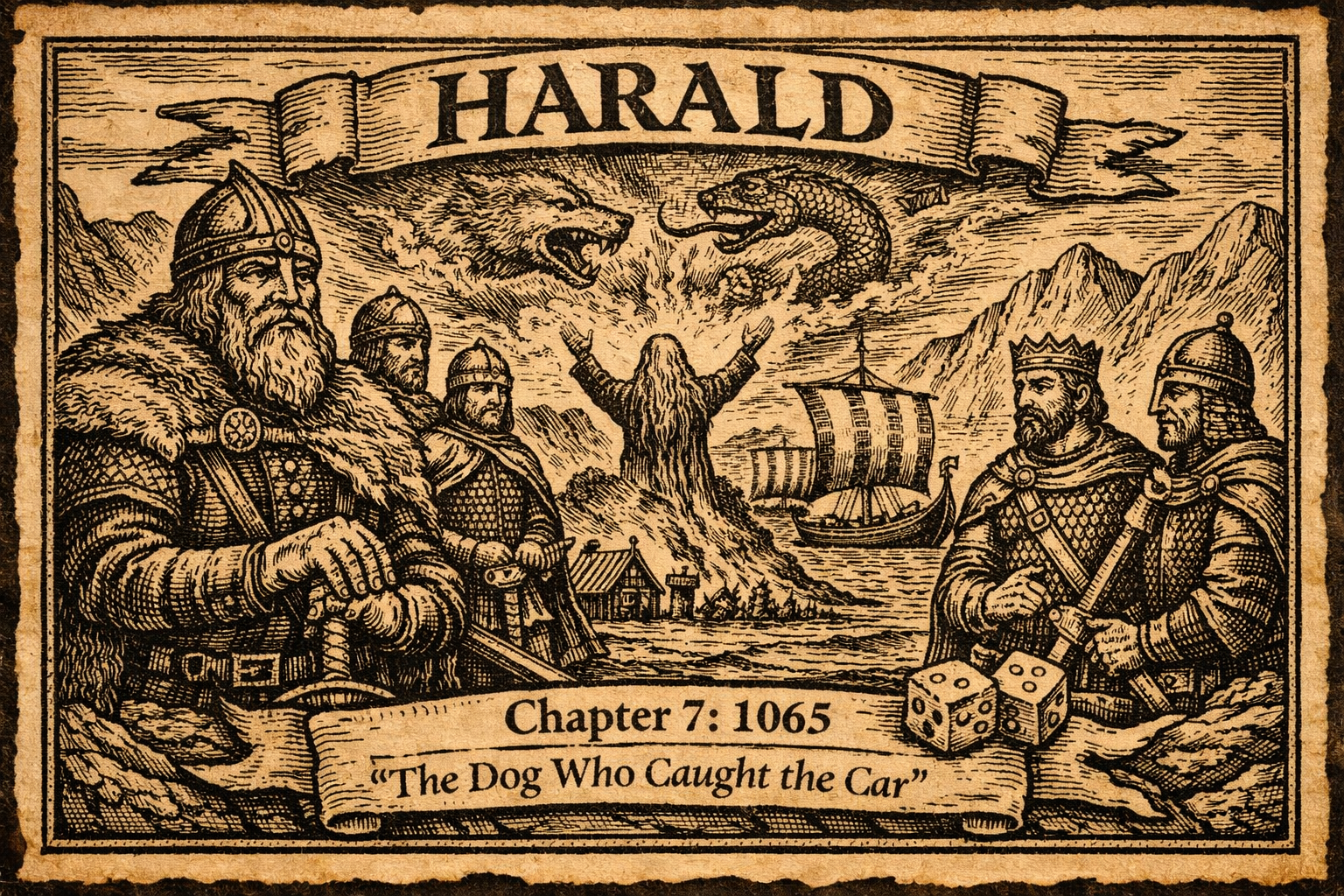
A Lion in Winter
Halogaland lay at the far edge of the king’s reach, where the land grew lean and the sea grew broad.
In the Lofoten islands the mountains rose like broken teeth from the water, black rock streaked with last summer’s snow. Fjords cut deep into the stone; their mouths opened to the whale-road, their inner reaches narrowed to calm basins where a man could hear every gull-cry and every creak of oarlock. The air tasted of salt and kelp and smoke from fish-oil lamps. It was late in the year, after harvest and before winter’s lock; the light had begun to thin, and dawn came reluctant over the ridgelines.
King Harald Sigurdsson Hardrada had come north with a small following, not as a raider but as a ruler taking measure of his realm. He had long made it his custom to travel the length of Norway, to show himself, to hold assemblies, to settle disputes with an even hand when he chose and with a heavy hand when he must. Yet there was another reason for his journey, one he did not speak aloud: the north gave distance from the press of court and the constant talk of England that had never entirely ceased around him. A king can be surrounded by men and still be alone. Here, among cold seas and narrow farms, he could hear his own thoughts.
He had sailed from Nidaros after the summer trading was done. The voyage north was not swift. The wind came contrary along the coast, and the ship’s mast stood bare more than once while the crew bent to the oars. It took days measured by headlands and safe anchorages: a night under shelter of an islet with only seals watching; a day hauled up at a fishing station where men traded dried cod for weighed silver; a morning delayed by fog so thick the prow seemed to cut into wool. Harald paid in hacksilver and clipped arm-rings, the old way, measured on a small balance with bronze weights—payment that spoke plainly to men who counted value by the feel of metal in the palm.1
He was not a small man. Age had not reduced him, only hardened him. His shoulders remained broad beneath his cloak, and his hands—scarred, thick-knuckled—were the hands of a fighter who had never been long from steel. Yet his hair and beard were threaded with gray now, and the old wound at his throat, taken in boyhood at Stiklestad, tightened when the weather turned cold. His gait was still quick, but in the quiet of early morning one could see him stretch his neck and roll his shoulders as if loosening a mail shirt that no longer hung there. Those who had served with him in Miklagard remembered the young captain who laughed easily and took risks as if the world were made to be seized. This king laughed less. He watched more.
In Lofoten he lodged in a loyal man’s hall, a broad timbered house with turf on the roof and carved posts at the high-seat, the carvings worn smooth by generations of hands. Fish hung in the rafters; nets dried near the door. Outside, the sea breathed against rock and the wind combed the grass on the slopes. The household was not rich by southern measures, but it was orderly and proud. The bondi’s wife set out what the north could provide: dried fish softened in broth, lamb when there was lamb, barley cakes, butter kept cool in a stone-lined pit, and ale that tasted of smoke and heather.
Harald hunted in the short mornings. He rode along narrow tracks between pasture and cliff, a hawk on his wrist, his men following in a line like dark beads against the pale grass. He watched the hawk strike and felt, for a moment, the old clean joy of mastery—swift decision, swift consequence. He fished from a small boat with local men who did not flatter him because they did not know how to flatter. When a halibut bent the line like a bow, Harald laughed aloud and braced his feet, hauling until his arms trembled. The fishermen, seeing the king strain and sweat like any man, smiled in their beards.
He held a local thing-assembly on a flat patch of ground above the fjord. Men came in rough cloaks, their hands cracked from salt and work. They argued over grazing rights and driftwood, over the boundary between two small fields, over whether a man had paid his dues in good silver or in clipped metal. Harald listened without impatience. He spoke of law and trade, of keeping the northern fisheries guarded, of fair dues on Sami traders who came with furs and reindeer-horn, of the need to repair a beacon station on a headland where storms had torn the frame away. He promised protection, but protection was never free. He took his share.
It was peace, and peace had weight.
In the evenings, when the hall’s lamps were lit and the talk turned to weather and catch and winter stores, Harald’s mind wandered. Peace, he knew, could rot a warrior’s edge if it became complacency. Yet he had labored for this peace with hard measures—coin taxes, ship levies, stricter law—because a kingdom that could not feed itself could not fight. Now that peace lay before him like a settled sea, he found himself restless. He had lived too long on the road and the deck-planks to sit easily in stillness.
His son Olaf came north to join him for a time. Olaf was nearly a man, with a straight back and a cautious tongue. He had been raised in Harald’s court, trained by the best huscarls, instructed in law and the handling of men. He watched and learned. In the yard he sparred with seasoned fighters, moving well, stepping in and out of range with care. Harald watched and saw a restraint that was not fear but judgment.
“You spare too much,” Harald said one afternoon, when Olaf broke off a clinch rather than wrench a man’s arm.
Olaf wiped sweat from his brow. “A king must know when to spare,” he answered.
Harald looked at him a long moment, then nodded once. He did not say that there are times when sparing costs more blood later. He did not say that mercy can be mistaken for weakness by the wrong eyes. He only watched his son, measuring him as a smith measures iron: not by shine, but by temper.
That night Harald dreamed of oars beating black water and of shields flashing in torchlight. He woke before dawn with the taste of smoke in his mouth and the feeling, sharp as cold iron, that the quiet north was a pause and not an ending.
What Could Possibly Go Wrong?
The first ship from the west arrived in weather that matched its purpose: low cloud, a hard wind, and rain that came in needles.
It was not a trader’s knarr heavy with cloth and grain, nor a coastal boat from the fjords. It was a longship of English build, narrow and quick, its sail patched and salt-stiff. The prow bore a carved beast-head that had lost one ear to some earlier fight. The men aboard were a mixed crew—Northumbrians with broad axes, Danes with ring-mail, a few hard-faced men who carried themselves like housecarls trained for close work. They were lean from travel and watchful as wolves in another man’s forest.
They brought few goods. Instead they carried words.
The man who stepped onto the shore wore a cloak of fine cloth, though it was worn at the edges from hard use. His boots were good leather, but scuffed. His hands were not soft. He had the look of a man accustomed to command, and accustomed also to being obeyed without being loved. He bowed correctly when he was brought into the hall, but his pride remained intact. His name was Tostig Godwinson, brother of Harold, now king of England.2
The hall’s talk softened as men made room. Harald sat at the high-seat with his captains close and Olaf at his right. Tostig took the offered bench. The bondi’s wife set ale before him, and he drank as a man who had been thirsty a long time.
“I come with grievance,” Tostig said, “and with a path to settle it.”
He spoke plainly, not as a skald but as a man laying out timber for a frame. In England, he said, the old king Edward had died without a son. Harold Godwinson had taken the crown quickly with support from the council of the realm. Yet England was not settled under him. In the north, Northumbria had risen against Tostig and cast him out. They accused him of harsh taxes, of bending northern custom to southern will, of bringing foreign advisers into their councils. And when Tostig appealed to his brother, Harold chose the realm’s peace over his own blood, confirming the rebels’ chosen earl, Morcar, and leaving Tostig in exile.
“I was not thrown down by a king,” Tostig said. “I was thrown down by men who feared law, and by a brother who wished to be loved.”
Harald watched him over the rim of his cup. Tostig’s voice held anger, but beneath it there was calculation. This was not a man who came merely to wail his misfortune. He had come to trade it.
Tostig then spoke of England’s wider danger. Across the sea, Duke William of Normandy claimed that Edward had promised him the kingdom, and that Harold had sworn an oath to support that claim.3 In Denmark, King Sweyn watched and weighed the chance of profit. In England itself, rival earls balanced their loyalties like men balancing cargo on a heaving ship.
“There are many who will not fight for my brother,” Tostig said. “There are some who would fight against him, if a strong hand came into the north. Not a petty raider’s hand. A king’s hand.”
He let the words settle. Then he added, “You have such a hand.”
In the hall, men shifted. A name like England is a spark in Norse blood. There were old songs of kings who had taken tribute there, of fleets that had come home heavy with silver. There were old grudges, too, and old claims whispered around hearth fires.
Harald did not speak of glory. He asked questions of roads and rivers, of stores and muster.
“How many ships can gather on the Humber?” he asked. “What is held at York? What bridges guard the crossings? How long from landing to the raising of the fyrd?”
Tostig answered as a man who knew the land and the men. He spoke of the Humber’s wide mouth and the Ouse leading inland. He spoke of York, rich and old, and of the river crossings that could choke an army if held. He spoke of the earls Edwin and Morcar—brothers in power, cautious in decision—who might not rush to spill blood for Harold if the fight came in the north. He spoke also of the housecarls, Harold’s hard core, men trained to stand and die where ordered.
Harald leaned forward. “And what do you seek?”
“My earldom,” Tostig said. “And vengeance. Let me return with you, and I will open doors that are closed to strangers. Let me speak to men who still remember my gifts. Let me guide you to the places where the north is weakest.”
It was honest, and honesty in a bargain is a kind of strength.
Later that same day, another messenger came into the hall, this one from Denmark. He brought tidings and warnings: Sweyn Estridsson did not sleep. He watched England as a hawk watches a field. He had his own reasons—old Danish rights and old Danish hunger. If Harald moved, Denmark would move. If Harald delayed, Denmark might strike first.
Harald listened, then dismissed the messenger with a small gift—enough to send word back that he had been heard, not enough to show weakness. When the man was gone, Harald stood and paced the length of the hall. His boots struck the boards in a steady rhythm that made the firelight flicker in the cup-shadows.
In his mind, the board was clear.
In England, Harold Godwinson had the crown but not yet the deep-rooted authority of a long reign. William of Normandy gathered strength across the sea. Sweyn weighed the north like a merchant weighing silver. And here was Tostig, offering a key to the northern door.
Men began to speak of an older thing: the claim inherited through Magnus the Good. Years before, Magnus and Harthacnut of Denmark and England had made agreement that if either died without an heir, the other would inherit the realm. Harthacnut died childless. Magnus died young. Harald had taken Magnus’s rights with Magnus’s crown, and though England had not accepted that claim, a claim unfulfilled is not always a claim forgotten.4
Olaf watched his father’s face and said quietly, “Peace is strong now. Why stir the sea?”
Harald did not answer at once. He looked toward the door, where rain hissed and the wind worried the timbers. Then he said, more to himself than to Olaf, “Because the sea is never truly still.”
Tostig waited with the patience of a man who knows that hunger, once named, does not fade by being ignored.
A Doom Foretold
That night the wind turned and drove hard against the hall. Rain rattled on the roof like thrown gravel. In the darkness the fjord groaned with waves striking stone, and the sound traveled up through the ground as if the earth itself complained.
Harald slept little. When he woke, he lay for a time listening to the hall’s breathing—men’s snores, the crack of a log shifting in the fire, the soft stir of someone turning under a cloak. Then he rose, drew on boots and cloak, and stepped out into the cold.
The sky had broken open in places, and stars showed sharp and distant. The northern lights trembled faintly, green threads drawn across black. The yard was slick with rain, and the air smelled of wet wood and fish.
He walked beyond the outbuildings to a slope where a lone ash tree clung to thin soil. Its leaves were already turning, and the wind made them chatter like small bones. There, as if she had been waiting for him, stood the völva called Völuspa—seeress, wanderer, and the keeper of old songs that did not die simply because churches were built. She leaned on a staff, her cloak drawn tight. Silver rings bound her hair. In the starlight, her eyes seemed too bright.
She did not bow. She never did. Harald had tolerated many proud men, but the völva’s pride was of a different kind: not worldly, but rooted in whatever she claimed to see beyond it.
When she spoke, her words fell into verse, as though the night demanded it.
“Old is the wolf
that has wandered far;
his teeth are worn,
yet hunger stays.
Full is the hoard,
yet the heart is empty;
fate is a net
no knife can cut.”5
Harald breathed out, and the air smoked in front of him. “Is this warning,” he asked, “or invitation?”
“Both,” she answered.
“The Norns weave tight.
Gold and glory
are one road’s stones.”
He looked past her to the fjord’s mouth, where the dark sea waited. “If I go,” he said, “what do you see?”
The völva’s staff pressed into the wet earth. She tilted her head, listening to something he could not hear. Then she spoke again, and the verse came with a harder edge.
“South lies the field
where the shield-wall breaks.
South lies the bridge
where the spear-song rises.
The raven will fly
with his beak made red;
the wolf will feast
on the fallen great.”
Harald’s jaw tightened. He had heard prophecy before. He had been promised greatness in Uppsala when he was a wounded boy fleeing Stiklestad’s slaughter. He had taken Miklagard’s gold with prophecy in his ears. Prophecy had not saved men; it had only made their choices feel heavier.
“Ragnarök,” he said, “comes even to gods. They know their end and yet they ride to it. Tell me—why do they not stay their hands?”
The völva’s mouth curled in something that was not quite a smile.
“Odin hung
on the wind-cold tree,
nine nights wounded,
to win the runes.
He sought knowledge
knowing the cost.
Better to burn
than to rot.”6
The ash leaves rattled, and the northern lights trembled like a drawn breath.
Harald stood a long time without speaking. He was a Christian king in name—baptized, married, ruling in a land where churches stood. Yet he had never fully abandoned the old ways in his heart. He understood oaths sworn on rings, understood the pull of fate, understood the need to meet the world head-on. If he was to die, he would rather die with his face to the storm.
When he returned to the hall, he did not rouse everyone at once. He sat by the dying fire and watched the embers pulse. Then, when the first pale light began to creep into the cracks between boards, he summoned Olaf and his captains and the best of his counselors.
They gathered with sleep still on their faces, pulling cloaks tight against the chill. Tostig came too, as if he had slept with one eye open. Harald stood, and the hall’s murmurs died.
“England is unsteady,” Harald said. “A new king sits on the throne, and his enemies gather. If we strike in the north, we draw him far from his strength. If Harold defeats us, he will be weakened for Normandy. If we defeat him, England is ours.”
He did not speak like a man guessing. He spoke like a man who had already set his foot on the path.
Olaf looked from his father to the captains. “Norway is at peace,” he said. “The coffers are full. The law is held. Why hazard all?”
Harald’s gaze rested on him, heavy as a hand. “Because peace makes men forget how to fear,” he answered. “And because a king who will not take what he can, when he can, will someday watch another man take it instead.”
There was silence. Outside, the wind eased for a moment, and the sea’s distant sound seemed to draw nearer, as if listening.
Harald lifted a hand. “This is not a raid for plunder,” he said. “It is a claim pursued. We go as kings, and we take a kingdom—or we leave our bones in English earth.”
No man contradicted him. Some faces brightened with ambition. Others tightened with worry. But worry does not undo a command when the commander is Harald Hardrada.
In the corner, the völva sat wrapped in shadow. She said nothing more, but her silence was a presence like a closed door.
Once More Into the Breach
Preparations began the same day, as if the decision had been waiting behind the king’s teeth for years.
Harald sent messengers south along the coast-road and inland routes, carrying carved tokens and sealed letters. The message was plain: ships were to be readied; men were to muster; stores were to be gathered. In Nidaros, shipwrights would need to work by lamplight. In Bergen, merchants would be compelled to sell grain and rope at the king’s set price. In the fjords, farmers would be required to furnish men and supplies as part of their duty. Some would grumble, but the king’s law had teeth, and Harald had never been shy about showing them.
He thought in numbers, because numbers decide whether a story becomes a victory or a wreck.
To cross the North Sea with an army required more than courage. It required barrels of water, sacks of flour, smoked meat, dried fish, ale, salt, spare oars, spare sailcloth, pitch for repairs, iron nails, and the small things men forget until they are far from home: needles, thread, whetstones, medicine herbs, bandages. It required boats strong enough to take open water and to beach quickly on hostile shore. It required pilots who knew tides and sandbars. It required luck, but luck favors men who plan.
Harald ordered that the fleet include not only longships but broad-bellied cargo vessels. The longships would carry fighters and move swiftly; the cargo ships would carry food and horses where possible, and the tools needed to build campworks. He spoke with his captains about the route: north to gather men, then south to Nidaros, then westward over the whale-road with a staging at the islands of the jarls—Orkney and Shetland—where friendly harbors could shelter ships and where more warriors could join.7
Season pressed on the plan like a hand on the back. Too early, and the English might muster fully and meet them at the shore. Too late, and storms could scatter ships, break masts, drown men, and strip the army of its strength before it ever saw land. Harald calculated days by the length of daylight and the likely winds. He had spent enough years on sea and river to know that time is a weapon as sharp as any sword.
Tostig remained close. He spoke quietly with Harald’s men, naming harbors and river mouths, describing the landings where horses could be unloaded and where the shore was firm enough for heavy men in mail to run without sinking. He sent messages westward by fast ships to the friends he still claimed in Northumbria. Some messages went in Latin letters, sealed, carried by men who knew how to appear as traders. Others were carried by word of mouth, because a spoken promise can slip through cracks where a written one is caught.
In return, Harald demanded oath.
Tostig swore on a ring held over the fire, a ring that Harald had worn on his arm once in his Varangian days. Tostig spoke Christ’s name, because he was Christian and would not deny it, but he also spoke the old words of binding because he understood what Norsemen trusted. A man who can swear in more than one tongue often means the same thing in all of them: his own advantage. Harald accepted the oath anyway. Advantage can be useful when held by a strong hand.
Harald also made decisions that showed he knew the risk.
Olaf, his son, would not go into England’s hazard as the king’s only heir. Harald ordered that Olaf remain in Norway with trusted men, prepared to hold the realm if the fleet did not return. It was not a slight; it was prudence. A king who gambles must leave something un-staked, or else the kingdom dies with him.
Olaf accepted without open protest, but Harald saw the tension at his jaw. Young men want glory as a child wants sweet drink. Harald had wanted it once too. He placed a hand on Olaf’s shoulder.
“If I return,” he said, “you will have learned to rule in my absence. If I do not return, you will have learned to rule without me.”
Olaf lowered his eyes and nodded once.
In Lofoten, the hall that had been quiet now rang with hammering and shouted orders. Men came and went with lists of stores. Ships were tarred and their seams checked. Rope was coiled and counted. Spears were straightened, axes rehung, mail patched where rings had broken. The smith’s fire burned late into the night, and the smell of iron work mixed with the smell of fish and wet wool.
Harald walked among the preparations without haste, speaking little, seeing much. He knew every kind of man in his following: the eager young fighter who would die for a song; the old warrior who would fight because he knew no other life; the merchant who came because war opens markets; the farmer pressed into service who prayed only to return. A king must carry them all like cargo and not capsize.
On the last evening before Harald sailed south to join the main muster at Nidaros, the weather cleared for a brief span. The fjord lay dark and smooth, reflecting stars like scattered silver. The king went down to the shore where his ship waited, its prow newly tarred, its dragon head gleaming faintly in starlight.
Men worked quietly around him, loading barrels, stowing sacks, tying down bundles. A ship preparing for war has its own hush, as if the timber knows what it is built for. Tostig stood nearby speaking with a captain, his head bent close, his hands moving as he described some bend in a river or some road between fields. Olaf watched from a slope above the shore, a dark shape against darker sky.
Harald placed his hand on the ship’s prow. The wood was cold and damp under his palm.
He thought of the years that had carried him here: the boy at Stiklestad bleeding into leaves; the exile in Rus’ halls; the captain in Miklagard, fat with gold and danger; the king who had taken Norway with hard law. He thought of the crowns he had already worn, and of the crown he had not.
England had been a story in his mind for too long. Now it would become a deed.
He turned from the ship and looked once more up at the hall where the firelight glowed. He did not look for the völva, but he felt her presence somewhere in the dark as surely as he felt the tide.
“We sail at dawn,” Harald said, not loudly, but with the certainty that made men obey even before the words finished.
Oars creaked. A barrel thumped into place. Somewhere a man muttered a prayer, and another man laughed as if to drown it out.
As the night thinned toward morning, the fleet’s first movement began—not westward yet, not across the open sea, but south along the coast to gather strength like a storm gathering wind.
Beyond the horizon, England waited with its own troubles—two claimants sharpening their wills, a kingdom unsure which oath would hold, and roads that would soon carry men running toward battle.
Harald stepped aboard, and the ship rocked under him as if eager.
The dice were in the air, and they had not yet fallen.
Footnotes
- Harald’s use of weighed silver and “hacksilver” reflects common Scandinavian practice in the Viking Age and into the eleventh century; saga narratives frequently assume payment by weight in silver rather than by uniform coinage. See Heimskringla for the saga-world’s recurring references to silver payments and arm-rings as wealth. ↩
- Tostig Godwinson’s exile after the Northumbrian revolt and his status as Harold Godwinson’s brother are central elements in English narrative sources and later histories; the political fracture in Northumbria forms the hinge for his alliance-seeking. See the Anglo-Saxon Chronicle entries surrounding 1065–1066 for the revolt and its consequences. ↩
- Duke William’s claim to the English throne and the allegation of Harold’s oath appear in Norman accounts and are echoed in later traditions; the disputed nature of these claims is part of the political pressure on Harold’s new reign. For narrative framing, compare later Norman sources with English annalistic accounts such as the Anglo-Saxon Chronicle. ↩
- The “Magnus–Harthacnut agreement” and Harald’s inherited claim to England are presented in Norse tradition (notably in Heimskringla), providing a saga-legal basis for Harald’s ambition even if English acceptance was absent. ↩
- The völva’s warning draws on the tone and imagery of Eddic prophecy, especially the cadence and fatalism associated with Völuspá (Poetic Edda). The verse here is an adaptation in that register rather than a direct quotation. ↩
- Odin’s self-sacrifice on the tree to win the runes is a well-known Eddic motif, most explicitly associated with Hávamál in the Poetic Edda tradition; it underpins the saga-era idea that knowledge and power demand pain. ↩
- Harald’s intended staging through the Northern Isles (Orkney/Shetland) and the broader logic of gathering ships and men along the Norwegian coast align with saga tradition about the 1066 expedition and the practicalities of North Sea sailing. Heimskringla is the principal narrative source for this framing. ↩